



Currently, the entire commune has nearly 260 km of inter-commune and inter-village roads, of which about 80% have been hardened. As transport infrastructure is synchronously finalized, the circulation of goods has become increasingly favorable, reinforcing the connection between production zones, boosting investment attraction, and expanding development space for various sectors in the new phase.
.jpg)
New roads reaching high milpas
In mid-June, as heavy rains pour down on the hillsides, the route from Mới village to Kéo village remains clear, allowing vehicles to travel conveniently. The road has been asphalted, winding through lush green coffee hills. For households in the two villages, the image of the rugged dirt road from years past - which brought extra obstacles to travel and agricultural transport every rainy season - has receded deep into memory.
The new route brings clear advantages for production. Nowadays, transporting agricultural supplies, harvesting, and consuming farm products have become much easier. Motor vehicles can now drive straight into the production zones, shortening travel times and reducing transport costs. Harvested coffee shipments are brought to purchasing points faster, enhancing economic efficiency.
.png)
Lò Văn Hòa’s family owns a coffee area at the highest zone along the route through Mới village, placing them among the households directly benefiting from the road upgrade. Having been attached to coffee trees for many years, he deeply understands the value of transportation to production. He shared: “Two years ago, traveling was arduous and difficult, making it unfavorable to bring coffee down to sell at the commune center. Now that the State has invested in building a new road, vehicles can drive right into the coffee orchard.”
Consensus to clear roads
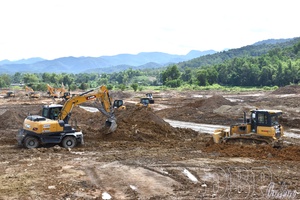
While the route from Mới village to Kéo village stands as a testament to the distinct efficiency following investment, the route from Hón Sáng village to Hua Nặm village showcases the locality’s great determination to complete a synchronized infrastructure system. The project spans a length of over 6 km, passing through 7 villages and connecting multiple concentrated production zones.
.png)
On the construction site, human resources, machinery, and vehicles are maximally mobilized to accelerate progress. After more than six months of construction, the project has completed over 40% of its volume. The greatest advantage during project deployment in Mường Ảng commune lies in the site clearance phase, as the local team of cadres and party members always upholds an exemplary spirit by executing first to mobilize citizens to follow suit.
That spirit continues to spread deeply across the community, as households in the villages where the road passes have proactively coordinated in property inventorying to donate land for road expansion.
“As a party member and a village chief myself, I must set an example by acting first. Once the people understand the meaning of the construction project, everyone actively coordinates so that the project can be deployed smoothly. At sites where land has been handed over, the construction unit immediately concentrates human resources and machinery to execute the work, so the new road will soon be completed,” stated Hón Sáng Village Chief Lò Văn Cường.
Expanding agricultural scale and regional connectivity
Mường Ảng commune is currently maintaining and caring for 1,813 ha of coffee, striving to newly plant 150 ha and replant 30 ha by the end of 2026, raising the total acreage to nearly 2,000 ha to gradually form a concentrated coffee production zone tied to safe production processes and value chain linkages. Along with coffee, in recent years, the locality has effectively cared for and exploited 125 ha of fruit trees and 9.68 ha of existing macadamia trees, while developing OCOP products and actively building brands for signature agricultural products.
.png)
With existing advantages, Mường Ảng commune determines that transport infrastructure is a vital driving force to elevate production value, expand consumption markets, and attract investment. According to Mường Ảng commune Vice Chairman Trần Minh Giáp, the commune is tasked with managing nearly 260 km of roads, with a hardening rate reaching around 80%.
“In the coming time, the commune will focus on investing in finalizing transport routes connecting with Mường Lạn and Pu Nhi communes, as well as local upland villages. Through this, we will step-by-step complete a synchronized transport system, creating favorable conditions for residents to develop production and trade goods,” added Trần Minh Giáp.
Developed transport infrastructure has opened up wider development spaces for Mường Ảng commune. Notably, the Sơn La - Điện Biên - Tây Trang International Border Gate Expressway Project, which just broke ground last May (with Mường Ảng arranged with the IC.2 intersection), is expected to create a vital shift in regional connectivity. Situated on the province’s arterial transport axis, Mường Ảng is evaluated to possess multiple key advantages. Upon completion, goods transport times will be shortened and logistics costs will plunge significantly, opening up opportunities for key products like coffee, fruits, and signature agricultural items to access out-of-province markets. This also presents an opportunity to attract enterprises to invest in deep processing and shape sustainable value chains locally.
.jpg)
The inter-village and inter-commune roads in Mường Ảng commune that have been hardened or continue to be upgraded and expanded are step-by-step shortening the distance between production zones and the market, opening up new development spaces for agriculture, trade, services, and tourism. Under the foot of Tằng Quái pass, from the center of Mường Khoe valley, these routes continue to be extended, building a solid foundation to reinforce regional connectivity, contribute to investment attraction, and drive sustainable socio-economic development in the new era.
Bùi Quang
.jpg)
.jpg)

.jpg)
.jpg)
.jpg)

.jpg)
.jpg)


.jpg)
You have 500/500 characters left
Please enter 5 or more characters!!!