



From identifying and dismantling bottlenecks during execution to proactively promoting trade, partnering with businesses, and maximizing the efficiency of investment projects, the province is steadily transitioning from “resolving difficulties” to “enabling development,” broadening its growth horizons in the new era.
Part 1: From bottlenecks to reform resolve
From projects facing delays to construction sites accelerating day by day, the progress of investment undertakings clearly reveals existing bottlenecks in Điện Biên’s business environment. By confronting shortcomings directly, eliminating barriers, and shifting from “administrative control” to “active partnership,” the province has progressively fostered a more open and transparent investment climate. Resolution No.14 of the Executive Board of the provincial Party Committee for the 2025-2030 term concretizes that determination through bold objectives and solutions for the 2026-2030 period.
.jpg)
Confronting bottlenecks, innovating approaches
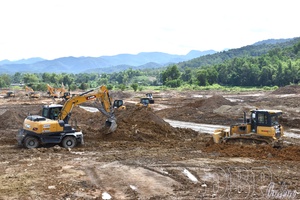
On the construction site of the Thanh Minh - Độc Lập road and residential area project, construction activity has grown notably urgent. Road sections previously stalled due to land clearance hurdles are steadily linking up; machinery and personnel have been mobilized, and work items are advancing synchronously.
For Huy Hoàng Construction Investment and Trading Joint Stock Company, this marks an encouraging turnaround after prolonged site clearance impediments. “What an enterprise desires most is receiving land on schedule to take the initiative in organizing construction. Over recent times, Party committees, local authorities, and relevant agencies have decisively addressed emerging obstacles. With site clearance progressively resolved, we are well positioned to concentrate manpower and equipment to accelerate progress,” stated Nguyễn Hữu Thanh, investor representative of Huy Hoàng Construction Investment and Trading Joint Stock Company.
.jpg)
Looking at a concrete project proves that the business climate is not an abstract concept; it is reflected in tangible details: whether procedures are swift, whether information is transparent, and whether emerging difficulties are promptly accompanied and resolved by the government. Grounded in that reality, Điện Biên province continues to identify and clear bottlenecks, accelerate administrative reform, and cultivate a more welcoming and favorable investment climate for enterprises.
Following five years of implementing Resolution No.12-NQ/TU dated July 29, 2021, of the Executive Board of the provincial Party Committee on administrative reform, improving the business climate, and enhancing provincial competitiveness for 2021-2025 with orientations toward 2030, Điện Biên province has generated marked changes. In 2024, the province’s Public Administration Reform Index (PAR Index) reached 88.23 points, its highest score to date, while the Satisfaction Index of Public Administrative Services (SIPAS) achieved 82.96%. 100% of digital administrative documents (excluding state secrets) are processed and exchanged seamlessly across networked environments; all eligible administrative procedures are provided online. The investment environment and competitiveness have progressed steadily. In the provincial Competitiveness Index (PCI), Điện Biên ranked 31st out of 63 provinces and centrally run cities in 2023 - its highest position in a decade - and placed 32nd in 2024 with 67.67 points, reaching its highest absolute score to date.
Nevertheless, these achievements do not indicate that structural bottlenecks have been entirely eliminated. In certain localities, administrative reform remains uneven, internal procedures overlap, and digital infrastructure - especially at the commune tier - remains constrained. Several PCI sub-indices and corporate support policies have demonstrated limited efficiency, compelling Điện Biên to continue reforming decisively and closer to practical needs.
This reality requires Điện Biên not only to sustain administrative reforms, but to innovate operational approaches, elevating responsibility and implementation efficacy. In refining its investment climate, the province begins by addressing the specific hurdles faced by enterprises and investors, particularly across focal projects.
.jpg)
Lò Văn Cương, Permanent Vice Chairman of the provincial People’s Committee, emphasized: “The government must stand alongside investors and businesses. Departments, sectors, and localities must proactively review operations, pinpoint challenges, assign responsibilities, and set definitive processing deadlines; matters within assigned authority must be tackled decisively, while issues exceeding local jurisdiction must be reported promptly with proposed solutions. The imperative is to avoid shirking or deflecting responsibility.”
That spirit was demonstrated in unraveling site clearance difficulties at the Thanh Minh - Độc Lập road and residential area project. Trần Quốc Long, Deputy Director of the provincial Land Fund Development Center, shared: “The decisive factor was the resolute involvement of grassroots Party committees and local administrations. The Center coordinated closely with the Party Committee and People’s Committee of Điện Biên Phủ ward to strengthen outreach, maintain dialogue, listen to concerns, and resolve public complaints case by case. Every case was thoroughly reviewed, assigning specific duties to specific individuals and following through to completion. By August 31, the Center had handed over 100% of clean project land to the investor.”
According to Nguyễn Hữu Thanh of Huy Hoàng Construction Investment and Trading Joint Stock Company, once site obstacles were resolved, the enterprise mobilized additional personnel and machinery while reorganizing construction workflows to compensate for earlier delays. The investor strives to conclude the project by December 31, 2026.
This case illustrates that administrative reform must be concretized through agile methods, seamless coordination, and distinct accountability. The quality of the public administration is reflected in every issue resolved, every bottleneck eliminated, and the satisfaction of residents and businesses.
Resolution 14 concretizes renewed resolve
Development realities demand that Điện Biên pursue stronger reforms. Constrained by limited state budgetary resources, mobilizing private capital and attracting foreign and domestic investment are vital to advancing infrastructure, urban zones, tourism, commercial agriculture, processing industries, and services. Simultaneously, inter-provincial competition for investment capital is intensifying. Investors evaluate not only raw potentials and natural advantages, but also governance quality, operational transparency, administrative workflows, access to land and infrastructure, and municipal partnership.
.jpg)
In light of these needs, the Executive Board of the provincial Party Committee for the 2025-2030 term promulgated Resolution No.14 on administrative reform, improving the business climate, and enhancing provincial competitiveness for the 2026-2030 period.
The resolution establishes targets to elevate provincial rankings across the PAR Index, SIPAS, PAPI, and PCI by at least 1 to 2 places each year, striving to enter the upper-performing group of provinces, ranking 17th or higher nationwide. Notably, the province targets reducing processing times for administrative procedures by a minimum of 50%; reviewing, simplifying, and cutting 100% of administrative procedures governed by mandatory technical regulations and standards; and transitioning 100% of enterprise reporting regimes to digital platforms.
The province will also establish a “green lane” mechanism for key investment projects; transition 100% of internal administrative procedures within state agencies to electronic governance environments; and enforce a one-time document submission rule, ensuring all paperwork and data related to business operations need only be provided once to state administrative agencies.
According to Nguyễn Phi Sông, Director of the Department of Finance, these targets are designed to rectify lingering deficiencies in the investment climate while creating substantive breakthroughs in governance quality. “The core issue is not merely raising PCI standings, but improving the underlying factors that drive business satisfaction. Enterprises require access to transparent information, streamlined procedures, lowered compliance costs, and prompt dispute resolution. Therefore, Resolution 14 sets clear targets, linking reform benchmarks directly to the accountability of individual agencies, units, and administrative heads,” Nguyễn Phi Sông stated.
.jpg)
The handling of the Thanh Minh - Độc Lập road and residential area project indicates that when responsibilities are clearly allocated and agencies enter the fold in unison, bottlenecks are systematically resolved.
Resolving one project represents only a small piece in the province’s broader socioeconomic development picture. Yet positive progress from individual projects reinforces corporate confidence, establishing the foundation for Điện Biên to draw further investment capital. Resolution No.14 clearly defines the goals, duties, and solutions for the 2026-2030 period. The decisive challenge lies in execution - infusing this reform spirit into every department, cadre, procedure, and project.
Moving from identifying bottlenecks to clearing them is the foundational step. As the investment climate improves and trust is reinforced, Điện Biên province will secure greater leverage to attract resources and generate development momentum. This also provides the springboard for the province to shift from “resolving difficulties for active projects” to “proactively identifying and attracting new investment undertakings.”
Phạm Trung - Tuấn Anh
.jpg)
.jpg)

.jpg)
.jpg)
.jpg)


.jpg)
.jpg)

.jpg)

You have 500/500 characters left
Please enter 5 or more characters!!!