



In the early days of summer, when the water recedes, daily life here shifts into a familiar rhythm. On the newly planted corn and cassava milpas, green plants are taking root. Down by the river wharf, fishing boats busily ply back and forth in the early morning mist. Inside the villages, the steady creaking of looms echoes from beneath every roof.
Among the four Làn Tẻn Dao villages in Tủa Thàng, the two villages of Nậm Bành and Huổi Lóng nestle along the banks of the Đà River. Far from the bustling cities, life here follows a peaceful cycle amidst the vast Northwest forests.
Huổi Lóng consists of 114 households with nearly 600 inhabitants, predominantly of the Dao ethnic group. For generations, the local people have settled here, bonding with the hills, the milpas, and the Đà River as an inseparable part of their flesh and blood.
.jpg)
According to the village elders, the name Huổi Lóng originates from a stream that flows through this area and empties into the Đà River. In the local ethnic language, “Huổi” means water; this stream flows year-round and its temperature is always warmer than other streams in the region, which is why the locals named it Huổi Lóng. Passed down through generations, it has become the official name of the village to this day. Beside that warm stream, countless generations of the Dao people have lived. Despite the many changes brought by modern life, Huổi Lóng still preserves its inherent cultural traits and the tranquility of an upland riverside village.
These days, with the planting season basically completed, Huổi Lóng enters a special time of the year. The locals refer to this as the “season of working far from home.” After finishing sowing corn and transplanting rice, about 80% of the main household laborers pack their bags to head to companies and industrial zones in provinces such as Bắc Ninh, Phú Thọ, and Hà Nội to work as factory laborers. It is not until late September or October that these young people return to the village to help their families harvest the crops.
However, this temporary emptiness does not mean that the pace of life here slows down. On the waters of the Đà River, fishing and trading activities continue steadily every day, serving as a vital source of livelihood for many local households.
From the early hours of dawn, while mist still blankets the river surface, small boats leave the wharf. Some cast nets, others pull up lift nets, and some inspect shrimp traps. During the low-water season, the river surface becomes lively with the sound of engines, people calling out to one another, and conversations about the day’s catch.
Lý A Hy from Huổi Lóng village shared: “We usually start fishing from 2:00 AM to 5:00 AM. Net fishers mainly catch tilapia, Elopichthys bambusa, and backscale carp... while trapping mostly yields shrimp and miscellaneous fish. I have 150 shrimp traps; after baiting and setting them, I harvest them in rotation. Normally, I pull up about 50 traps a day, collecting 7 to 10 kg of shrimp per session. With the selling price fluctuating around VND 50,000 per kg, after deducting expenses, each session brings in an income of VND 300,000 to 500,000, providing my family with an extra source to cover living expenses.”
.jpg)
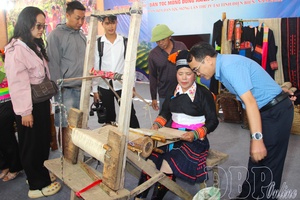
While the men seek livelihoods on the river, the village women have their own duties. Under the eaves of their houses, women sit by the looms, their hands swiftly tossing the shuttles. The rhythmic creaking and clacking of wood and bamboo echo through the quiet space like the steady heartbeat of traditional culture, enduring through generations of the Dao people here.
Phàn Thị Hiệp from Huổi Lóng village expressed: “From a young age, Dao girls are taught by their grandmothers and mothers how to gin cotton, spin thread, and weave fabric. In the past, almost every family wove their own cloth to make clothes. Today, life has changed a lot and there are more choices available, making ready-made clothes common, but the village women still maintain the weaving craft because every stitch and every stage carries their thoughts and emotions. Each neatly tailored and well-fitted outfit made for family members to wear during New Year festivals and celebrations is a testament to the skill, resourcefulness, and devotion of Dao women to their families.”
As dusk falls over the Đà River, boats carrying traps and lift nets pull into the wharf one after another. Kitchen smoke drifts from houses nestled against the mountainside. Inside the village, the sounds of children playing mingle with the laughter and chatter of adults. Even though life changes day by day, the rhythm of life intertwined with the mountains, forests, and waters in Huổi Lóng remains preserved across generations. From the story of the village’s founding to traditional cultural traits and daily river life, everything blends to create a peaceful Huổi Lóng, rich in identity amidst the majestic Northwest.
Trần Nhâm
.jpg)
.jpg)
.jpg)
.jpg)

.jpg)

.jpg)
.jpg)
.jpg)
You have 500/500 characters left
Please enter 5 or more characters!!!