



This is not only a solution to upgrade production efficiency, increase agricultural product value, and raise public income, but it also generates a driving force to boost comprehensive development in rural areas, step-by-step creating a modern and civilized face for new-style rural areas.
.jpg)
As a mountainous province with diverse climatic conditions and an abundant fund of production land, Điện Biên possesses multiple advantages to develop a commodity-oriented agriculture with core sub-sectors such as rice, Arabica coffee, macadamia, and tea. However, in the context of increasingly high demands for product quality, green development, and economic integration, efficiently exploiting potentials, reorganizing production along value chains, and attracting investment have become urgent requirements to elevate the value-added and competitive edge of local agricultural products.
To materialize that target, the Executive Board of the provincial Party Committee issued Resolution No.11-NQ/TU on restructuring the agricultural sector towards concentrated commodity production, green, smart, and sustainable development for the 2026-2030 period with an orientation to 2035, shaping a baseline for the agricultural sector to develop modernly, efficiently, and sustainably. In the spirit of the Resolution, the province is step-by-step shifting sharply from a production mindset to an agricultural economic mindset, promoting the advantages of each ecological zone, each sub-sector, and core products, while forming concentrated production zones linked with processing, consumption, and markets.
Prominently, guided by Plan No.1850/KH-UBND, developing coffee and macadamia crops and testing low-altitude space economic development models have quickly become core tasks for many localities. With a drastic, synchronous, and proactive spirit, localities have focused on deploying numerous solutions, creating fresh momentum for the agricultural restructuring process toward modern and centers of sustainability.
.jpg)
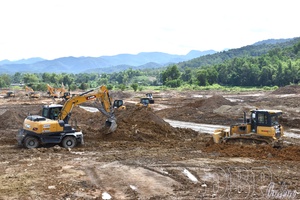
In 2026, Điện Biên sets a target to plant 12,000 ha of new coffee and macadamia. By July 15, 2026, the entire province had planted over 6,900 ha of new coffee and macadamia, reaching over 57 percent of the plan. During these days, localities are mobilizing maximum manpower and means to accelerate planting progress, striving to complete the entire plan before July 30, 2026.
Driven by the drastic involvement of the entire political system in propagating and mobilizing residents to transform crop structures, alongside proactively executing seedling nurseries and coordinating with enterprises for material supplies, technical support, and production linkages, Chiềng Sinh commune has completed planting over 600 ha of coffee to date.
Đỗ Văn Sơn, Chairman of the Chiềng Sinh commune People’s Committee, stated that alongside taking good care of the seeded crop areas, the commune continues to step up dissemination and mobilize residents to participate in new coffee and macadamia planting, proactively untying difficulties and accelerating execution progress to complete the targets on schedule and contribute to elevating the efficiency of agricultural restructuring.
.jpg)
In the process of agricultural restructuring, the collective economy and the One Commune One Product (OCOP) Program are becoming two vital pillars driving agricultural development toward modern and sustainable directions. Currently, the entire province has 253 cooperatives and 149 cooperative groups operating in the agricultural domain. The network of cooperatives, cooperative groups, and linkage models increasingly promotes its role in connecting farmers with enterprises and reorganizing production along value chains, contributing to upgrading production efficiency, ensuring stable outlets, and increasing competitiveness for agricultural products.
Across a linkage scale of 120 ha, Pha Đin Coffee Cooperative has step-by-step formed a closed linkage chain running from production to consumption, building a baseline to develop coffee in a commodity-oriented and sustainable manner. Sùng A Dia, Director of the Cooperative, shared that linking with local residents not only helps the cooperative master raw material sources but also creates stable consumption outlets for products. The cooperative guides households to produce under a unified workflow, purchases the entire output that meets standards, and steps up brand building and market expansion to elevate the value of Điện Biên coffee beans.
Currently, the entire province has 147 valid OCOP products, including 142 three-star products and 5 four-star products. Each standardized, branded, and market-expanded OCOP product has contributed to elevating agricultural values and boosting the rural economy. This also stands as evidence of the shift in Điện Biên’s agriculture from broad development to deep development, taking quality, value-added, chain linkages, and sustainability as the driving force for long-term growth.
.jpg)
The “Phìn Hồ Dried Buffalo Meat” product of Phìn Hồ Agricultural Cooperative in Pháng Chủ village, Si Pa Phìn commune is one of the products recognized with a 3-star OCOP certification, helping upgrade product value. Lò Thị Nhung, Director of the Cooperative, stated that since achieving the certification, the product has been known by more customers, its consumption volume has increased, and the product value has been elevated, creating favorable conditions for the cooperative to expand its production scale in the near future.
Alongside forming concentrated production zones and developing linkage chains, Điện Biên identifies human resource development as one of the key solutions to elevate the efficiency of agricultural restructuring. With more than 355,000 laborers, including nearly 308,000 in rural areas as of June 2025, the province boasts a great advantage in human resources serving agricultural development.
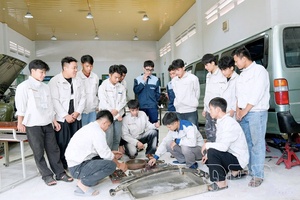
To promote this advantage, vocational training, technical transfer, and job creation have been prioritized for implementation. In the first six months of the year, the entire province organized 80 vocational training classes for 3,000 rural laborers, while concurrently creating new jobs for 5,580 workers. These outcomes not only contribute to upgrading production proficiency and boosting the application of science and technology into production, but also create sustainable livelihoods and raise income for rural populations.
.jpg)
Applying knowledge learned from vocational training classes on animal husbandry and cultivation, Quàng Văn Hoan from Pa Bói village, Thanh Yên commune proactively integrated them into his family’s practical production, developing 50 red-fleshed Thai jackfruit trees, maintaining a herd of over 30 pigs, along with hundreds of various poultry. He shared that during the production and breeding process, he always prioritizes complying with technical workflows from care to disease prevention and control, which helps the economic model develop stably, upgrading product yield and quality to bring an income of over VND 100 million each year.
With high political determination, the synchronous involvement of the entire political system, and the proactive, creative spirit of citizens and enterprises, Điện Biên is step-by-step materializing the target of building a commodity-oriented agriculture linked with processing, value chain linkages, and sustainable development. This also serves as a vital baseline to construct livable countrysides, raise income, improve the quality of locals’ living standards, and build increasingly civilized and modern new-style rural areas, driving Điện Biên to develop rapidly and sustainably in the new era.
Sầm Phúc
.jpg)
.jpg)
.jpg)
.jpg)
.jpg)
.jpg)
.jpg)
.jpg)
You have 500/500 characters left
Please enter 5 or more characters!!!