



Houses situated beneath cut slopes, adjacent to hillsides, or along roads face constant safety hazards when heavy rains persist. Facing this reality, local authorities are urgently reviewing high-risk areas, relocating households from dangerous zones, and investing in resettlement areas and essential infrastructure to help residents settle down and overcome anxiety every rainy and flood season.
Following days of heavy rainfall, residents of Hát Tao village (now Pa Hua village, Núa Ngam commune) still harbor a sense of unease. Multiple houses located below negative slope cuts showed signs of subsidence, with soil and rocks sliding down the hillside after every downpour.
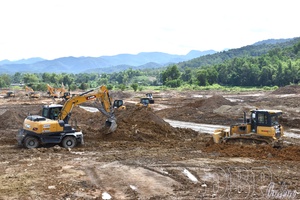
Driven by these circumstances, the local government formulated a plan to arrange and relocate residents alongside investing in synchronous infrastructure. Under the proposed plan, households will move to a new residential site roughly 1.3 km from their current location. Each household will receive a plot exceeding 300 m², supported by synchronous investments in transport roads, domestic electricity networks, and clean water supply systems to guarantee stable, long-term living conditions.
.jpg)
During implementation, commune leaders and specialized agencies held direct dialogues to listen to the thoughts and aspirations of residents. Public opinions focused on requesting financial support for house construction, relocation costs, and the swift completion of resettlement infrastructure so people can stabilize their lives.
Nông Quang Thắng, Party Committee Secretary and Chairman of the Núa Ngam commune People’s Council, emphasized: “The highest target of the project is to ensure the safety of life and property for the people against landslide hazards and traffic corridor safety risks. Concurrently, constructing the new residential area will shape favorable conditions for residents to stabilize their lives, work peacefully, and expand production. Local authorities will continue to absorb legitimate opinions, coordinating with specialized agencies to research, advise, and finalize the plan, ensuring the full execution of state policies and regulations.”
In another area, the hill section behind 10 households in Residential Group 2, Na Sang commune recently developed a large crack approximately 60 m long, averaging 30 to 40 cm wide, with a subsidence depth of around 1.2 m. Rainwater continuously flowed down the hill into the residential area, flooding homes and causing wall and foundation cracks in several structures, posing severe landslide risks.
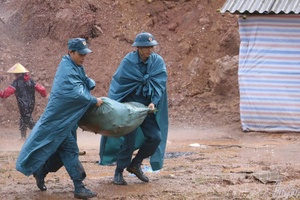
Immediately upon receiving the news, leaders of the Na Sang Commune People’s Committee arrived on-site to direct emergency response measures. Applying the “4 on-the-spot” principle, police, military, self-defense militia forces, and mass organizations quickly assisted residents in moving property and evacuating households out of the danger zone.
Trần Hồng Quân, Chairman of the Na Sang commune People’s Committee, stated: “Emergency relocation serves as an immediate solution. More importantly, we must continue reviewing and comprehensively evaluating landslide-prone areas, building long-term residential arrangement plans, and investing in synchronous infrastructure so residents no longer worry every rainy season. Authorities will mobilize maximum resources and coordinate with functional sectors to deploy solutions ensuring a stable and safe life for the people.”
Driven by the drastic involvement of authorities and functional forces, evacuations were carried out promptly, preventing any loss of life. During the extended heavy rains from July 1 to July 9, People’s Committees of communes and wards across the province activated natural disaster response plans simultaneously. Civil Defense Commands alongside police, military, self-defense militia, disaster response volunteer forces, and mass organizations inspected sites, compiled damage statistics, and mobilized personnel, vehicles, and materials to overcome consequences under the “4 on-the-spot” principle.
Along with post-disaster recovery, communes across the province proactively deployed response measures as soon as heavy rains appeared. Hundreds of officers, soldiers, militia members, volunteer forces, and residents were mobilized to clear landslide points, unblock stream flows, ensure traffic safety, and assist households in moving property to safe places. Localities also organized the relocation of 50 households out of high-risk areas, contributing to mitigating losses of life and property.
On the night of July 9, after receiving news from Lò Văn Thiên’s family in Mường Tùng village, Mường Tùng commune regarding their stilt house foundation slipping due to prolonged rain and risking collapse, commune police and grassroots-level security teams arrived promptly to help the family relocate all assets, taking the elderly and young children to safety.
Recalling the dangerous moment, Lò Văn Thiên shared: “Without the timely assistance of the forces, my family wouldn’t have known how to manage. Thanks to the support from the local government and police forces, both our lives and property were kept safe.”
Through the proactiveness of party committees and authorities, the drastic involvement of functional forces, and the solidarity of the people, safe residential areas are gradually taking shape, helping highland residents live with peace of mind without worrying whenever rains and floods return.
Phạm Quang
.jpg)




.jpg)
.jpg)
.jpg)

.jpg)
.jpg)
.jpg)
.jpg)
You have 500/500 characters left
Please enter 5 or more characters!!!