



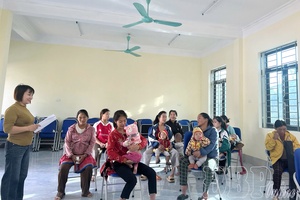
This is a class designed for trainees who have passed their youth and drifted into the vortex of drugs, and are now patiently learning to hold pens and carefully trace the very first letters of their lives.
.jpg)
Like many other trainees, L. V. P. from Mường Lay ward carries not only a past filled with mistakes, but also an interrupted journey of education. Raised in impoverished circumstances with parents working endlessly year-round, P. dropped out of school as a young child and never knew what a primary school diploma felt like. Growing up in a deprived highland area, he strayed down the path of addiction. Years spent buried in drugs left him with no concept of a future until he was brought to the Drug Rehabilitation Center for treatment in early 2025.
V. P. confided: “At my age, having to practice reading and writing often makes me feel deeply embarrassed. But looking around and seeing everyone trying hard, I tell myself it is better late than never.”
At the provincial Drug Rehabilitation Center, some individuals over 50 years old are encountering the alphabet for the first time. Others once knew how to read and write, but after spending years submerged in drugs, they forgot almost all characters. Still others never had a single day at school due to difficult circumstances. They approach the class carrying self-doubt, insecurity, and the fear that it is too late to start anew. Yet with encouragement from teachers, support from management officers, and their own determination, words gradually take shape on paper, opening up hope for a fresh journey.
.jpg)
Teacher Phan Văn Điệp, an officer at the provincial Drug Rehabilitation Center, noted: “During the learning process, we closely guide trainees, sometimes holding their hands to trace each letter. Beyond classroom hours, we assign extra homework so trainees in the same rooms can support one another in studying.”
The provincial Drug Rehabilitation Center currently organizes rehabilitation for over 600 trainees, most of whom come from special circumstances with low education levels, with many unable to read or write. Following reviews, the center coordinated with the education sector to organize literacy classes tailored for trainees. Since June 2025, the facility has held two classes for nearly 80 trainees. Three times a week, following medical treatment and labor therapy, trainees bring books and pens to class. Lessons are designed appropriately for adults using visual images and practical exercises to ease absorption and reduce pressure.
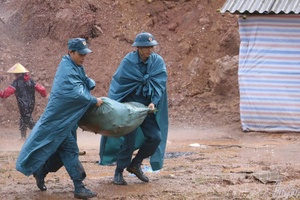
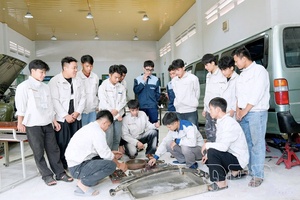
Along with literacy classes, the provincial Drug Rehabilitation Center maintains labor therapy, vocational orientation, and job training programs - such as rattan and bamboo weaving, wig making, livestock farming, and crop cultivation - helping trainees build discipline, form working habits, and accumulate necessary skills prior to returning to their local communities. Trainee N. T. T. from Mường Nhé commune shared that after dropping out of school early without a job, he was enticed into drug addiction at age 16, but after entering the center and learning wig making, he hopes to secure a stable job upon return to give his family peace of mind and become a useful member of society.
.jpg)
For the provincial Drug Rehabilitation Center, every step forward a trainee makes in learning, laboring, or self-improvement represents a positive milestone on the journey toward comprehensive recovery.
Lieutenant Colonel Lò Văn Bao, Deputy Head of the Drug Rehabilitation Center under the Drug Crime Investigation Police Department of the provincial Police, stated: “We determine that addiction treatment must link with comprehensive recovery for trainees. Alongside detoxification treatment, the center organizes cultural education, labor therapy, vocational orientation, and job training so trainees step-by-step transform mindsets, practice skills, and cultivate working habits. This stands as a crucial condition helping trainees gain extra confidence when returning to their families and communities.”
Each trainee at the Drug Rehabilitation Center presents a different story. Some dropped out of school young due to poverty, others grew up in remote areas with scarce educational opportunities, and some once possessed stable families and jobs before losing everything to drugs. Though their pasts differ, they share a common desire to rebuild their lives. For that aspiration to turn into reality, opportunities, partnership, and trust from families and the community remain essential.
Quang Long
.jpg)

.jpg)
.jpg)
.jpg)

.jpg)
.jpg)
.jpg)
You have 500/500 characters left
Please enter 5 or more characters!!!