



Part 1: Villages lacking youths, Party cells lacking successors
Notably, numerous village Party branches confront severe obstacles in generating Party admission candidate pools and cultivating successor cadres. This workforce deficit raises pressing concerns regarding the future succession of grassroots-level Party organizations and local political systems.
The “hemorrhage” of young labor force
Pá Ban village in Pu Nhi commune comprises 59 households, with 22 families having members working outside the province. Those remaining behind consist primarily of the elderly, women, and small children, shifting farm work, domestic care, and shared communal duties onto their shoulders.
Past the age of 70, Lò Văn Khụt and his wife still climb the hillsides daily to work their plots, manage household chores, and look after two young grandchildren while their parents work far from home. Khụt shared that while his children went away to earn money to alleviate family poverty, their departure forces grandparents to raise grandchildren and tend to field chores, creating hardships at an advanced age.
.png)
According to Vì Văn Kẹo, Head of Pá Ban village, this trend has unfolded over several years. Initially, a few individuals left, secured stable incomes, and returned to introduce and guide relatives to follow. Today, the village retains mostly senior citizens, women, and small children, significantly undermining production and collective community activities.
Beyond Pá Ban, we visited Pàng Dề village in Sáng Nhè commune on an early September day. In broad daylight, the access road into the village was quiet and deserted, with only a few elderly people heading up the hillsides and young children playing in front yards. Tending corn rows, 70-year-old Vàng Thị Xa explained the solitude by noting that grown youths have departed for distant jobs, leaving only the elderly and small children at home, with two of her own children having traveled lowland for employment.
Following administrative mergers, Pàng Dề village in Sáng Nhè commune counts 259 households with over 1,000 residents, among whom approximately 70% of working-age laborers are employed away from home. According to Phạm Ngọc Điện, Chairman of the People’s Committee of Sáng Nhè commune, the entire commune currently has nearly 1,400 laborers working outside the province, excluding unorganized and freelance workers. The underlying reason, Điện noted, is that local employment remains scarce, while small-scale agricultural production generates volatile incomes unable to meet the rising aspirations of youths, prompting them to seek outside opportunities.
The entire province currently counts over 355,000 laborers aged 15 and above, with rural areas representing nearly 87%. Over the first six months of 2026, roughly 353,000 workers were employed, including approximately 5,580 newly created jobs. Localities recording substantial numbers of residents working outside the province include Tìa Dình commune with over 50% of working-age labor force, Thanh Yên commune with nearly 2,000 people, Thanh Nưa commune with over 1,000 people, and Na Son commune with nearly 2,000 people, figures that omit unorganized freelance laborers.
The underlying cause stems from constrained local employment and livelihood avenues. Highland agricultural production remains fragmented, low-yielding, and unstable, whereas industrial parks and urban centers outside the province offer diverse job opportunities and steady wages, exerting strong pull factors on young workers. Early departures who secure employment and earnings become an impetus for others to follow, creating an expanding outward exodus that leaves major consequences in its wake.
The “gap” left behind
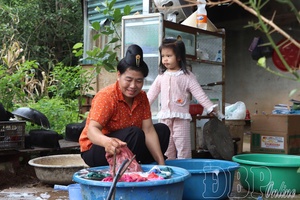
Behind the departing footsteps of youths lie profound voids within each family and community. While outbound workers generate supplemental income, those staying home must shoulder additional tasks. Grandparents well past working age become primary caregivers managing childcare, domestic chores, and field work. Like the elderly couple Mùa Chờ Sùng in Huổi Sông village, Tìa Dình commune, who despite being over 70 still work the hillsides, manage housework, and care for two young grandchildren while their parents work afar. The prolonged absence of parents shifts the burden of raising children onto grandparents, who, despite their best efforts, struggle to substitute for parental presence, potentially affecting the children’s development.
The exodus of young labor force also creates voids in community life. When youths depart, grassroots-level Youth Union and mass organizations struggle to rally ranks, convene meetings, and sustain campaigns. Volunteer drives, cultural and sports events, public outreach, and mobilizing youths to build new-style rural areas frequently operate at a minimal pace, relying on middle-aged residents or the few young members remaining locally.
.jpg)
In Na Hý village, Thanh Nưa commune, following mergers the village comprises 193 households with more than 900 residents. Working-age labor force aged 15 to 60 stands at roughly 600 people, yet out of around 300 young workers, nearly 200 have left to work outside the province, underscoring the stark youth deficit in village life.
Lò Văn Quân, Head of Na Hý village, shared that previously, whenever village projects arose, an announcement was enough to gather a large group of youths. Now, with many working away, mobilizing youthful energy faces persistent bottlenecks. Implementing new-style rural development programs, including road building, canal repairs, and village lane renovations, requires substantial working days, yet with youths away, tasks once shouldered by them now fall to middle-aged and elderly residents.
Critically, the youth shortfall exerts a substantial impact on grassroots-level Party-building endeavors. Through Youth Union and association activities, Party cells can identify active, responsible, dedicated youths with community prestige to monitor, mentor, and cultivate as candidates for Party admission. When this contingent is persistently absent, discovering talents is difficult, while maintaining communication, assigning tasks, and monitoring ideological tempering becomes far more challenging.
Thào Văn Xiêng, Secretary of the Ta Pao Village Party Cell in Mường Mùn commune, noted that finding candidates for Party admission is harder than before. Individuals possessing competence, responsibility, and community trust tend to join the outward labor migration. Meanwhile, those remaining behind are largely elderly, lack environments to demonstrate their abilities in collective activities, or lack personal motivation to strive for membership.
Departing footsteps in search of livelihoods leave behind voids across family routines, community dynamics, and grassroots-level Party building. As the younger cohort grows increasingly sparse, the pool of outstanding mass prospects for Party cells to discover, nurture, and admit steadily shrinks. Without solutions that both foster localized livelihoods and sustain connections with outbound workers, the risk of disruption across successor ranks will become ever more pronounced.
Thu Phương
.jpg)

.jpg)
.jpg)

.jpg)
.jpg)


.jpg)

.jpg)
.jpg)
You have 500/500 characters left
Please enter 5 or more characters!!!