



Alongside securing funding sources, reviewing eligibility accurately and implementing each regime fully and promptly have received dedicated attention from Điện Biên’s Education sector right from the start of the academic year.
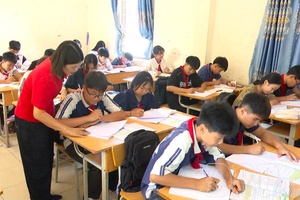
Pu Nhi Secondary Boarding School for Ethnic Minorities currently has 24 classes with 910 students, including 475 beneficiaries eligible for semi-boarding support policies. With more than half of the student body benefiting from these policies, reviewing and finalizing dossiers and organizing regime distribution were prioritized by the school from the opening of the school year. Organizing semi-boarding meals, accommodations, and receiving and disbursing allowances are conducted in accordance with regulations.
.jpg)
Hoàng Quốc Huy, Principal of Pu Nhi Secondary Boarding School for Ethnic Minorities, noted that the school identifies policy execution as starting from accurately vetting each student. Homeroom teachers, who know their students’ living situations intimately, coordinate closely with families and guide dossier completion to avoid cases where eligible students face delays in receiving benefits. Once the lists receive approval, support allowances are disbursed transparently, lawfully, and in alignment with good management of semi-boarding life.
Decree No.66/2025/NĐ-CP stipulates that eligible semi-boarding pupils and learners receive VND 936,000 for meal allowances and 15kg of rice per month, for a maximum duration of 9 months per academic year. In cases where students must arrange their own accommodation and meet specified conditions, they receive an additional housing support allowance of VND 360,000 per month. In highland regions, direct allowances exert a noticeable impact on daily living and study conditions. Meal allowances, rice, and semi-boarding lodgings help households reduce schooling expenses. Having their children eat, rest, study, and stay under teacher supervision gives parents living far from school significant peace of mind.
Lò Đức Toàn, a resident of Phù Lồng village, shared that his family relies on farming with unstable income, leaving them with many expenses to worry about each school term. With his child benefiting from the semi-boarding regime and receiving meal and rice support, the household’s financial burden has eased. More importantly, his child eats and stays at school under teachers’ care, leading to much more disciplined study habits.
.jpg)
Realities at Pu Nhi Secondary Boarding School for Ethnic Minorities demonstrate that policy effectiveness depends heavily on grassroots organization and implementation. When teachers grasp students’ circumstances and schools coordinate well with families and local authorities, policies materialize into daily meals, living spaces, and learning conditions.
For the 2026 - 2027 school year, the entire province of Điện Biên comprises 194 public educational institutions, encompassing 7,289 classes and 207,118 pupils and learners. Following the school network restructuring, the number of public educational administrative units dropped from 466 down to 194. A key requirement throughout this process is maintaining stable teaching and learning while safeguarding learners’ legitimate benefits.
Amid broad adjustments to administrative areas and school networks, screening beneficiary groups accurately and closely at the grassroots is essential. Students transferring classes or satellite campuses, changing administrative units, or experiencing changes in family circumstances must be updated promptly. This serves as a vital step to guarantee that support regimes continue smoothly, reaching the right individuals in line with regulations.
Alongside grassroots screening and policy delivery, Điện Biên province has proactively allocated resources to secure learners’ rights. In 2026, Điện Biên implemented 11 social welfare policies in education, training, and vocational education for 520,491 recipient turns, with total funding exceeding VND 2,187 billion, marking a 2.04-fold increase compared to 2025. Central funding allocations were disbursed 100% by the province to executing units and localities. For 3 policies promulgated by the Government without assigned funds, the province proactively balanced nearly VND 126 billion from the local budget for deployment.
To secure assistance for learners, Điện Biên continues investing in studying and living infrastructure for highland students. Solidified classroom rates across the province reach 80.7%, specialized subject rooms reach 80.6%, and boarding and semi-boarding rooms reach 67.6%. In the 2026 - 2027 school year, Điện Biên completed and put into use 9 additional inter-level ethnic boarding schools in border communes, bringing the total number of completed schools of this type to 10.
.jpg)
Caring for highland pupils is conducted comprehensively, spanning direct financial support, school and boarding facility infrastructure investments, teacher contingent consolidation, and educational quality improvement. This orientation aligns with the spirit of Resolution No.71-NQ/TW on breakthroughs in education and training development, which demands educational equity while dedicating greater attention to ethnic minorities, mountainous areas, borderlands, and disadvantaged groups.
Hoàng Tuyết Ban, Director of the Điện Biên provincial Department of Education and Training, emphasized that the education sector regards the complete, timely, and properly targeted delivery of student support policies as an essential task. Educational institutions must proactively vet circumstances, cooperate with families and local administrations to complete records, and ensure transparency throughout implementation. The overarching objective is to enable students, especially ethnic minority and highland pupils, to study with peace of mind and maintain steady attendance.
Grassroots implementation plays a decisive role in ensuring policies reach disadvantaged students. Therefore, alongside budget allocations, the responsibility of teachers, schools, and regulatory bodies in verifying each beneficiary must remain regular and rigorous.
For a mountainous border province like Điện Biên, caring for ethnic minority education is linked with goals of raising intellectual standards, training human resources, achieving sustainable poverty reduction, and fostering a stable, developing border region. Concrete support measures today broaden learning opportunities for highland children, creating a solid foundation for long-term local progress.
Tú Trinh
.jpg)
.jpg)
.jpg)
.jpg)
.jpg)

.jpg)
.jpg)
.jpg)
.jpg)

.jpg)
You have 500/500 characters left
Please enter 5 or more characters!!!