Enhancing food testing capacity and product surveillance

ĐBP - Confronting rising demands in food safety assurance, Điện Biên’s health sector is stepping up market surveillance, elevating laboratory testing capacity, and proactively sampling high-risk food groups. These efforts enable authorities to promptly detect, issue warnings, recall, and handle substandard products, safeguarding consumer health.

Executing directive documents from the Ministry of Health, the Ministry of Public Security, and the provincial People’s Committee, the health sector directed specialized units to coordinate with localities in rolling out synchronized inspection, surveillance, and food testing measures.

Currently, the province has 2,220 food production, business, and catering establishments managed by the health sector. In the first 7 months of 2026, 106 inspection teams were established, inspecting 1,899 establishments. As a result, 1,891 facilities met food safety standards (accounting for 99.6%), while 8 establishments failed to comply (0.4%). Violating establishments were fined a total of over VND 11.7 million, and 5 types of food products from 2 facilities were destroyed. Identified violations mainly involved trading expired goods, selling items with unclear origins, and failing to fully comply with safety condition regulations in food production, processing, and trading.

Alongside formal inspections, food safety monitoring has been intensified. During the first 7 months of the year, all administrative tiers monitored 1,233 food establishments under health sector management, with 1,229 meeting requirements (99.6%) and 4 failing to meet standards. Notably, rapid screening tests were performed directly during inspections and field monitoring. Inspection teams conducted 659 rapid food safety tests, with 100% yielding compliant results. The Provincial Food Safety and Hygiene Sub-Department also collected 4 food samples from school collective kitchens for laboratory testing during suspected food poisoning incidents, all of which met safety standards.
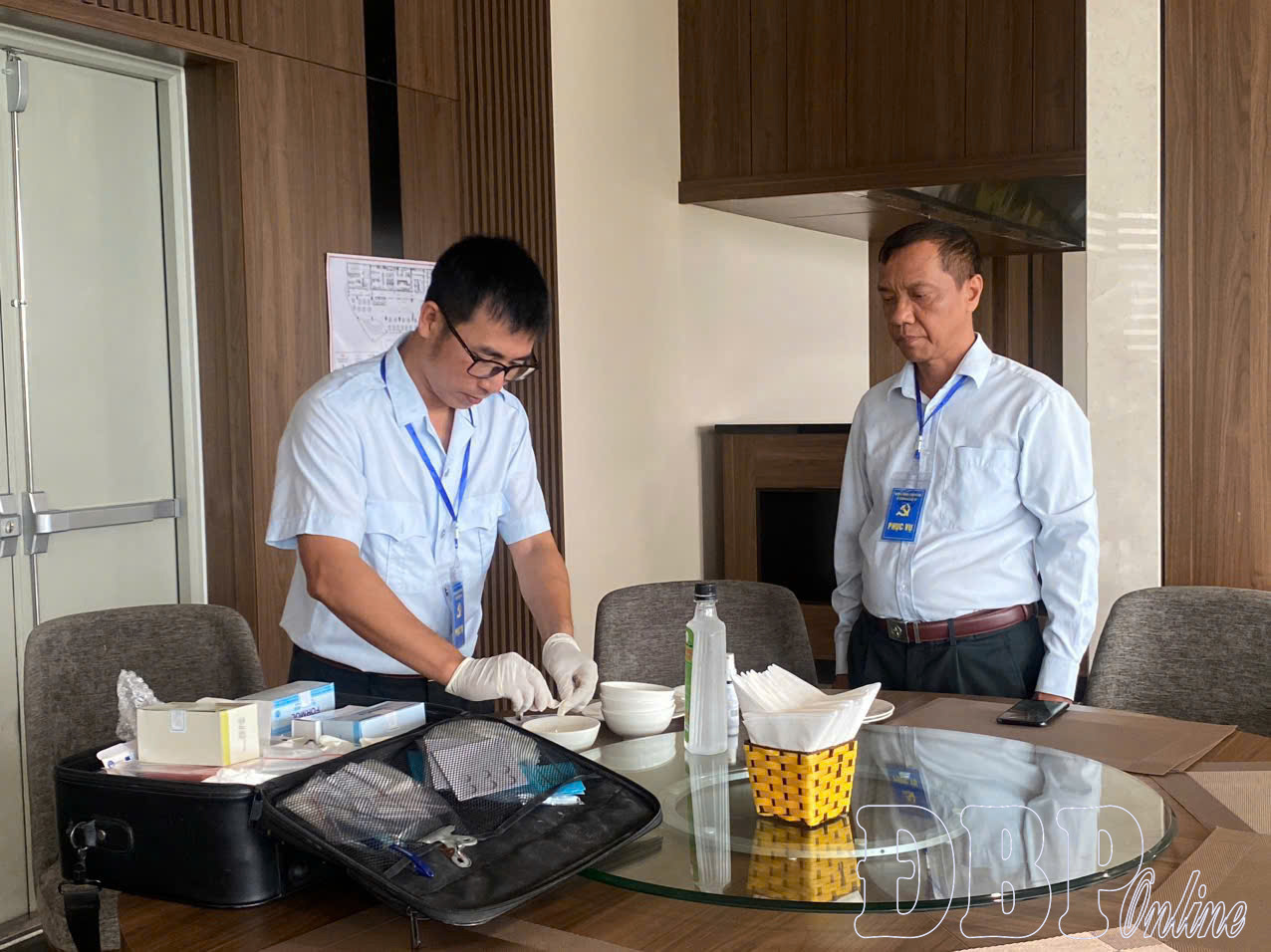
The inspection team of the Provincial Food Safety and Hygiene Sub-Department conducting rapid food safety tests at Mường Thanh Luxury Điện Biên Hotel.

According to Hoàng Xuân Chiến, Head of the provincial Food Safety and Hygiene Sub-Department, food safety assurance faces new demands. Beyond regulating production and trading establishments, authorities must intensify surveillance of goods circulating in the market and proactively sample and test high-risk food groups. Testing results serve as an essential scientific foundation for functional agencies to promptly issue warnings, recall, and penalize substandard goods, preventing public health risks.

In line with the health sector’s orientation, localities and units in the coming period must formulate targeted surveillance plans, concentrating on alerted product categories, especially milk and nutritional formulations for young children. Upon detecting substandard goods, authorities must act swiftly to handle violations, execute recalls, and disseminate information widely so the public can proactively avoid them. Testing operations must also be paired with routine inspections and post-licensing checks, elevating effectiveness in preventing and addressing food safety risks.

In Điện Biên, most food production and trading establishments operate on a small, household scale scattered across expansive terrain; grassroots food safety personnel remain sparse and work largely in concurrent roles, while operating budgets remain modest. Concurrently, risks stemming from expired goods, products of unknown origin, and counterfeit or substandard foods persist, demanding continuous and focused inspections and surveillance.

Addressing this practical reality, enhancing laboratory testing capacity, intensifying targeted sampling, and monitoring circulating goods serve as critical solutions to transition from passive control to proactive prevention. Leveraging testing outcomes provides regulatory authorities with robust scientific evidence to issue early warnings, handle violations, and prevent substandard goods from reaching consumers.

Strengthening inspections from the provincial level to the grassroots, intensifying post-audits, and reinforcing personnel and professional expertise will help build a more proactive, stringent food safety management system. Through these measures, the province can steadily mitigate risks associated with counterfeit and substandard food, safeguard public health, and enhance the efficacy of state food safety governance across the locality.

Minh Thảo

Comment

You have 500/500 characters left

Please enter 5 or more characters!!!

Recent news

  • 'Listening to residents, building consensus in Si Pa Phìn

    Listening to residents, building consensus in Si Pa Phìn

    NEWS - POLITICS -
    ĐBP - From everyday concerns to local policies and initiatives, residents of Si Pa Phìn commune are increasingly able to contribute their opinions, express their aspirations and monitor implementation. By proactively listening, making information public and working together to address legitimate public concerns in a timely manner, local authorities are making grassroots democracy more meaningful and fostering consensus on local development.
  • 'Transmitting heritage through community classes

    Transmitting heritage through community classes

    CULTURE - SPORTS -
    ĐBP - The preservation of cultural heritage in Điện Biên is being carried forward through community classes and daily transmission activities in hamlets and villages. Driven by the dedication of artisans and culture bearers, alongside the proactive spirit of learners, traditional folk songs and dances are transmitted, contributing to safeguarding ethnic identity and ensuring the vitality of heritage within community life.
  • 'Preserving beauty of ethnic minority costumes in Na Sang

    Preserving beauty of ethnic minority costumes in Na Sang

    CULTURE - SPORTS -
    ĐBP - Along with their languages and scripts, the traditional costumes of ethnic minority groups reflect customs, traditions and aesthetic values, while preserving knowledge and skills passed down through generations. In Na Sang commune, efforts to maintain embroidery and tailoring traditions, together with classes teaching traditional pattern-making techniques, are helping preserve the cultural identity of local ethnic communities.
  • 'Nà Hỳ restructures crops

    Nà Hỳ restructures crops

    ECONOMY -
    ĐBP - From swiddens cultivating corn, rice, and cassava on steep land, the people of Nà Hỳ commune are gradually shifting to planting coffee, macadamia, and several perennial industrial crops of high economic value.
  • 'Innovating leadership methods, generating growth momentum

    Innovating leadership methods, generating growth momentum

    ECONOMY -
    ĐBP - Executing the 11.02% growth target for 2026, in the closing months of the year, alongside efficiently exploiting resources, Điện Biên province is focusing on innovating leadership, directing, and administrative methods toward clear objectives, specific solutions, distinct responsibilities, and resolute execution.
  • 'Transparent procurement prices, protecting coffee growers

    Transparent procurement prices, protecting coffee growers

    ECONOMY -
    ĐBP - Faced with the reality that fresh coffee procurement involves multiple focal points and prices between trading spots can fluctuate, local administrations have coordinated with enterprises to maintain daily price transparency, helping farmers proactively choose where to sell and curbing price-squeezing.
  • 'Removing barriers, narrowing gender gap

    Removing barriers, narrowing gender gap

    SOCIAL AFFAIRS -
    ĐBP - Through practical approaches, the Women’s Unions at all levels in the province have recently stepped up communication on gender equality, supporting women in developing livelihoods, creating jobs, and enhancing their capacities.
  • 'Sowing seeds of green agriculture

    Sowing seeds of green agriculture

    ECONOMY -
    ĐBP - Possessing a vast agricultural and forestry land fund alongside diverse, distinctive microclimates, Điện Biên holds substantial headroom to develop green agriculture. From expanding Arabica coffee, macadamia, and fruit tree zones to organic, VietGAP, and high-tech application models, a new direction is steadily taking shape: advancing agriculture not merely by scale, but placing sharper emphasis on quality, value, and sustainability.
  • 'Protecting biodiversity “treasure trove”

    Protecting biodiversity “treasure trove”

    ECONOMY -
    ĐBP - In the westernmost region of the Fatherland, the verdant forests of Mường Nhé Nature Reserve stretch across frontier mountain ranges, where a diverse ecosystem converges with thousands of flora and fauna species coexisting. Spanning 46,577.19ha of forest and forestry land, this sanctuary preserves valuable natural habitats. Conserving that space contributes to safeguarding biodiversity while unlocking potentials for scientific research, eco-exploration, and elevating forest ecosystem values.