



Over recent years, Vocational Education - Continuing Education Center 2 in Điện Biên province deployed synchronous solutions to elevate vocational training quality and build sustainable livelihoods for laborers.
The center focused on innovating training contents and methods, centering on learner needs to satisfy local socio-economic development demands. Annually, the center proactively coordinates with communes to review, survey, and synthesize vocational learning demands among laborers, while proactively grasping labor utilization needs among enterprises and business production facilities alongside labor market requirements. On that basis, the center selects suitable training trades, formulates enrollment plans, and proposes opening classes to guarantee training aligns with practical needs.
Concurrently, the center boosts dissemination through various forms, such as integrating information into village meetings, coordinating with mass organizations to mobilize members to join vocational courses, and directly advising residents on training benefits, support policies, and post-training employment opportunities, thereby step-by-step elevating public awareness regarding vocational education and encouraging many laborers to proactively register for vocational learning to develop household economies.
.jpg)
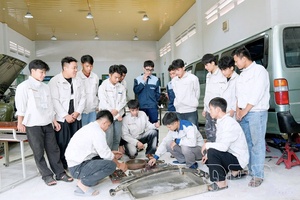
To facilitate learners, the center organizes training classes right in villages, arranging flexible schedules to minimize impacts on residents’ labor, production, and daily activities, while enhancing practical exercises centered on trade skills. Teachers pass on theoretical knowledge while directly guiding trainees through practical work on crops and livestock, helping learners absorb information easily and apply knowledge immediately upon finishing courses. Training trades are highly diverse and tailored to local demands, encompassing classes such as hill and garden chicken raising techniques, pig raising and disease prevention techniques, coffee planting, care, harvesting, preservation, and processing techniques, macadamia planting and care techniques, alongside sheet metal working and welding techniques. For trades where the center lacks organizational conditions, the unit proactively coordinates with qualified vocational education institutions to conduct teaching and satisfy laborers’ learning demands.
Lê Sỹ Tường, Director of the center, emphasized that from 2025 to date, the center organized 35 vocational training classes for over 970 rural laborers, including 6 non-agricultural classes and 29 agricultural classes. In the first 7 months of 2026 alone, the center opened 15 classes for 320 trainees. Through these vocational classes, laborers elevated their qualifications and trade skills, securing conditions to apply knowledge into production and business, creating jobs, increasing incomes, and contributing to labor structure shifts and human resource quality elevation, with post-training employment rates exceeding 80%.
Lò Thị Thu from Lập village, Tuần Giáo commune, shared that after attending a hill and garden chicken raising technique class, she boldly invested in buying chicken, duck, and goose breeds to raise for meat and eggs, noting that applying learned techniques from care and barn hygiene to disease prevention allowed her poultry flock to develop stably, yielding 3 batches annually of nearly 100 birds each and generating profits of VND 5 to 7 million per batch after costs.
Despite achieving positive results, vocational training work at Vocational Education - Continuing Education Center 2 faces remaining difficulties, such as limited awareness and hesitation regarding vocational learning among a section of laborers, a shortage of full-time teachers relative to demand requiring guest lecturers or coordination with other vocational education facilities, alongside deficient and unsynchronized facilities and training equipment for certain trades. Therefore, in the coming period, alongside boosting dissemination, the center will focus on enrollment work, strengthening grassroots-level learning demand surveys, opening vocational classes suited to production conditions in each area, and investing in facilities and equipment to elevate vocational training quality toward substantive efficiency that satisfies labor market demands.
Đức Linh
.jpg)
.jpg)
.jpg)
.jpg)

.jpg)
.jpg)
.jpg)
.jpg)
You have 500/500 characters left
Please enter 5 or more characters!!!