



This approach enables students and trainees to hone their vocational skills and accumulate hands-on experience, establishing a steadfast foundation to secure employment and adapt to employer requirements upon graduation.
In vocational education, theoretical knowledge serves as the foundation, but technical proficiency and practical application capacity directly determine a worker’s adaptability on the job. Stemming from that imperative, Điện Biên College emphasizes expanding practical training hours, reforming instructional methods, and stepping up partnerships with businesses, progressively bridging the gap between education and recruitment criteria.
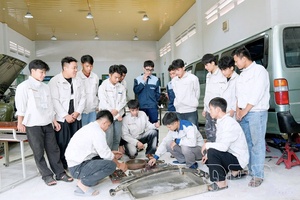
In Automotive Technology, students gain hands-on access to machinery and equipment, performing inspection, maintenance, and repair operations. Practical training helps learners reinforce specialized knowledge, hone problem-solving skills for technical situations, and steadily master professional techniques.
Lò Văn Kiên, a student of the K13 Automotive Technology class, shared that during his studies at the college, he is regularly provided with hands-on practice, familiarizing himself with machinery and refining technical operations. This reinforces his professional knowledge and elevates craftsmanship, laying the groundwork to meet job requirements after graduation.
For Industrial Electricity, the curriculum places distinct emphasis on practice. Students are trained in installing and inspecting electrical systems, operating equipment, and adhering strictly to occupational safety protocols. These constitute essential requirements for workers in electrical engineering, demanding meticulousness, precision, and a high sense of responsibility.
.jpg)
Lò Văn Khánh, a student of the K12A Industrial Electricity class, noted that alongside theoretical coursework, he frequently practices electrical system installations and inspections, equipment operations, and workplace safety procedures. Through hands-on practice, he progressively enhances his vocational skills and cultivates a thorough, precise work ethic that meets the professional demands of the trade.
Dr. Trần Bá Uẩn, Rector of Điện Biên College, stated: currently, the college offers 16 majors at the college level, 22 majors at the intermediate level, alongside dozens of elementary-level vocations and short-term training programs lasting under three months. The annual training capacity reaches approximately 3,500 to 4,000 students and trainees. Enrollment outcomes over recent years demonstrate that vocational learning demand continues to expand. In certain years, admissions for elementary-level and short-term vocational courses reached 185.9% of the target, while the intermediate level attained 113%. Notably, the employment rate of graduates reached 83.2%, with 79.9% working in occupations directly matching their trained majors. These metrics reflect positive initial strides in vocational education, while highlighting the necessity to continuously elevate graduate output quality to ensure learners possess sufficient competence to satisfy real-world demands.
To align instruction closely with the labor market, the college has established partnerships in training, internships, and recruitment with 96 production facilities and enterprises both within and outside the province. Through cooperation, students gain opportunities to access real working environments, becoming accustomed to machinery, production lines, labor discipline, and corporate professional expectations. This linkage allows the college to grasp recruitment needs, reviewing and adjusting curricula to reflect practical reality. Several enterprises visit the college directly to conduct skills assessments, select candidates, and recruit students upon graduation. With businesses participating directly in training and skills evaluations, learners enjoy greater access to employment, while employers find it far more convenient to recruit a trained workforce.
Amid rapid scientific and technological advancement, expectations placed upon workers extend beyond specialized expertise or practical skills. Capabilities in technological literacy, teamwork, problem-solving, self-directed learning, and adaptability to change have grown increasingly indispensable. Confronting these demands, Điện Biên College is oriented toward continuing pedagogical innovation, intensifying hands-on training, and reviewing curricula in accordance with recruitment standards; while placing emphasis on digital competencies, foreign languages, occupational safety, and professional working manners. The educational goal is not only to ensure learners graduate with firm vocational craftsmanship, but to empower them with adaptability, professional development prospects, and income growth throughout their careers.
Elevating vocational education quality necessitates tight coordination among educational institutions, enterprises, and learners. By prioritizing practical training, expanding recruitment linkages, and closely tracking market requirements, Điện Biên College is progressively enhancing the caliber of young human resources, contributing to broadening employment opportunities and fulfilling local socio-economic development demands.
Minh Thư
.jpg)
.jpg)


.jpg)
.jpg)
.jpg)


.jpg)
.jpg)


.jpg)

You have 500/500 characters left
Please enter 5 or more characters!!!