



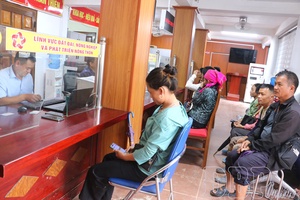
Arriving at the provincial Public Administration Service Center to carry out procedures for the issuance and reissuance of badges for commercial transport automobiles and motorized four-wheeled vehicles, Nguyễn Tiến Bình from Điện Biên Phủ ward was guided by cadres through quick and convenient steps to process his application via VNeID. Under statutory regulations, this procedure is settled within one working day. Publicly disclosing processing timelines assists citizens and enterprises in proactively preparing paperwork, monitoring progress, and arranging work schedules.
Nguyễn Tiến Bình shared that operating within the transportation sector makes administrative processing timelines directly impact plans to commission vehicles into service. Settling administrative procedures swiftly online through the VNeID application, alongside publicizing workflows, required document components, and settlement deadlines, carries practical significance and minimizes repeated travel. Furthermore, utilizing an electronic identification account enables him to log into the system proactively, select procedures, declare details, file dossiers, and monitor processing stages.
.jpg)
For enterprises, shortening administrative processing timelines contributes to facilitating production and business operations. A representative of Hòa Phát Điện Biên Company Limited arrived at the provincial Public Administration Service Center to conduct procedures for the issuance of transport business licenses for automobiles and motorized four-wheeled vehicles. Through implementing the “Green Lane” mechanism, the turnaround time for this procedure was reduced from 4 days to 1.5 days. Shortened timelines assist enterprises in completing procedures promptly, taking initiative in business planning, and curbing waiting periods. When administrative procedures are delivered online, enterprises can complete several stages electronically without necessarily visiting administrative agencies in person.
Lương Quốc Khánh, an officer at the Public Administration Service Center who regularly receives, guides, and processes dossiers across transportation domains, noted that on average each day, he handles over 20 online administrative dossiers concerning the issuance and reissuance of badges for commercial transport automobiles and motorized four-wheeled vehicles, as well as the issuance and reissuance of cross-border transport permits between Việt Nam and Laos. The workload is relatively heavy, yet thanks to online reception and the application of the “Green Lane” mechanism, dossier processing times and waiting durations for citizens and enterprises have been substantially curtailed.
Realities demonstrate that when citizens and enterprises remain unaccustomed to digital operations, the instructional role of cadres at the one-stop shop section remains vital. Cadres do not merely receive dossiers; they explain procedures, guide data entry, verify information, and support residents in accessing digital utilities on mobile phones or via smart kiosks.
According to consolidated data from January 1 to September 10, 2026, units within the aggregation scope received 5,405 administrative procedure dossiers. Among these, the Center for Motor Vehicle and Transport Equipment Technical Inspection received 4,106 dossiers, resolving 4,101 dossiers with 5 remaining in process. At the Department of Construction, total received dossiers reached 1,299, with 1,279 settled and 20 dossiers currently undergoing resolution. These figures reveal that the volume of dossiers received and settled across transportation and construction sectors is relatively large. Maintaining electronic processes, digitizing dossiers, and publicizing resolution progress are of paramount importance in elevating service quality for citizens and businesses.
.jpg)
Alongside compressing processing time, provincial specialized agencies are stepping up the digitization of records and administrative results. At the Department of Construction, all 1,299 incoming dossiers were digitized, attaining a 100% rate, while dossiers completing the digitization of both inputs and results reached 1,281 dossiers, representing 98.61%. These outcomes illustrate that administrative procedure dossiers have entered the digitization pipeline at a high proportion. This forms the foundation for state authorities to store, manage, look up, and utilize records more conveniently, while enabling citizens and enterprises to access resolution outcomes electronically.
Nevertheless, the rate of exploiting and reusing digitized data remains modest. Only 62 out of 5,405 dossiers reused digitized electronic information, data, and documents, accounting for 1.15%. Among these, 51 dossiers reused population data and 11 reused personal and organizational data, while no dossiers utilized corporate business data.
These figures show that while dossier digitization has recorded initial outcomes, exploiting and reusing data requires continued acceleration. Once data is fully digitized and interconnected, citizens and enterprises will avoid repeatedly declaring and submitting information that state agencies already hold.
According to the August 2026 Administrative Procedure Control Report, during the reporting period, the provincial administrative procedure settlement information system alongside systems of central ministries and sectors received 7,696 dossiers. Newly received dossiers totaled 7,243, including 1,532 full-process online dossiers, 3,602 partial-process online dossiers, 2,097 in-person submissions, and 12 dossiers filed via postal services, with 453 dossiers carried forward from the previous period.
The proportion of online dossiers among newly received submissions exceeded 70%, proving that resolving administrative procedures in the electronic environment has become widespread. However, for online public services to maximize efficacy, the system requires ongoing upgrades, interfaces must remain user-friendly, processes need clarity, and support for citizens must be delivered regularly.
When VNeID, online public services, record digitization, and data exploitation operate synchronously, digital government will become a practical utility, contributing to building a modern, transparent administration that serves citizens and enterprises increasingly well.
Anh Nguyễn
.jpg)


.jpg)

.jpg)
.jpg)

.jpg)
.jpg)
.jpg)
.jpg)


.jpg)
.jpg)
You have 500/500 characters left
Please enter 5 or more characters!!!