



Điện Biên College was established through the merger of Điện Biên Vocational College and Điện Biên College of Economics and Technology under Decision No. 2146/QD-BGDDT dated July 25, 2025, issued by the Ministry of Education and Training. Following the merger, one of the college’s key priorities has been to review, standardize, and refine its academic programs to align with the new institutional model.
This process has gone beyond simply combining existing curricula. It has involved screening, updating, and restructuring programs to ensure consistency, eliminate overlap, and incorporate content that reflects labor market demands and evolving trends in vocational education. Alongside completing the legal framework needed to expand its training portfolio, the college has gradually strengthened its capacity to meet both learners’ vocational training needs and businesses’ workforce requirements.
Trần Văn Sơn, Director of Trần Sơn Trading and Services Co., Ltd., said: “After one year of operation, Điện Biên College has introduced many positive changes in its training programs, particularly its stronger focus on meeting the practical needs of businesses. This is an essential step toward improving workforce quality. As a business, we are ready to work closely with the college by providing internship opportunities, contributing to curriculum development, and giving priority to recruiting graduates who meet our employment requirements.”
.png)
After its first year, one of Điện Biên College’s most significant achievements has been the effective integration of human resources following the merger. Previously operating as two relatively independent teaching teams, the college has built a unified academic community comprising 175 lecturers, including 171 with university degrees or higher (97.71%), among them 2 doctoral degree holders and 92 master’s degree holders. Bringing these faculty members together has enabled the knowledge, experience, and strengths of both former institutions to be combined within a single academic system.
Through professional exchanges, collaborative curriculum development, and innovations in teaching methods, the valuable traditions established at the two former colleges have been preserved, complemented, and further developed. These efforts have also fostered a stronger culture of research and innovation among faculty members. During its first year, the college’s Scientific Council successfully evaluated 12 scientific research projects and 18 institutional-level innovation initiatives.
Đỗ Xuân Tuấn, Dean of the Faculty of Agriculture, Forestry, and Enterprise Development, said: “The merger has created more opportunities for lecturers from different disciplines to exchange professional expertise, share teaching and research experience, and jointly organize practical training activities. Faculty members also have greater access to professional development programs, digital transformation initiatives in education, scientific research, and partnerships with businesses. These opportunities provide an important foundation for modernizing teaching methods, adopting new technologies, and training a highly skilled workforce in agriculture, forestry, and construction.”
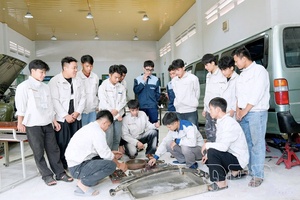
The merger has also enabled the college’s facilities to be reorganized and utilized more efficiently, maximizing the investments previously made by both institutions. Faculties and academic departments now share laboratories, workshops, and other facilities, reducing fragmented investment and improving equipment utilization. At the same time, the integration of practical training spaces, libraries, and information technology infrastructure has created a learning environment that closely connects theory with practice and research with real-world application.
Vàng A Sơn, a student from the Faculty of Mechanical Engineering, shared: “The college provides well-equipped workshops, machinery, and equipment that allow us to practice more effectively. In addition to classroom learning, we can use the library and computer labs to access learning materials, complete assignments, and study independently. These resources help students develop practical skills and become more confident during internships and after graduation, enabling us to meet employers’ expectations.”
To date, Điện Biên College has gradually overcome the initial challenges associated with the merger, successfully stabilizing its organizational structure, optimizing available resources, and maintaining its training activities.
Trần Bá Uẩn, Principal of Điện Biên College, said: “After one year of operating under the new model, the college has essentially fulfilled its assigned responsibilities. Our organizational structure has been consolidated and is operating smoothly; enrollment and training activities have remained stable; and partnerships with businesses have continued to strengthen, creating more opportunities for students to undertake internships and secure employment. At the same time, we are mobilizing additional resources to modernize our facilities and further improve training quality.”
Although one year is a relatively short period, the achievements made so far have established a solid foundation for Điện Biên College to strengthen its position as one of the province’s leading vocational education institutions. These accomplishments will support the college’s continued development toward becoming a modern, high-quality educational institution capable of meeting the workforce demands of a new era.
Nhật Oanh
.jpg)
.jpg)

.jpg)
.jpg)
.jpg)
.jpg)
.jpg)
.jpg)
You have 500/500 characters left
Please enter 5 or more characters!!!