



With the flexible and decisive approach of the party committee and authorities, along with the people’s strong will to rise, the revolutionary countryside of Pú Nhung is gradually transforming, creating a solid foundation for the goal of sustainable poverty reduction and new rural construction.
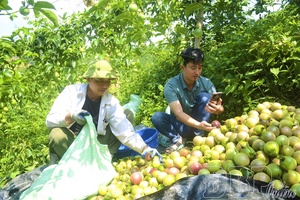
On an early morning, with dew still lingering on the gently sloping hills, Trần Bình Trọng, Secretary of the Pú Nhung commune Party Committee, led us along the red dirt road, weaving through patches of coffee plants sprouting pure white blossoms. In the distance, rows of pineapples stretched along the hillside, with lush green leaves and fruit bearing the first batches, glowing pinkish-red in the morning sun; healthy macadamia trees with high canopies signaled a favorable growing season.
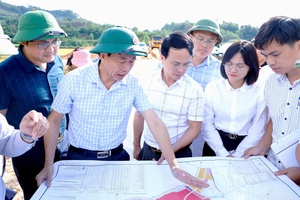
Trần Bình Trọng stopped, his eyes following each patch of hill: “In the past, this place was full of only corn and cassava. Now people are used to new crops and new ways of doing things. These are not just new crops, but the result of a whole process of bringing resolutions into life. To make the people trust and follow, first of all, the party committee must determine the right direction and see it through to the end.”
Pú Nhung was established based on the merger of 3 communes: Pú Nhung, Ta Ma, and Rạng Đông. The whole commune has 21 villages, over 2,400 households, and over 12,300 people, with 9 ethnic groups living together; of which the Hmong ethnic group mainly accounts for over 66%, and the Khang people account for 25.1%. The terrain is strongly divided with high mountains and deep streams; the population is scattered along the mountainsides, making travel, production organization, and State management work face many obstacles.
.jpg)
Previously, people’s livelihoods mainly relied on growing corn and cassava on degraded sloping land, with fragmented production dependent on nature. Low income and a high rate of poor households prevailed; many villages were almost “information white” zones with intermittent phone signals, making it difficult for people to access knowledge, markets, and public services. Therefore, immediately after its establishment, the Pú Nhung commune Party Committee faced a significant problem: Stabilizing the organizational apparatus and the ideology of officials, party members, and the people, while simultaneously finding a fundamental direction for economic development and sustainable poverty reduction.
From that reality, the Executive Board of the Pú Nhung commune Party Committee clearly determined: To develop, first of all, it is necessary to change the way of thinking and doing; bringing the resolution into the most core issues of people’s lives. Implementing the Resolution of the 1st commune Party Congress, term 2025 - 2030, the Pú Nhung commune Party Committee identified crop structure transformation and improving people’s lives as one of the top key tasks. On that basis, the resolution was concretized into action programs and plans close to the actual conditions of each village. The Standing Board of the Party Committee assigned clear responsibilities to each committee member in charge of areas and fields; linking the implementation of the resolution with the assessment of the head’s responsibility. Village party cells were required to include crop conversion and economic development content in periodic meetings, discussing publicly to create consensus among the people.
With the motto “Party members go first, the village follows,” many members of the party committee and commune officials directly piloted models of planting coffee, pineapple, and macadamia. From the initial models, people saw the effectiveness with their own eyes, thereby trusting and following, such as Vừ Thị Mỷ, Chua Lú village, Pú Nhung commune. Vừ Thị Mỷ said: “Previously, my family was only used to growing corn and cassava. Being propagated and mobilized by commune officials right at the village about changing crop structure, to date, the family’s coffee area is growing and developing well. Hoping that in the coming time, there will be a bumper crop...”
Based on soil conditions, the Pú Nhung commune Party Committee agreed to identify a group of key crops: Macadamia, coffee, and fruit trees. The selection of crops was not a movement but was carefully discussed, with market surveys, assessments, and consumption linkage capabilities. Under the direct leadership of the Party Committee, the commune government focused on directing the conversion of over 1,000ha of ineffective short-term crops to long-term crops. To date, the whole commune has formed concentrated production areas with over 1,111ha of macadamia, over 705ha of coffee, and 244ha of fruit trees. A clear mark in the leading role of the party committee is the proactive linkage with enterprises. The Commune Party Committee directly worked and connected with enterprises to build pineapple raw material areas and link coffee production and consumption. Cooperative groups and household groups were established according to the value chain, helping people feel assured in production. Along with that, the commune actively built OCOP products, step by step improving the quality and competitiveness of local agricultural products. From small, fragmented production, Pú Nhung agriculture is gradually shifting to commodity production associated with the market.
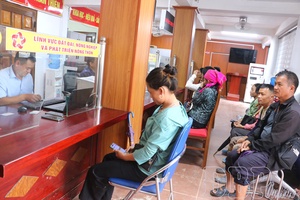
Not only focusing on agriculture, the Pú Nhung commune Party Committee identified digital transformation as an important breakthrough to “reduce information poverty.” The commune built an electronic information portal, deployed a document management system, an electronic one-stop shop, and specialized software. Thanks to synchronous investment in telecommunications infrastructure, to date 95% of residential areas have telecommunications signals, and nearly 95% of the population uses the national power grid. People are step by step accessing online public services and learning production techniques through the digital environment. Models of “clever mass mobilization” and “farmers emulating good production and business” are deployed effectively, associated with the core role of village party cells.
Thanks to the drastic and synchronous leadership of the party committee, the lives of Pú Nhung people are gradually being improved. Average income reached VND 34.7 million/person/year; community awareness has changed markedly; the situation of child marriage and deforestation for farming has decreased sharply. The commune achieved 14/19 new rural criteria, with 3 villages meeting standards. Towards 2030, Pú Nhung sets a goal of average income reaching VND 50 million/person/year, the poverty rate decreasing to below 5%, and the commune basically meeting new rural standards.
The road ahead still has many difficulties, but the faith in a sustainably changed Pú Nhung is clearly present on this difficult highland land.
Mai Phương
.jpg)

.jpg)
.jpg)
.jpg)
.jpg)
.jpg)
.jpg)
.jpg)
.jpg)
.jpg)
You have 500/500 characters left
Please enter 5 or more characters!!!