



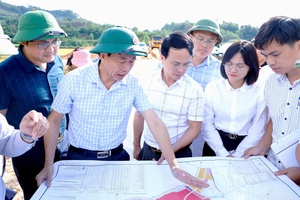
The primary focus of the session was to evaluate the implementation of political tasks, socio-economic development, and national defense and security from the latter half of 2025 through the first quarter of 2026, while also outlining key solutions for the upcoming period. High-level officials in attendance included Lò Văn Cương, Standing Vice Chairman of the provincial People’s Committee, along with members of the Provincial Party Standing Committee and leaders from various provincial departments.
.jpg)
During the period from July 2025 to March 2026, the Party Committees of the five communes strictly followed higher-level directives to implement local political tasks. By issuing resolutions with specific targets, these localities maintained economic stability and organized production according to planned schedules. Significant emphasis was placed on restructuring crops and livestock, while forest management and fire prevention were handled with rigorous synchronization. Furthermore, sectors such as trade, services, budget collection, and basic infrastructure investment saw strong promotion, complemented by positive advancements in healthcare and education. Throughout this time, the national defense and security situation across these communes remained firmly upheld.
Looking toward future tasks, the communes have committed to further building and rectifying the Party and political system to ensure they remain clean and strong. The leadership methods are being modernized to be more scientific and effective, with a core focus on agricultural restructuring. This transition aims to turn farming into a sustainable commodity-based industry by prioritizing high-value products such as macadamia, coffee, and medicinal plants that are well-suited to the local climate. Additionally, the communes plan to mobilize resources for essential infrastructure like transport, irrigation, and digital connectivity while continuing to improve social welfare and sustainable poverty reduction.
.jpg)
During the working session, local representatives presented several key proposals to the provincial delegation, particularly regarding the attraction of investment for coffee and macadamia processing plants and the development of ecotourism projects linked to cultural experiences. They also requested a review of forestry land targets to better serve agricultural restructuring and called for budget allocations for commune-level general planning. Furthermore, the communes highlighted the need for improved electricity access in highland villages and the reinforcement of the local civil servant workforce to meet increasing task demands.
Leaders from provincial departments provided direct responses to these proposals, offering specific solutions for the communes’ future growth. These orientations included attracting deep-processing projects for agricultural products, enhancing the efficiency of the two-tier local government model, and stabilizing the operations of project management boards. There was also a strong call to expand the functions of commune-level general service centers and to accelerate the adoption of science, technology, and digital transformation in all administrative and economic activities.
.jpg)
In his concluding remarks, Trần Tiến Dũng commended the communes for their outstanding results. For the coming period, he urged the Party Committees to effectively internalize and concretize central and provincial resolutions. He emphasized that the leadership style must evolve to follow the principle of “clear tasks, clear responsibilities, clear deadlines, and clear results,” shifting the focus from traditional “management” to “enabling development.” He encouraged a spirit of proactivity and creativity among local cadres to turn these communes into important growth poles for the province.
Furthermore, Trần Tiến Dũng required the communes to focus on attracting investment and developing enterprises and cooperatives through transparent mechanisms. He stressed the importance of linking these entities with local farmers to streamline production and consumption. Utilizing land potential effectively, developing medicinal plants under forest canopies, and building strong product brands through technology were identified as top priorities. He also noted that while promoting trade and services, the communes must drastically reduce poverty rates, implement national target programs effectively, and ensure that security remains stable and proactive.
.jpg)
Prior to the formal meeting, Trần Tiến Dũng and the delegation visited and presented gifts to support disadvantaged and policy-beneficiary families in Tuần Giáo. These visits included the household of Lò Văn Soan in Sái Ngoài village and the family of Vũ Đình Hiệu in Tân Giang. These activities reflected the province’s ongoing commitment to encouraging local residents and ensuring that social security remains a top priority alongside economic development.
Phạm Trung

.jpg)
.jpg)
.jpg)
.jpg)
.jpg)
.jpg)
.jpg)
.jpg)
.jpg)
.jpg)
You have 500/500 characters left
Please enter 5 or more characters!!!