



While the primary bottlenecks in the past were identified as a lack of capital, technical expertise, or market access, the current focus has shifted toward the core means of production, the land itself. This vital resource is steadily shrinking in size and diminishing in quality, exerting significant pressure on the province’s sustainable development goals.
Over recent years, the total area of agricultural land has trended downward, primarily driven by land-use conversion for infrastructure development, urbanization, and various socio-economic projects. Furthermore, natural disasters and climate change have exacerbated this loss. A prime example is the flash flood that struck Mường Pồn commune in July 2024, which buried 81.2 hectares of productive land under debris. This included over 79 hectares of annual crop land and significant portions of perennial and forestry land.
Even now, nearly two years later, much of this area remains uncultivated. Lò Văn Tuấn from Lĩnh village shares that his family’s 4,000 square meters of fields remain buried under thick layers of rocks and soil; despite substantial efforts to clear the land, the sheer volume of debris has made full restoration an elusive goal, leading to a visible drop in productivity.
.jpg)
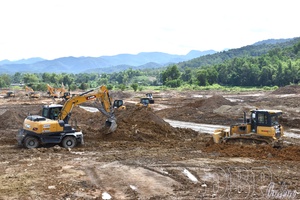
Beyond natural disasters, the drive for modern infrastructure and investment has claimed significant agricultural tracts for non-agricultural purposes. Projects such as the commercial residential area in Thanh Hưng and the former Thanh Chăn commune required the recovery of 24.20 hectares of double-crop paddy land. Additionally, the rural power grid project for the 2021-2025 period occupied 38.30 hectares, while other major developments like the Him Lam New Urban Area and the expansion of Điện Biên Airport have further reduced the available farming footprint.
According to the latest land inventory, the province’s total agricultural land stands at 887,945 hectares. However, land for annual crops has decreased by 9,026 hectares compared to 2019. Within this category, paddy land dropped by nearly 300 hectares, with specialized rice-growing areas losing over 201 hectares. Perhaps most concerning is the decrease in perennial crop land by over 890 hectares. These figures reflect a significant shift in land-use structure and a shrinking foundation for traditional farming.
The challenge is not merely quantitative; the quality of the remaining land is in alarming decline. In many localities, particularly in upland areas, erosion and soil exhaustion have become increasingly common. Unsustainable production habits, such as the overuse of chemical fertilizers and pesticides, have severely depleted the soil structure. When coupled with climate change impacts like heavy rains and prolonged droughts, the soil loses its fertility rapidly, directly impacting agricultural efficiency.
The province’s geography presents inherent difficulties, as a majority of the land features steep slopes and thin cultivation layers, offering low efficiency for intensive farming. Specifically, land suitable for wet rice accounts for only 1.5% of the total natural area, while land for other short-term crops is only 1.6%. This forced “dual challenge” means the agricultural sector must find ways to ensure output while simultaneously increasing the value per unit area. Although food production in 2025 reached over 289,646 tons, growth is slow, and flagship crops like rice have even seen a decline in volume. Mùa Chớ Sùng from Na Son commune notes that even with increased fertilizer use, the yields on his exhausted upland fields simply do not improve, forcing his family to switch crops just to maintain a basic income.
From a livelihood perspective, the shrinking and degrading land directly threatens the incomes of residents, especially given the province’s high multidimensional poverty rate of 30.83%. Since Điện Biên is home to the headwaters of several major river systems, soil degradation on steep slopes increases the risks of landslides and localized droughts. This affects not only farmers but also the broader ecological balance and downstream communities.
Addressing these challenges requires a comprehensive approach to land management and production. First, it is essential to tighten land-use planning to ensure that high-value agricultural land is protected during the urbanization process. Simultaneously, the province must effectively exploit its 38,875 hectares of unused land. While much of this is steep, it can still be productive if managed through agroforestry models.
Transitioning toward sustainable production methods is a fundamental solution. Adopting organic farming, circular agriculture, and agroforestry models can improve soil fertility while enhancing product value. In areas where land is limited, focusing on high-value crops like coffee, macadamia, and medicinal plants tailored to local soil conditions is a strategic direction. Furthermore, the application of science and technology in soil improvement, erosion control, and water retention is vital. Investing in irrigation systems and field restoration will also help maximize land-use efficiency and reduce the pressure to expand into new areas.
Ultimately, raising public awareness is a critical factor. Much of the current degradation stems from outdated habits like slash-and-burn farming and over-exploitation without replenishment. Therefore, educational outreach must shift the public mindset from “extraction” to “protection and regeneration.” As Điện Biên continues to modernize, balancing development with the preservation of its land resources is no longer optional, it is a necessity for the province’s long-term prosperity and resilience.
Văn Tâm
.jpg)
.jpg)

.jpg)
.jpg)
.jpg)
.jpg)
.jpg)

.jpg)
You have 500/500 characters left
Please enter 5 or more characters!!!