



Once marked by hardship on the journey to pursue education, students now study, live, and play in a spacious and modern school nestled in the remote border region.
.jpg)
This is the first project nationwide to be implemented following the issuance of Conclusion No.81-TB/TW by the Politburo on July 18, 2025, regarding the policy of building schools for mainland border communes.
The country’s first inter-level boarding school was built on an area of nearly 6.88 hectares and includes 31 standard classrooms, 14 specialized subject rooms, a library, a STEM room, dormitories, playgrounds, sports fields, a swimming pool, and many synchronized supporting facilities, meeting the learning and living needs of more than 1,000 students.
.jpg)
The campus was designed in harmony with the cultural identity of the highland region, creating an educational environment that is both modern and closely connected to the lives of borderland students.
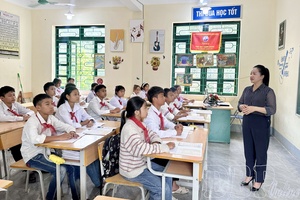
The new learning environment has brought about significant positive changes in the school’s educational quality. With modern and well-equipped facilities, students now have greater opportunities to access innovative teaching methods, develop practical skills, and grow comprehensively.
.jpg)
End-of-school-year results show that educational quality has steadily improved. At the primary level, the proportion of students achieving strong performance in many subjects reached encouraging levels, particularly in upper grades where several subjects recorded achievement rates exceeding 50%. At the lower secondary level, a high percentage of students achieved good and excellent academic results, while the number of underperforming students remained very low.
These figures reflect the effectiveness of renewed teaching methods and demonstrate the positive transformation brought by the new educational environment - a place where every classroom nurtures knowledge and every schoolyard becomes a space where the dreams of children in the highlands can take flight.
.jpg)
At the same time, previously, the learning conditions for students in Si Pa Phìn commune were difficult because of scattered school sites and inconsistent facilities. Therefore, the completion of this multi-level boarding school holds special importance for the socio-economic development of the locality.
In the midst of the difficult border highlands, the presence of this modern school carries a meaning that transcends a mere educational building. Not only does it create a foundation for improving the quality of teaching and learning, but it also opens a door of opportunity for ethnic minority children. This allows them to have better learning conditions and step-by-step narrows the educational gap compared to more favorable regions.
Diệp Chi
.jpg)


.jpg)
.jpg)
.jpg)
.jpg)
.png)
.jpg)
.jpg)
.jpg)
.jpg)
.jpg)
You have 500/500 characters left
Please enter 5 or more characters!!!