



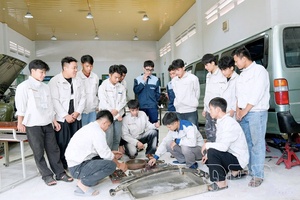
Many years ago, Quàng Văn Tươi from Bua village, Búng Lao commune, did not have a stable job, relying mainly on fields and upland plots, which made life highly challenging. In 2023, after local authorities coordinated with a recruitment agency in Hanoi to introduce a labor export program to the Japanese market in the field of machinery repair and mechanics, he proactively conducted research and decided to register. Initially, his income reached around VND 20 million per month. To date, as his skills have steadily solidified, his monthly income fluctuates between VND 30 million and VND 40 million.
.png)
Quàng Thị Hinh, Tươi’s wife, shared that while family life faced numerous hardships in the past, it has now gradually stabilized. From the income her husband sends home, in addition to daily living expenses, the family has the means to invest in livestock husbandry and accumulate a sum of savings.
In June 2024, 79 households in Nà Tấu, Mường Ảng, Búng Lao, and Mường Lạn communes were delighted to receive support from the Mường Ảng Area Program, with each household being provided one breeding cow, among which Lò Thị Oai’s family was a beneficiary.
Lò Thị Oai emotionally shared that her family has six members and was classified as near-poor, with their livelihood relying mostly on a few plots of fields and upland land, causing them to struggle year-round. Her eldest daughter had to work as a hired laborer in Hanoi to support the family, while she, her husband, and the grandchildren stayed home to work and save bit by bit. Receiving the breeding cow from the program brought immense joy to her family, serving as an accumulated asset. Thanks to their careful tending, the cow has now given birth to a calf, infusing their lives with renewed hope to rise up.
.jpg)
Similar to Oai’s family, across many villages aided by the Mường Ảng Area Program, the reproductive cow support model is step-by-step demonstrating efficiency, helping people secure stable livelihoods and become more proactive in household economic development.
Nguyễn Xuân An, a representative of the Mường Ảng Area Program, stated that from 2022 to the present, the program has delivered 323 reproductive cows to local households. Monitoring results indicate that the vast majority of households provide good care, and many cows have reproduced, contributing to herd expansion and creating an accumulated asset source for families.
Implementing livelihood support programs and projects under the three National Target Programs - encompassing new-style rural building, sustainable poverty reduction, and socio-economic development in ethnic minority and mountainous areas for the 2021 - 2025 period - the lives of local residents have undergone positive shifts. Many disadvantaged households have boldly changed their ways of thinking and doing, proactively learning technical skills to develop their economies, with Vừ A Sùng from Phô village, Sính Phình commune, serving as a prime example.
.png)
After participating in a training class on livestock husbandry techniques and disease prevention for cattle and buffaloes organized by the regional Vocational Education - Continuing Education Center in coordination with local authorities, Sùng effectively applied this knowledge to reality. He built shelters and prepared animal feed strictly according to technical guidance, enabling his family’s livestock herd - comprising three pairs of buffaloes and 40 goats - to grow healthily and reproduce regularly.
Vừ A Sùng shared that in the past, life for his family and many others in the village was filled with difficulties, as livestock farming mostly followed old habits and lacked knowledge, resulting in low efficiency. Ill livestock were often treated without guidance, leading to slow growth or even losses. Once they received training, their awareness shifted, and livestock farming gradually stabilized, yielding a better income.
Following the rearrangement of administrative units, the requirements placed on the commune level regarding leadership and governance have become increasingly distinct, particularly in deploying socio-economic development tasks tied to sustainable poverty reduction. Within this framework, new-style rural building does not stop at finalizing infrastructure but also aims at creating livelihoods, upgrading income, and improving public life.
.jpg)
In many localities, grassroots party committees have maximized their role as leadership cores, focusing on propagating and mobilizing residents to change their mindsets and proactively develop household economies. In Na Sang commune, moving away from a psychological reliance on external aid, many households have gradually transitioned toward self-reliance. Cadres and party members stay close to villages, guiding residents to apply technical progress to production and husbandry, step-by-step creating stable livelihoods.
These transformations are manifested not only in the brightening appearance of rural areas but also in the shift in public perceptions and actions, with many households proactively writing applications to withdraw from the poor household list, exemplified by Chớ A Sình’s family in Sa Long village, Na Sang commune.
Five years ago, Sình’s family borrowed VND 100 million from the Bank for Social Policies to invest in livestock development and pineapple cultivation. Frequently reached by commune cadres and party members for propaganda and technical guidance, his awareness gradually evolved, allowing him to manage production with calculation. Thanks to proper application, his family economy step-by-step stabilized and yielded accumulation, prompting Sình’s family to voluntarily write an application to exit the poor household list once their life became stable, thereby passing on support to more disadvantaged families.
.png)
It is evident that through the empowerment of programs and projects along with the involvement of party committees and authorities at all levels, residents have gradually transformed their awareness, proactively developing livelihoods and step-by-step rising out of poverty. As material and spiritual lives improve, the province’s multidimensional poverty rate currently stands at 17.66%, decreasing by an average of 3.97% annually, a result that affirms the correctly oriented leadership and direction of party committees and local authorities in hunger eradication, poverty reduction, and socio-economic development across the province.
Implementing national target programs on new-style rural building, sustainable poverty reduction, and socio-economic development in ethnic minority areas for the 2021 - 2025 period, the Provincial Bank for Social Policies deployed loan programs for poor, near-poor, and newly escaped poverty households, with total loan sales reaching over VND 6,600 billion, benefiting nearly 60,000 household turns, and outstanding debt by mid-2025 exceeding VND 5,299 billion. Preferential capital was disbursed in a timely manner, closely following the needs of the public to support investments in cultivation, husbandry, and agricultural production applying new techniques.
Quang Long
.jpg)
.jpg)

.jpg)
.jpg)
.jpg)
.jpg)
.jpg)
.jpg)
You have 500/500 characters left
Please enter 5 or more characters!!!