



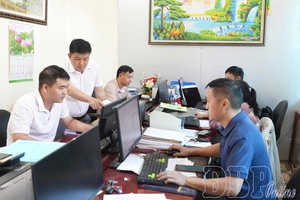
Implementing Resolution No.68-NQ/TW of the Politburo and Resolution No.13-NQ/TU of the Provincial Party Committee on private sector development, the Điện Biên Provincial People’s Committee has concretized these into decisive plans and action programs. A highlight in governance is the implementation of the “Green lane” mechanism for administrative procedures regarding key non-budget investment projects. With the requirement to shorten processing time by at least 60% and applying to 23 administrative procedures in key fields such as finance, construction, industry, trade, and agriculture, this mechanism has initially created a smooth procedural path for investors. From January 30 to April 15, 2026, the province received 20 applications under the “Green lane” mechanism, and specifically, the financial sector processed 19 applications for 13 large-scale investment projects.
According to statistics from the beginning of the year until now, the province has seen 108 newly established enterprises with a total registered capital of over VND 817 billion, along with 34 enterprises returning to operation. To date, the province has 1,672 enterprises with a total registered capital of over VND 39,621 billion. Furthermore, the province has granted investment policy approvals and information for 6 investment projects with a total registered capital of more than VND 12,649 billion. Many large projects in renewable energy, urban areas, and education are being implemented, such as the Điện Biên 1 solar power plant, the Envision Nậm Pồ wind power plant, the Điện Biên Education Complex, and the Huổi Phạ golf, commercial, tourism, and service urban area and its surroundings.
.jpg)
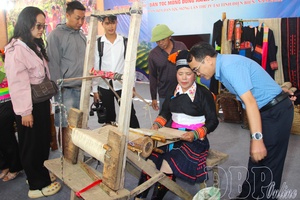
Currently, many small local production facilities are gradually asserting their position through deep processing to increase the value of agricultural products. In Mường Ảng commune, the Hà Chung coffee processing facility owned by Bùi Thị Việt Hà is a typical model. Using local coffee products, the facility has invested in workshops and machinery for deep processing of Arabica Mường Ảng products, building a brand and developing several OCOP products. The facility currently has three main products, including pure filter coffee powder with a 4-star OCOP rating, paper filter coffee with a 3-star OCOP rating, and salt coffee with a 3-star OCOP rating. Having products recognized by OCOP has helped the facility expand its market, enhance product value, and create more jobs for local labor.
Bùi Thị Việt Hà mentioned that the process of developing the facility still faces many difficulties. When OCOP products expire, the facility must re-perform many procedures as if applying for the first time, which causes the facility to lose more time and costs for documentation and administrative procedures. Additionally, to upgrade product quality to a 5-star OCOP rating, the facility must invest in expanding workshops, machinery, and technology, with the most difficult factor remaining capital. She expressed hope that the province and functional agencies would provide more preferential credit packages so that local agricultural processing facilities could access capital and boldly invest in production development.
Not only small producers but many enterprises in the province also believe that the greatest need currently is more convenient access to capital and long-term support policies. Nguyễn Phú Đỏ, Director of the Điện Biên Import-Export Trade Joint Stock Company, stated that the province has recently stepped up administrative reform, helping businesses save time and costs in procedure resolution and creating favorable conditions to expand production and business. However, to develop organic agriculture and deep processing of agricultural products, businesses still need more support policies regarding capital, credit incentives, and investment attraction to invest in technology, enhance competitiveness, and expand the consumption market for Điện Biên agricultural products.
Reality shows that despite many changes, the private economic sector in Điện Biên still faces various difficulties, such as a small number of enterprises with limited scale and low competitiveness. There is a lack of large manufacturing enterprises capable of leading the market, and the ability to access capital, science, technology, digital transformation, and consumption markets for many businesses and business households remains limited. Furthermore, the socio-economic infrastructure in rural areas of the province has not met the requirements for commodity production development. Some administrative procedures still depend on many coordination steps and inter-departmental consultations, so the actual processing time has not reached expectations.
To ensure the private economy truly becomes a driver of development, Điện Biên will continue to promote administrative reform, digital transformation, and the improvement of the investment and business environment. The province will also strengthen support for businesses to access capital, management training, trade promotion, and market expansion. The province aims to build appropriate support mechanisms for small businesses and households in mountainous and ethnic minority areas while accelerating investment in transport infrastructure to create conditions for production development and attract enterprises to invest in agriculture, rural areas, trade, and tourism.
Anh Nguyễn


.jpg)
.jpg)


.jpg)
.jpg)
.jpg)


.jpg)
.jpg)

.jpg)
You have 500/500 characters left
Please enter 5 or more characters!!!