



After many seasons of cultivation and prolonged heavy rains, the loose, fertile topsoil was gradually washed away, leaving behind a barren surface of gravel and stones. Consequently, her crops withered and yields plummeted. Despite working year-round, her life remained a constant struggle; the land was there, but it could no longer sustain her family. At one point, she even considered abandoning her fields to find a new place to farm.
However, she soon realized that if she continued her old ways, moving elsewhere would only provide a temporary reprieve before that soil, too, became exhausted and eroded. She decided to change her approach, moving away from short-term crops on sloped land to planting grass, upgrading her barns, and developing a centralized goat-farming model while simultaneously planting forests to hold the soil and water for a long-term future.
.jpg)
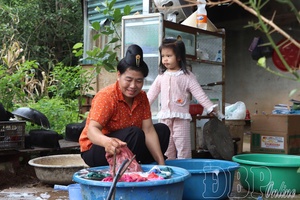
This bold shift allowed Quàng Thị Minh to invest in breeding stock and master modern care techniques, leading to a thriving herd that stabilizes at 200 to 300 goats. Her family now earns nearly VND 200 million annually, transforming a mere existence into a life with savings and consistent education for her children. Her experience demonstrates that preserving the land is not about stubbornly clinging to outdated methods on exhausted soil, but rather about choosing a path that allows the earth to continue nourishing human life.
Her story is mirrored in many other regions where shifting production methods are opening new horizons. Along National Highway 12 in Na Sang commune, hillsides that once yielded low-value corn, cassava, and peanuts are now covered in vast pineapple fields. This crop is perfectly suited to the local soil, resists pests, and offers high economic value. Farmers here are also leveraging these changes to develop livestock, creating a more stable livelihood on the same land area. A prime example is Giàng A Chía from Na Sang 2 village, who initially invested in buffalo before transitioning to a combined pineapple and livestock model. This innovation has significantly boosted his efficiency, yielding over 10 tons of pineapple per season and a net profit of approximately VND 70 million.
In another approach, the Hà Ân Agricultural Cooperative in Phiêng Kham village, Mường Nhé, is driving visible change through organized production. By involving families like Mào Văn Khiên in wax gourd projects, the cooperative provides technical guidance and links products directly to market outlets. Đinh Quốc Hoạt, a representative of the cooperative, emphasizes that core transformation isn’t just about changing the type of plant; it is about reorganizing production and securing the output. When businesses and cooperatives stand alongside them, farmers feel secure in their investment and no longer worry about the market volatility that once plagued them.
“The land does not disappear, but if we continue to exploit it in the old ways, its value will gradually erode. This change is not simply about swapping one crop for another; it is a fundamental shift in mindset, moving from habit-based farming to calculated, linked, and long-term strategies.”
Ultimately, preserving the land does not come from isolated support but from reorganizing production and changing mindsets. When a piece of land creates enough value, people will choose to stay. As the way humans connect with and exploit the earth’s resources changes, new livelihoods are created, lives are improved, and lands once at risk of being abandoned continue to yield profit.
Tú Trinh
.jpg)
.jpg)

.jpg)
.jpg)
.jpg)
.jpg)
.jpg)
.jpg)
You have 500/500 characters left
Please enter 5 or more characters!!!