



Điện Biên Phủ ward is one of the localities with high budget revenues in the province. According to the estimates assigned by the ward People’s Council, the total State budget revenue for 2026 is VND 448,996 million; the estimated execution for the first six months reaches VND 386,301 million, equal to 86% of the assigned estimate and an increase of 656% compared to the same period in 2025. Within this, the State budget revenue collected in the area is estimated at VND 239 billion, equivalent to 107% of the assigned estimate, while the ward-retained budget revenue stands at VND 129.22 billion, reaching 68% of the estimate.
.jpg)
Multiple revenue streams achieved outstanding results, becoming bright spots in budget collection work, such as revenue from the non-state economic sector exceeding VND 72.9 billion (reaching 142% of the estimate assigned by the province and the ward People’s Council) and revenue from land-use fees exceeding VND 61.1 billion (reaching 58% of the estimate). Additionally, there are stable revenue sources from construction lottery activities, land and water surface leases, and environmental protection taxes.
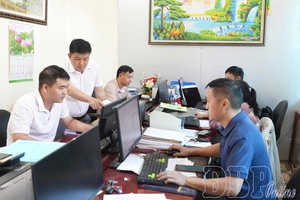
To achieve the above results, right from the beginning of the year, the People’s Committee of Điện Biên Phủ ward concentrated on directing and managing budget revenues and expenditures in accordance with regulations. The ward stepped up the urging of revenue collections, coordinated closely with tax authorities in managing revenue sources, and combated revenue losses, while concurrently issuing a land-use rights auction plan to efficiently exploit land resources and generate additional revenue for the local budget.
Hà Thanh Tùng, Chairman of the Điện Biên Phủ ward People’s Committee, stated: “In the coming time, the ward will continue to strictly manage state finance and the budget, drastically deploy solutions to increase revenue, combat revenue losses, recover tax debts, and efficiently exploit revenue sources arising in the area. In particular, the ward will focus on completing the auction of land-use rights in the third quarter of 2026 for eligible land plots, generating land-related revenue for the budget, while coordinating with departments and sectors to untangle difficulties in planning, assets, and land to finalize auction dossiers and procedures according to regulations.”
.jpg)
Not only in the central area, budget revenue collection in disadvantaged localities has also shown positive signs. In Chiềng Sinh commune, the local government has focused on synchronously deploying budget revenue management solutions according to the assigned estimate. Budget expenditure management basically ensures the regular operations of the government apparatus while meeting the requirements for executing socio-economic development and national defense and security tasks.
As a result, in the first six months of the year, the commune’s total budget revenue is estimated at VND 118,500 million, reaching 72% of the assigned estimate, and the on-site budget revenue is estimated at VND 1,780 million, reaching 98% of the assigned estimate. The revenues mainly come from registration taxes, fees and charges, and revenues from production, business, and service activities.
These results demonstrate the efforts and determination of the entire political system in budget revenue management, while reflecting positive transformations in production, business, trade, services, and investment attraction at the grassroots level. To complete the budget revenue scenario for the first months and the entirety of 2026, communes and wards across the province are focusing on executing a synchronized array of solutions. Among these, emphasis is placed on tightening discipline and order in budget revenue management, tying the responsibilities of heads of units to task execution results, and assigning specific targets to each department and officer in charge.
Along with that, grassroots authorities are enhancing coordination with tax agencies to review and update business households and individuals with newly arising tax obligations. They are stepping up inspections in sectors with a high risk of revenue loss - such as private construction, transport, trade, and services - while urging timely tax submission, thoroughly handling outstanding debts, and limiting the occurrence of new debts.
.jpg)
At the provincial level, the tax authority is also synchronously deploying several core groups of tax management solutions. In addition to stepping up dissemination and the dissemination of new policies, the tax sector creates favorable conditions for citizens and enterprises to fulfill their obligations to the budget through digital applications and solutions like eTax Mobile, implementing new contents of Decree No.144/2026/ND-CP (which amends and supplements several articles of Decree No.181/2025/ND-CP detailing the implementation of several articles of the Law on Value Added Tax), alongside the “tax identification number cleaning” campaign. Along with nurturing revenue sources, the tax sector is strengthening analysis, forecasting, and tracking of collection progress by locality, sector, and tax category, while elevating the efficiency of risk management, inspection, and supervision of tax declaration dossiers to promptly detect and handle cases of incomplete declarations.
Reality indicates that communes and wards represent the level of government closest to the people, closely grasping the situation of residents, business households, and production and business activities in the area. Maintaining stability and growth in grassroots budget revenue sources not only contributes to expanding local financial resources but also enables authorities to proactively execute socio-economic development, guarantee national defense, security, and social security, and invest in essential infrastructure to serve the People’s lives.
Đức Kiên


.jpg)
.jpg)


.jpg)
.jpg)
.jpg)


.jpg)
.jpg)

.jpg)
You have 500/500 characters left
Please enter 5 or more characters!!!