



For the 2026-2030 period, the province has identified its core strategy as restructuring the agricultural sector toward a centralized, green, smart, and sustainable commodity model. The central task involves leveraging local strengths to form large-scale specialized cultivation zones and promoting linkages to effectively shift the mindset from traditional “agricultural production” to a modern “agricultural economy.”
.jpg)
Possessing a massive agricultural land area of 883,000 hectares, which accounts for 93% of the natural area, along with favorable soil conditions, local districts have step-by-step planted coffee and macadamia, forming several concentrated production areas. However, historical fragmentation and a lack of deep processing have kept production values relatively low.
To rectify this, Điện Biên has placed agricultural development at the heart of its political agenda, demanding that the entire political system get involved under the leadership of individuals who are bold enough to think, act, and innovate. Macadamia and coffee have been selected as the flagship crops due to their high economic value and compatibility with the local climate.
By 2030, the province strives to cultivate 40,000 hectares of macadamia and over 20,000 hectares of coffee, along with 3,000 hectares of fruit trees such as pineapple and passion fruit, and 6,500 hectares of vegetables. This ambitious target is poised to make Điện Biên the largest macadamia producer in the country and the second-largest Arabica coffee producer in Vietnam.
With clearly defined goals, commune-level authorities are playing a decisive role in direct implementation while the State provides guidance and support. In the early days of April, communes across the province simultaneously launched campaigns to plant macadamia and coffee. Coffee development is being concentrated in areas such as Mường Ảng, Quài Tở, Mường Mùn, Pú Nhung, Chiềng Sinh, and Xa Dung. Macadamia is being expanded across a large area in Na Son, Mường Luân, Mường Nhà, Tuần Giáo, and Mường Nhé, while the production of pineapple and passion fruit is being scaled up in Mường Nhà, Mường Pồn, and Sam Mứn.
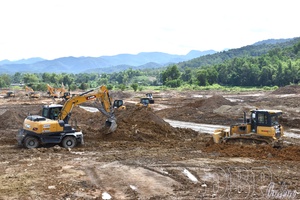
To foster a green and sustainable foundation, the province is resolutely directing the conversion of inefficient corn and cassava lands into high-value macadamia and coffee plantations. In 2026, the province aims to plant 12,000 hectares of these two crops, including 5,930 hectares of coffee and 5,930 hectares of intercropped macadamia, alongside 140 hectares of pure macadamia. Approximately 6,000 households are expected to participate, with each household managing an average of 1 hectare of each crop. Mường Ảng, acting as the pilot site, mobilized over 400 officials, Party members, and armed forces to plant 20 hectares in the initial launch phase. Overall, the April campaign across the province has mobilized more than 14,000 laborers, including farmers, soldiers, and militia members, to directly dig holes and plant seedlings.
.jpg)
The movement is fueled by the action slogan: “Upholding the spirit of Điện Biên Phủ and the strength of civil-military unity to make coffee and macadamia the province’s flagship products.” While local authorities focus on leadership and clear task assignments, specialized sectors like the Department of Agriculture and Environment provide technical guidance on seed selection and care.
The Department of Science and Technology is further pushing boundaries by applying low-altitude spatial economic models and using unmanned aerial vehicles (UAVs) in production. Specialized task forces have been established to monitor progress at the grassroots level, ensuring that the principle of protecting forests is strictly followed while advancing green agriculture. Furthermore, the province has launched a widespread competition with the theme “Excellent hole-digging soldiers-Excellent hole-digging households-Communes completing early with high quality” to create a vibrant atmosphere for the planting season.
The determination to pursue green and smart agriculture serves as a vital engine for Điện Biên’s rapid and sustainable development. By identifying macadamia and coffee as primary drivers, the province is not only changing the production mindset of its people but also enhancing land-use efficiency and creating stable livelihoods to eradicate hunger and reduce poverty.
Gia Huy
.jpg)
.jpg)

.jpg)
.jpg)
.jpg)
.jpg)
.jpg)
.jpg)
You have 500/500 characters left
Please enter 5 or more characters!!!