



In Tuần Giáo commune, the changes in people’s lives today clearly reflect the effectiveness of policy credit. The roads into the villages are no longer as muddy as they once were, and many families now own properly invested livestock facilities.
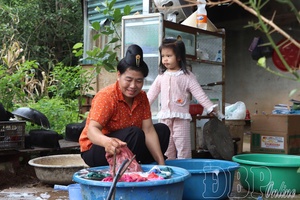
Previously, the family of Quàng Thị Minh in Cọ village was classified as a poor household, with income relying on small-scale, inefficient livestock farming due to a lack of capital and direction. In 2024, Quàng Thị Minh borrowed VND 50 million from the VBSP under the job creation program. Though the amount was modest, it served as a vital “boost” for her family. With the loan, she invested in breeding stock, renovated her barns, and shifted to concentrated goat farming. Through diligent learning, her herd grew rapidly, and she now maintains between 200 and 300 goats, generating an annual revenue of nearly VND 200 million. This has allowed her family to move out of poverty, stabilize their lives, and ensure her children receive a full education.
Policy credit has also shown distinct effectiveness in the difficult and remote border areas of Na Sang commune. In the past, agricultural production in local villages relied mainly on corn, cassava, and peanuts using traditional, low-efficiency methods. In recent years, utilizing preferential loans, residents have boldly transitioned their crop and livestock structures to better suit local conditions. Along National Highway 12, many hillside areas have been converted to pineapple cultivation, a crop that thrives in the local soil with few pests and high economic value. Residents have combined this with livestock farming to maximize available resources.
.jpg)
Quàng Văn Việt from Na Sang 2 village is a prime example. With a VND 150 million loan from the VBSP, he initially invested in buffalo and later shifted to a combined model of pineapple and livestock. This model currently yields over ten tons of pineapples per harvest, bringing in over VND 100 million in revenue and a profit of about VND 70 million after expenses.
Practical evidence shows that when given access to appropriate capital, people do not just invest in production but also change their thinking, moving from fragmented production to commodity-oriented economic development. Despite some initial procedural challenges arising from administrative mergers and the transition to a two-tier local government model, the timely direction from the provincial VBSP and close coordination with local authorities have ensured that the disbursement of preferential capital remains stable and uninterrupted. Lò Thị Thanh, Director of the VBSP Transaction Office in Mường Ảng, affirmed that the unit has proactively implemented credit programs to ensure funds reach the people promptly.
Currently, the provincial VBSP is implementing nearly 20 preferential credit programs, with the entrusted lending method through socio-political organizations continuing to prove effective. During the 2021-2025 period, policy credit supported over 118,000 turns of poor households and policy beneficiaries, contributing to an average annual poverty reduction rate of 3% to 4%. These funds helped create jobs for nearly 19,000 laborers, built 2,850 houses for the poor, and funded over 30,000 clean water and environmental sanitation projects.
Trần Ngọc Nam, Deputy Director of the VBSP Điện Biên branch, shared that policy credit has reached 100% of the villages in the province, with a credit growth rate exceeding 10% per year during 2020-2025, specifically reaching 11.2% in 2025.
The impact of policy credit is evident not only in growth indices but also within each production model and household. More importantly, the capital has contributed to a fundamental change in the mindset of the residents, shifting from a state of dependency to one of proactive economic development.
Đào Phương


.jpg)
.jpg)

.jpg)
.jpg)
.jpg)

.jpg)
.jpg)


.jpg)
You have 500/500 characters left
Please enter 5 or more characters!!!