



Concentrated production areas will overcome long-standing fragmentation, creating a foundation for applying modern techniques, attracting enterprises for consumption linkage, and opening up directions for sustainable agricultural development.
.jpg)
Before merging communes and wards, a number of concentrated fruit tree production areas had been formed in the province with a total area of about 3,200ha; mainly in: Điện Biên, Mường Ảng, Tuần Giáo... However, the biggest limitation was that production areas were scattered across many communes, leading to a lack of consistency in planning and difficulties in value chain linkage and investment attraction. This also caused many obstacles in quality management, granting planting area codes, and traceability, especially in the context of increasingly demanding market standards.
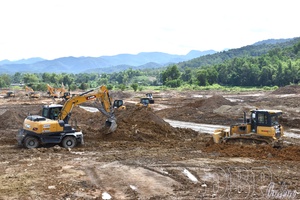
The merger of communes has created important conditions to re-plan production areas towards concentration, large scale, and higher competitiveness. When the area expands, fruit growing areas that were previously scattered are now within a unified management space, facilitating regional planning construction, connecting infrastructure, and reorganizing production. Unifying management focal points helps professional agencies easily provide technical support, transfer new varieties, guide VietGAP and GlobalGAP processes; and apply digital technology in farming...
The fruit tree area of the old Mường Ảng district had a total area of about 510ha. Previously, the fruit planting area was scattered in many communes such as: Búng Lao, Mường Lạn, Xuân Lao, Ẳng Tở, Ẳng Cang, Ẳng Nưa... Each commune had a different way of organizing production, plant varieties were not uniform, and care and pest control techniques were also different. This meant that although products had the same name, the quality was not equivalent, output was not high, and it was difficult to attract enterprises to purchase in large quantities. After the merger, with the rearrangement of administrative boundaries and review of land funds, a specialized fruit cultivation area was formed, concentrated mainly in Búng Lao and Mường Ảng communes. Thanks to this, conditions were created for the application of synchronous technical processes such as: Varieties, pruning, fertilizing, watering, applying science and technology, or harvesting are implemented consistently, and fruit quality meets more uniform standards.
.jpg)
Trương Hồng Bách, Chairman of the People’s Committee of Búng Lao commune, said that the formation of specialized crop cultivation areas after the merger has created a major turning point in local production organization. Previously, each commune and village did things their own way, so it was very difficult to control quality, and technical staff could not regularly monitor each small area. Currently, management work is more methodical. The commune can build care plans according to each growth stage, assign officials in charge of each area, and coordinate with cooperatives and enterprises to closely monitor the planting and care process of crops. Thanks to that, the status of pests and diseases on crops has decreased, productivity and quality have increased, and products can meet market purchasing requirements.
Pú Nhung, Ta Ma, and Rạng Đông communes (old Tuần Giáo district) all have advantages in land and climate, favorable for crop development, especially fruit trees. In previous years, these localities issued orientations and policies to support people in expanding areas, changing varieties, and applying farming techniques. However, crop areas were scattered, each commune implemented in its own way with different support mechanisms, so development lacked linkage and did not form a unified production area. This made efficiency not commensurate with potential, products scattered, difficult to build a common brand, and difficult to attract investment enterprises. However, after merging the above 3 communes into Pú Nhung commune, the locality has initially promoted the advantage of developing fruit tree areas.
Nguyễn Văn Bách, Chairman of the People’s Committee of Pú Nhung commune, said that after the merger, the commune has a large area, and characteristic climate and soil suitable for planting industrial crops and fruit trees. Promoting that advantage, the commune encourages people to convert crop structures from inefficient corn and cassava to planting high-economic value fruit trees. To date, the whole commune has over 1,000ha of concentrated crops, mainly coffee (705ha), pineapple (90ha), mango, and other fruit trees (244ha). The commune strives to have over 2,000ha of coffee and 1,700ha of macadamia by 2030... step by step building brands, forming concentrated, circular, and clean production models.
.jpg)
Along with expanding the area, Pú Nhung commune calls for and attracts enterprises and investors to create planned zones. At the end of last October, the commune coordinated with DOVECO Company to organize the commencement of a pineapple planting model to develop sustainable raw material areas in the locality. Initially, the company deployed planting 20ha of pineapple in villages: Rạng Đông, Bon A, Nậm Mu. During implementation, the company supports planting, care, and harvesting techniques, provides high-quality pineapple varieties, fertilizers, and agricultural materials according to safe production processes. The company commits to underwriting all harvested pineapple products of people in the commune at stable prices. This is an important step to develop concentrated pineapple growing areas in the locality, contributing to crop structure transformation, raising income, and creating sustainable livelihoods for people.
Implementing the Project on Developing advantageous and specialty fruit trees towards concentrated and sustainable commodity production for the 2021 - 2025 period, with orientation to 2030, Điện Biên has converted 578ha of rice land and annual crop land to fruit trees. To date, the total fruit tree area in the province reached over 4,160ha, an increase of 1,124ha compared to 2020, reaching 83.2% of the plan; output is estimated at nearly 26,720 tons. The goal by 2030 is to strive to develop 20,000ha of coffee, 40,000ha of macadamia, and develop fruit trees based on main crops such as: passion fruit, bananas, pineapples...
.jpg)
Parallel with expanding production, the province focuses on training, coaching, and transferring technical progress, helping people improve production and management capacity. Agricultural products aim for deep processing, meeting OCOP standards, linking production with consumption, and ensuring stable output. Many communes such as: Búng Lao, Pú Nhung, Mường Nhà, Na Sang, Thanh Yên... have formed concentrated production areas of about 3,000ha, mainly planting pineapples, bananas, jackfruit; creating raw material areas for processing for large enterprises like Nafoods Northwest, Đồng Giao, TH True Milk.
Merging administrative units not only means organizing a streamlined apparatus but also opens up large room for Điện Biên agriculture to enter a phase of in-depth development. When land is gathered, production areas are clearly established, infrastructure is synchronously invested, and technical processes are unified, the increase in agricultural product value is inevitable. Newly formed specialized cultivation areas are showing the right direction: Linking production with the market, linking farmers with enterprises, turning potential into competitive advantage. This is the foundation for Điện Biên to build a modern, sustainable agriculture, create stable livelihoods for people, and contribute positively to local economic growth.
Thành Đạt
.jpg)
.jpg)
.jpg)
.jpg)
.jpg)
.jpg)
.jpg)
.jpg)
.jpg)
You have 500/500 characters left
Please enter 5 or more characters!!!