



To guarantee sufficient water for farming, specialized sectors in Điện Biên are proactively deploying a synchronized set of solutions for the regulation, extraction, and efficient use of existing sources. These measures range from the flexible operation of irrigation works and the dredging of canals to the restructuring of crop patterns and the application of water-saving irrigation techniques, all aimed at ensuring the safety of the current harvest season.
.jpg)
The province is currently entering the peak heat phase, which also coincides with a period of vigorous crop growth and development, driving irrigation needs to an all-time high. The pressure to secure water is immense, particularly in high-altitude areas with fragmented terrain and at the tail ends of canal systems where water supply depends heavily on natural conditions.
A recent review indicates that several localities within the province are experiencing or facing an imminent risk of water shortages, especially in highland communes such as Tủa Chùa, Sáng Nhè, Phình Giàng, and Na Son. According to Cà Văn Thao, the Chairman of the Phình Giàng commune People’s Committee, the total food crop area of the commune exceeds 2,400 hectares. Currently, a significant portion of rice and other crops is at risk because water levels in local streams, ponds, and lakes have dropped rapidly during the prolonged hot days, while the existing canal system remains too limited to bring water to all cultivated areas.
Highland communes rely almost entirely on natural water sources, yet rainfall in the early months of 2026 has reached only 15 - 35mm, which is notably lower than the average for the same period in previous years. Even agricultural land supported by formal irrigation works faces potential shortages as reservoir levels continue to fall. In Tuần Giáo commune, five out of 26 irrigation works are at risk; in Quài Tở, four out of 30 works are threatened; and in Xa Dung, three out of 26 works currently in operation are facing similar pressures. This creates a daunting task for the storage and regulation of water during this decisive stage for crop yield and quality.
.jpg)
To ensure water for production, Phan Văn Vượng, Acting Director of the provincial Department of Irrigation and Disaster Prevention, stated that the Department of Agriculture and Environment has directed localities to utilize all existing water sources while emphasizing economical and efficient usage. Units managing irrigation works are required to strictly follow reservoir operation procedures and establish specific water delivery schedules tailored to each region and the specific growth stages of the crops. Water delivery is managed under the principle of “Enough - Correct - Economical” to minimize loss.
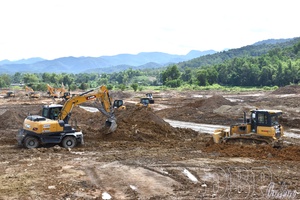
In addition to management, internal canal systems are being dredged and cleared of obstructions to enhance water conduction efficiency. Many localities have mobilized manpower and resources to reinforce temporary dams and install mobile pumping stations to respond immediately when water levels drop too low. Furthermore, dissemination efforts are being intensified to raise public awareness about water conservation, with residents being notified of specific schedules to avoid wasteful, widespread water intake.
The Điện Biên Irrigation Management Co., Ltd., which manages 34 irrigation works including 13 reservoirs, is responsible for supplying water to nearly 5,000 hectares of rice for the 2025 - 2026 Winter-Spring crop. The unit frequently monitors weather developments and reservoir volumes to adjust distribution plans flexibly. For smaller reservoirs with low levels, pumping systems are deployed to lift water from the reservoir bed into the canals. Currently, storage capacity in these reservoirs is being maintained at roughly 60 - 70%, which is sufficient to meet demand during this peak period.
.jpg)
Restructuring the agricultural sector is considered the “key” to reducing the overall pressure on water sources. Localities are carefully reviewing areas at high risk of shortage to proactively switch to alternative crops. In 2025, the province converted 947.68 hectares of rice land to other crops. In 2026, the target is to convert 1,561.35 hectares, including 1,339.45 hectares of upland rice, 128 hectares of single-crop rice, and 93.90 hectares of specialized rice land into annual and perennial crops. Selecting crop varieties that are resistant to drought and cold is also being prioritized to mitigate risks in adverse weather.
In several areas, residents and cooperatives are applying advanced technology to production, particularly Israeli drip irrigation and misting systems that help eliminate water waste. Currently, approximately 350 hectares of vegetables and fruit trees across the province utilize these water-saving systems. A prime example is the Bản Mé High-Tech Agricultural Cooperative, which operates a 3,500 square meter greenhouse using fully automated Israeli drip technology, significantly reducing labor costs and saving water.
Thanks to these synchronized solutions, the water shortage situation is essentially under control. The 2025 - 2026 Winter-Spring crop has seen positive results, with the rice cultivation area reaching 9,778.42 hectares, an increase of over 15 hectares compared to last year. Other crops are also growing well, with Spring-Summer corn reaching 2,496.30 hectares, an increase of over 1,000 hectares, while peanut and soybean areas have also expanded. Ultimately, ensuring water resources requires close coordination between sectors, from cultivation and meteorology to local governments and the people themselves, creating a chain of links that allows the entire system to operate effectively through proactive adaptation.
Thu Phương
.jpg)
.jpg)

.jpg)
.jpg)
.jpg)
.jpg)
.jpg)


.jpg)
You have 500/500 characters left
Please enter 5 or more characters!!!