



Results of the 2021 - 2025 period, especially in 2025, show that the crop conversion trend is entering a new stage, with larger scale, higher economic efficiency, and consistent with the orientation of modern, sustainable agriculture.
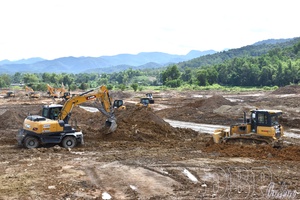
Possessing a natural area of nearly 25,900ha, with extensive land for agricultural production, Mường Pồn commune identifies agricultural restructuring as the central development axis. With the orientation of shifting from small-scale farming to high-value crops, creating stable livelihoods for the people, from 2020 to present, the commune has converted over 50ha of degraded upland fields and inefficient one-crop rice land to planting high-economic value crops, forming distinct production zones by sub-region.
Nguyễn Văn Lương, Chairman of the commune People’s Committee, said that in the long-term industrial crop group, Mường Pồn is maintaining care and exploitation of 993.5ha of rubber, with output estimated at over 1,300 tons of dry latex/year. The commune also newly planted 116.11ha of macadamia, over 820ha of short-term industrial crops, fruit trees, and vegetables, aiming to contribute to diversifying production structure and reducing risks when depending on a single crop.
“A positive signal in the transformation is that the commune does not stop at production but links with the value chain and the market. To date, the locality has attracted 2 investors in the agriculture and forestry sectors; has 2 3-star OCOP products and 2 organically certified products, paving the way for local agricultural products to enter high-standard markets,” Lương said.
.jpg)
Not only in Mường Pồn, over the past 5 years, many localities in the province have actively transformed production models. From production on upland fields and low-efficiency food crops, gradually shifting to crops with higher economic value, suitable for ecological conditions and market demand. Reducing the area of inefficient crops to develop long-term industrial crops shows that production thinking has changed from “quantity-based” to “efficiency-based”.
In the restructuring picture, the long-term industrial crop group shows a prominent role. In 5 years, the whole province newly planted 5,265ha of coffee, raising the total area to 8,133.51ha by 2025; accumulated output reached 23,797.41 tons, reaching 176.21% of the target for the whole period. Macadamia is also considered a new potential crop and has begun to develop strongly in recent years. By 2025, macadamia is planted in 31/45 communes and wards, with a total area reaching 12,360.85ha, initial output reaching 4,961.2 tons. In addition, the province possesses 4,454.97ha of rubber put into exploitation, accounting for 88.77% of the existing area, exploitation output in the 2021 - 2025 period is estimated at 25,901 tons; 4,160ha of fruit trees, of which newly planted area reached 2,046.22ha, output estimated at 115,956 tons in the 2021 - 2025 period.
2025 is the final year of the term, with many challenges and major changes. However, Điện Biên has created many breakthroughs in shaping production and transforming crops towards building green, sustainable agriculture. In 2025 alone, the whole province converted 947.68ha of rice land to other crops, of which 444.77ha was converted to high-value perennial trees. Thereby, planting nearly 3,400ha of coffee, over 2,000ha of macadamia, maintaining production of nearly 632ha of tea, and 4,160ha of fruit trees. Wet rice area increased to nearly 32,000ha (an increase of 1,736.11ha compared to 2020) thanks to investment in irrigation infrastructure and reclamation for expansion.
The smart rice model reducing emissions was deployed on 76.58ha in Mường Thanh ward, Thanh An and Thanh Yên communes. The issuance of 7 new planting area codes and deployment of 5 coffee planting models on a scale of 91ha is the technical basis for Điện Biên agricultural products to participate deeper in the domestic and export market value chains. Along with that, the OCOP program developed strongly, with an increase of 34 recognized products, raising the total number of OCOP products in the province to 138. This is an important driving force to move agricultural products from raw production to branded and traceable goods.
It can be said that crop conversion in Điện Biên is following a modern direction, suitable for natural conditions and market trends. To make the transformation truly sustainable, the province currently continues to call for investors and perfect solution groups: Production - processing - consumption linkage chains to minimize the “good harvest, bad price” scenario; application of science and technology in varieties, water-saving irrigation, agricultural digital transformation; training and supporting farmers towards professional production associated with market standards. Through that, building a commodity, ecological, high-quality agriculture, contributing to raising the level of local agricultural products and promoting sustainable socio-economic development.
Hà Linh
.jpg)
.jpg)
.jpg)
.jpg)
.jpg)
.jpg)
.jpg)
.jpg)
.jpg)
You have 500/500 characters left
Please enter 5 or more characters!!!