



Its borderline of over 455km serves as a gateway connecting Việt Nam with the Greater Mekong Subregion. From Hà Nội, it takes just over 40 minutes by air or 10 hours by road to reach Điện Biên. In the future, the formation of the Sơn La - Điện Biên - Tây Trang border gate expressway will open up vast potential and opportunities for the development of border gate economy, logistics, trade, and cross-border services.
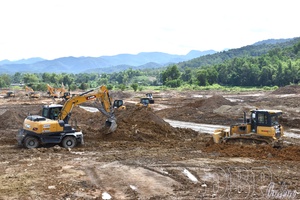
With nearly 954,000 hectares of natural area, ranking 14th in the country, of which over 92% is agricultural land, Điện Biên possesses advantages that few mountainous localities can claim. Notably, the province still has over 43,000 hectares of unused land, which serves as a vital resource for large-scale agricultural projects, high-tech farming, large livestock husbandry, afforestation, and medicinal plant cultivation. The province is home to the Mường Thanh field, the largest in the Northwest, providing a foundation for high-quality commodity production linked with deep processing and specialty rice branding. Furthermore, the mild climate with a large day-night temperature amplitude and a dense system of rivers such as Nậm Rốm, Nậm Mức, and Nậm Ma creates favorable conditions for green and sustainable agriculture.
.jpg)
The combination of a rich natural ecosystem with high mountains, wide valleys, and large reservoirs also gives Điện Biên outstanding potential for renewable energy. According to Việt Nam’s solar radiation map, Điện Biên is among the localities with the highest radiation intensity in the North, at 4.5-4.7kWh/m2/day. The high mountainous terrain and stable winds open up great potential for wind power, while the steep river systems and wide lake beds offer advantages for small and medium hydropower as well as pumped-storage hydropower. Additionally, the diverse ecosystem features unique natural landscapes such as Pá Khoang Lake, the Mường Nhé Nature Reserve, the Mường Phăng primary forest, and the U Va and Hua Pe hot springs, all of which are crucial elements for developing eco-tourism and community experiences.
The expansion and upgrade of Điện Biên Airport to meet Airbus A320 and A321 operational standards, with a capacity of 500,000 passengers per year, has helped bridge the distance between this once-remote locality and Hà Nội and Hồ Chí Minh City, while aiming for international flights. The province now has over 9,200km of roads, and 100% of communes and wards have year-round automobile access. National highways 6, 12, 279, and 4H, alongside the Trans-Asian highway, facilitate convenient connections with Bắc Lào, Southwest China, and Northeast Thái Lan. Digital infrastructure is also keeping pace with trends, with 100% of communes and wards covered by 4G signals and fiber optics, providing a platform for digital transformation and e-commerce.
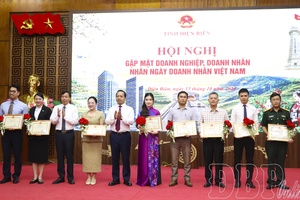
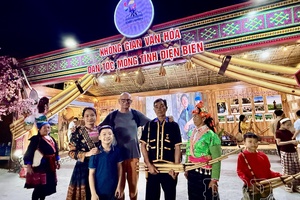
In 2025, the GRDP of Điện Biên was estimated at VND 17,661 billion, an increase of 8.51% over the previous year, with a per capita GRDP of nearly VND 53 million. The economic structure is shifting positively, with the service sector accounting for nearly 60%, industry and construction over 21%, and agriculture, forestry, and fishery at 14.6%. Tourism emerged as a bright spot with over 1.45 million visitors in 2025, generating revenue of nearly VND 2,400 billion. Điện Biên is sending a clear message of a government that accompanies businesses, reflected in its 2024 PCI score of 67.67 points, ranking 32nd out of 63 nationwide. Between 2021 and 2025, the province granted investment certificates to 223 projects with a total registered capital of over VND 48,000 billion. With a large land fund and maturing infrastructure, Điện Biên is an ideal market for medium- and long-term investors in high-tech agriculture, renewable energy, and eco-historical tourism.
Lý Quỳnh

.jpg)
.jpg)
.jpg)
.jpg)
.jpg)
.jpg)

.jpg)
.jpg)
.jpg)
You have 500/500 characters left
Please enter 5 or more characters!!!