



However, alongside the growth in the scale of livestock herds, the volume of wastewater and emissions generated is increasingly expanding, putting significant pressure on the water and air environment, especially in rural areas.
Currently, the entire province records nearly 143,000 buffaloes, over 104,000 cows, nearly 312,000 pigs, and more than 5.1 million poultry. Despite the large number of livestock and poultry herds, farming is primarily conducted on a small, scattered household scale. According to statistics, household farming accounts for approximately 99.6%, while farm-scale farming accounts for only 0.4%, with 306 mixed farms including 288 small-scale farms and 18 medium-scale farms. Regarding livestock farming methods, the semi-scavenging form still makes up 51.4%, free-range farming accounts for 38.8%, and captivity only accounts for 9.8%.
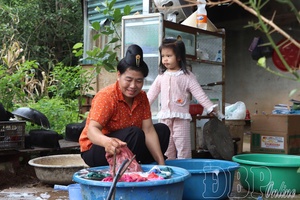
The small-scale, scattered livestock model suits the production conditions of local residents but poses many difficulties in waste management and treatment. Most livestock farming facilities are interspersed within residential areas with small land funds, making them ineligible to construct environmental treatment works. Lò Thị Thương, a resident of Huổi Lực village in Tủa Chùa commune, raises cattle, but due to difficult economic conditions, she has not been able to invest in a waste treatment facility. Wastewater from daily barn cleaning activities is discharged directly into the environment.
.jpg)
According to the Department of Agriculture and Environment, livestock farming activities stand as one of the sources putting the greatest pressure on the water and air environment in rural areas. Livestock waste does not only include feces and urine but also consists of leftover feed, bedding materials, livestock and poultry carcasses, and many pathogenic microorganisms. Currently, only about 40% to 50% of livestock waste is treated, while the remainder is still discharged directly into the environment. This is the reason why the risk of water and air pollution is increasing, while harboring a latent danger of disease spread.
Statistical data show that the volume of wastewater from livestock farming activities increases year by year. In 2021, the total volume of wastewater generated was about 10.38 million m³, but by 2025, it increased to more than 11 million m³. Among these, pig farming generates the largest volume of wastewater, reaching approximately 4.68 million m³ and accounting for more than 42% of the total wastewater of the entire sector. This is followed by poultry with 4.34 million m³, buffaloes with about 1.14 million m³, and cows with about 838,000 m³.
If not treated according to correct workflows, the volume of wastewater will become a heavy burden on the environment. According to analysis, a large content of organic pollutants such as TSS, BOD5, COD, nitrogen, and phosphorus exists in livestock wastewater, along with many types of dangerous microorganisms and pathogens. When entering water sources, these substances degrade water quality, cause a lack of dissolved oxygen, facilitate bacterial growth, and directly affect community health. Especially in deep and remote areas where residents still utilize natural water sources like rivers and streams for daily life, the risk of pollution becomes even more worrying.
Gas emissions from livestock activities such as CH4 and N2O also significantly affect the environment. According to calculations, in 2024, the volume of CH4 gas generated from buffalo, cattle, pig, and poultry farming activities was 7,851.4 tons, 5,763.2 tons, 641.8 tons, and 96.5 tons respectively. Similarly, the volume of N2O gas generated from these livestock groups was 15,631.5 tons for buffaloes, 7,649.4 tons for cows, 7,027.3 tons for pigs, and 5,282.3 tons for poultry. These are all gases with a high intensity of impact, accelerating climate change. Emission components in the livestock process include CO2, CH4, and N2O, along with other gases like H2S and NH3, which are strong odor-causing compounds that directly impact human health.
In recent years, biogas technology has been widely applied by residents to treat livestock waste. This is considered a relatively suitable solution for practical conditions in rural areas because it contributes to reducing environmental pollution while creating a fuel source for daily cooking. However, most biogas works in the locality are still small in scale, with uneven treatment efficiency, while the capacity to thoroughly treat pathogenic bacteria is not high, particularly for pig farming. Therefore, controlling livestock wastewater cannot merely rely on individual households but requires a synchronous, long-term strategy.
First of all, it is necessary to continue accelerating the transition from small-scale farming to concentrated, biosecure livestock production. Re-planning livestock farming areas will facilitate easy investment in centralized waste treatment systems. In parallel, it is essential to replicate production linkage models, which serve as an important foundation to step-by-step raise awareness and standardize farming workflows toward environmental friendliness.
Many large-scale livestock projects are being methodically invested in right from the start. A prime example is the pig farming project in Mường Pồn commune with an area of more than 10.5 ha and a total investment capital of around VND 120 billion. The project is constructed with 16 barns alongside a modern waste treatment system that satisfies environmental and biosecurity standards. When putting into operation, the farm is expected to produce about 8,000 commercial pigs per year. The application of a closed management workflow reflects a positive shifting trend from traditional farming to modern industrial livestock production.
Against the backdrop of the agricultural sector heading toward green development, controlling livestock wastewater and emissions is no longer a separate task of the environmental sector but has become the shared responsibility of authorities, enterprises, and the people. Only when constructing a biosecure livestock system and well controlling emission sources right from the beginning can Điện Biên fundamentally resolve the problem of rural environmental pollution, while establishing a solid foundation for the sustainable development of the livestock industry in the future.
Quốc Huy
.jpg)
.jpg)

.jpg)
.jpg)
.jpg)
.jpg)
.jpg)
.jpg)
You have 500/500 characters left
Please enter 5 or more characters!!!