



This result stems not only from decisive leadership and administration but also from the effective implementation of the “4 timely, 5 proactive” motto, which has shortened capital delays, cleared resource bottlenecks, and created momentum for economic growth.
For 2026, Điện Biên was assigned a public investment plan of over VND 4,275 billion. This includes more than VND 1,983 billion allocated at the start of the year and an additional VND 2,292 billion supplemented in March for the construction of multi-level school projects in border communes. The large total capital and high progress requirements, set against challenging local conditions, created significant pressure. However, through proactive and flexible distribution, the province successfully allocated more than VND 2,280 billion by mid-March 2026.
The implementation of projects using public investment capital has been pushed with a synchronous and decisive spirit. Accumulated disbursement by March 27 reached over VND 666 billion, equivalent to 15.59% of the Prime Minister’s plan and nearly 30% of the provincial plan, reaching 16.24% by the end of the month. Remarkably, according to Ministry of Finance data, by March 19, Điện Biên had disbursed over VND 711 billion, including capital supported by Hanoi for the Si Pa Phìn multi-level school project, reaching 35.88% of the initial plan. This figure surpassed the first-quarter growth scenario by nearly 10% and moved the province to the second spot nationally.
.jpg)
Behind these impressive figures is a systematic management process where the provincial people’s committee identified public investment as a key driver to achieve a GRDP growth target of over 11% in 2026. This was materialized through the “4 timely” approach, which covers capital allocation, payment upon completed volume, troubleshooting land clearance, and shifting funds from slow projects to those with better disbursement potential. Meanwhile, the “5 proactive” measures emphasize detailed planning, completing investment procedures, shortening appraisal times, coordinating land clearance, and conducting field inspections to handle difficulties immediately.
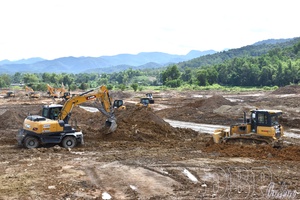
The clear movement on construction sites serves as the most convincing evidence of this strategy. From transport and power grids to national target programs, many projects have accelerated from the planning and land clearance stages to construction and final settlement. Even with the pressure of the special investment mechanism for border schools, which involves simultaneous design, land clearance, and construction, units have exerted great effort. At the site of the Thanh Nưa multi-level school in Thanh Nưa commune, the atmosphere is frantic as teams work in multiple shifts to meet the completion goal, which has been accelerated from August to an expected finish date of May 30.
According to Nguyễn Quốc Quân, deputy director of the provincial management board for civil and industrial projects, his unit is closely monitoring sites and coordinating with local authorities to resolve bottlenecks. By April 6, construction volume at the Thanh Nưa project reached 54%, with 100% of the VND 224.4 billion capital plan allocated. Other projects are also seeing good results, such as the Quảng Lâm school in Quảng Lâm commune, the Thanh Yên school in Thanh Yên commune, and the Sam Mứn school in Sam Mứn commune, which have all reached disbursement or construction milestones between 25% and 52%.
While the first quarter showed significant effort, the province still faces challenges such as fluctuating material prices, labor shortages, and slow land clearance in some areas. The pressure remains high as the province needs to disburse more than VND 3,500 billion in the remainder of the year. To drive this, the provincial people’s committee issued Directive No.2280/CT-UBND, setting disbursement targets of over 50% by the end of Q2, 75% by Q3, 90% by Q4, and a full 100% by January 31, 2027.
The province will continue to tighten discipline and hold heads of agencies accountable by linking disbursement results to official performance evaluations. Departments and localities are tasked with building specific solutions for each project while increasing inspections and replacing ineffective personnel.
Capital management will remain flexible, with monthly and quarterly plans and a requirement for owners to complete payment documents within five days of work completion. By turning disbursement pressure into a development driver, Điện Biên aims to make public investment a solid lever for sustainable growth and regional development.
Quốc Huy

.jpg)
.jpg)
.jpg)
.jpg)
.jpg)

.jpg)
.jpg)
.jpg)
You have 500/500 characters left
Please enter 5 or more characters!!!