



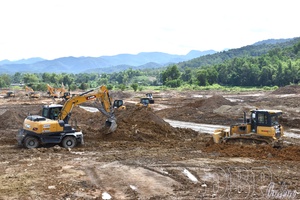
By late April 2026, the housing segments of the Mường Nhà multi-level boarding school project in Mường Nhà commune are gradually taking shape. However, during the construction process, units have encountered many difficulties owing to complex terrain with large rocks, high embankments, and potential landslide risks, while the shortage of workers has directly impacted the schedule.
.jpg)
At present, the construction site employs approximately 250 workers, yet this only meets about 80% to 85% of the required workload. In the coming period, as the project enters its peak phase, the volume of work will increase, and the demand for manpower is expected to rise to between 400 and 450 people, putting immense pressure on the contractor. Võ Thúc Chính, Director of Tuấn Thành private construction enterprise, one of the units executing the project, noted that his unit is maximizing every possible avenue to mobilize labor, from signing contracts with out-of-province suppliers to recruiting local resources. He pointed out that domestic provincial labor is currently very scarce, especially highly skilled workers. While local laborers make up about 90% of the workforce on-site, they are primarily unskilled, leaving a gap in positions that require specialized expertise.
To overcome these obstacles, contractors are forced to consider mobilizing more laborers from outside the province. If these resources are not secured, the project will fall behind, particularly during harvest seasons when local workers often take leaves of absence for 10 to 15 days. This creates significant disruptions in construction, requiring contractors to coordinate personnel flexibly. To stay on track, construction units at the Mường Nhà school have implemented night shifts and worked through weekends to accelerate progress, though businesses must carefully calculate these shifts to ensure safety and quality. Certain tasks can be performed at night, but workers cannot work continuously without rest to maintain their health.
.jpg)
At the Westernmost point of the nation, the Sín Thầu multi-level school project in Sín Thầu commune is expected to provide better learning opportunities for students in this border region. Yet, during the construction process, the units involved are also facing a manpower vacuum. A representative from Hải Đăng construction and consultancy joint stock company stated that the total number of workers across contractors currently stands at over 200, while the actual demand is for 350 to meet the project’s needs. Local labor is limited, and attracting workers from elsewhere is difficult as many prefer moving to lowland provinces for more attractive incomes, which complicates the construction process significantly.
Currently, 15 projects for multi-level boarding schools are being simultaneously deployed in border communes across the province. With a massive workload spread over many areas and urgent deadlines, the shortage of skilled labor is a direct threat to construction timelines. According to a report from April 2026, only the Si Pa Phìn multi-level school project is essentially complete. Meanwhile, nine projects started in 2025 have reached only 38% to 57% of their volume, and five projects initiated in 2026 are still finalizing investment procedures. The scarcity of labor is a persistent problem as local resources are limited in number and mostly unskilled, failing to meet increasingly high technical requirements.
.jpg)
Attracting labor from outside the province remains difficult due to lacking living conditions, remote geography, and high travel costs. The seasonal nature of local labor also means the workforce is unstable, often interrupted when residents return to agricultural production. To prevent these factors from stalling progress, the provincial department of education and training has requested that contractors focus their maximum resources, specifically by adding skilled workers and increasing the use of machinery. Units are reviewing the overall progress of each project and contract to identify key items and critical paths for adjustment. Any lagging segments must have their causes clarified to immediately supplement resources and organize extra shifts.
Contractors are also required to strictly adhere to contract schedules while strengthening quality management, labor safety, and environmental sanitation. Coordination between investors, supervision consultants, and local authorities must be stepped up to promptly resolve arising difficulties and minimize downtime.
Although the labor scarcity for multi-level school construction is a major challenge, the proactive stance of contractors and the close direction of functional agencies suggest that these projects will strive to reach the finish line on schedule, opening better educational prospects for students in border areas.
Phạm Quang


.jpg)
.jpg)

.jpg)
.jpg)
.jpg)


.jpg)
.jpg)


.jpg)

You have 500/500 characters left
Please enter 5 or more characters!!!