



In Điện Biên province, many enterprises, cooperatives, and business households have boldly invested in machinery and innovated processing procedures to enhance product value and meet market demands, contributing to building a sustainable local agricultural brand.
Beyond the goal of increasing output, technological application opens up opportunities to shift the production mindset from prioritizing quantity to focusing on quality, thereby enhancing the competitiveness of the locality’s signature agricultural and food products. For a product to firmly stand in the market, the deciding factor lies not only in the raw materials but also in the processing, preservation, and quality control procedures. From cleaning, sorting, and preliminary processing to drying, fermenting, packaging, and cold storage, everything requires precision and synchronization to ensure food hygiene and safety, retain nutritional value, and extend shelf life.
Previously, many production facilities in the province primarily relied on manual processing, but introducing machinery into production is now becoming a clear trend. Điện Biên holds many advantages in developing signature agricultural products such as coffee, macadamia, dried buffalo meat, cordyceps, Shan Tuyết tea, and products processed from purple sticky corn. In recent years, alongside the orientation of restructuring agriculture towards a commercial, smart, and sustainable direction, the province has encouraged enterprises and cooperatives to proactively invest in applying scientific and technical advancements throughout the entire production chain. Many production facilities have boldly invested in integrated processing lines, linking stages from preliminary processing to packaging within a closed procedure. As a result, product quality is uniformly controlled, manual labor is reduced, and market competitiveness is improved.

The clearest effectiveness is demonstrated through the province’s OCOP products. By the end of December 2025, the entire province had 157 OCOP products, among which five achieved 4-star OCOP certification, including Hồng Kỳ International Coffee HK13, Arabica Espresso, Hà Chung coffee, organic PH.14 Shan Tuyết tea, and Phan Nhất organic green tea. This is the result of technological investment and production process standardization, contributing to elevating the quality and brand of Điện Biên agricultural products.
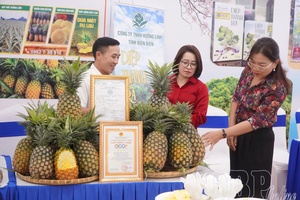
In Tuần Giáo, the 3-star OCOP crispy dried macadamia kernels of the Thoa Doãn macadamia processing facility are entirely produced using specialized machinery systems such as dryers, nut sorters, shellers, and vacuum sealers. Several products, including crispy seasoned pork fat, crispy seasoned pork skin, and chewy dried pineapple, are also processed by machinery instead of previous manual methods. Controlling the temperature, drying time, and periodic machinery hygiene procedures helps the products retain a stable flavor, ensure food safety, and extend preservation time. Along with investing in machinery, production and processing facilities focus on improving packaging, labeling, and branding to enhance their products’ competitiveness in the market. Consequently, these products are not only consumed stably within the province but are also known by many out-of-province customers.
The application of technology is creating a major shift for high-value products. Loan Nhẹ Trading and Service Company Limited is one of the first units in Điện Biên to successfully cultivate and produce cordyceps. Currently, the company has two 3-star OCOP products: dried cordyceps and cordyceps wine. The cordyceps are cultivated entirely according to a natural mechanism using chít worms, red rice, and coconut water. After about 135 days of cultivation, they are harvested and put into the drying process. To improve product quality, the company has invested in a Korean technology drying system. Modern drying technology distributes heat evenly and stably, thereby retaining the strand shape, crispness, and signature light aroma of the product. If stored properly, the product can maintain its crispness for up to two years while ensuring quality. Particularly, the club-shaped head of the cordyceps is kept intact, resulting in a higher nutrient content.
Nguyễn Văn Nhẹ, Director of the company, stated that thanks to the application of advanced drying technology and strict production procedures, the company’s dried cordyceps product now holds high economic value, reaching about VND 120 million/kg, and is positively received by the consumer market. In the coming time, the enterprise will continue to research and develop new products such as cordyceps tea bags and cordyceps facial masks for skincare to expand its consumption market.
Right from its establishment, the Tiến Đạt Cooperative in C17 village, Mường Thanh ward, synchronously invested in various equipment such as dryers, spice mixers, heat sealers, and smart packaging machines. According to Cà Thị Hoa, a cooperative member, applying technology throughout the production process helps the cooperative’s purple sticky corn products retain their signature color and flavor while extending their preservation time. Currently, the cooperative offers five main products: honey-flavored, cheese-flavored, fish sauce-flavored, spicy fish sauce-flavored, and original purple sticky corn. Introducing machinery into production not only helps improve product quality but also significantly reduces labor costs, enhances production efficiency, and creates conditions for expanding the consumption scale.
Applying science and technology in processing is creating an important driving force for the Điện Biên agricultural sector to shift from small-scale production to a professional commercial orientation. Previously, many products were only consumed locally, but now they have gradually expanded to markets outside the province. The processing industry is identified as an important stage in the agricultural value chain, contributing to increasing product value, reducing the pressure of consuming raw materials, and increasing income for the people. Developing modern processing lines not only helps extend the preservation time of agricultural products but also creates many new products, meeting the diverse demands of the market.
However, for the agricultural processing industry to develop sustainably, besides the proactiveness of enterprises, cooperatives, and business households, there is a great need for companionship from the State through policies supporting technology access, investment capital, trade promotion, and brand building. Shifting from quantity-based production to focusing on quality is identified as the key to creating additional added value, increasing product competitiveness in the market, and contributing to building consumer trust in Điện Biên agricultural products.
An Biên









You have 500/500 characters left
Please enter 5 or more characters!!!