



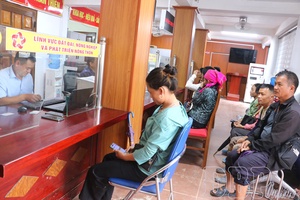
In the early days of May, the Public Administrative Service Center of Chiềng Sinh commune was already crowded with residents arriving in the morning to complete procedures related to civil status and land administration. Work was carried out smoothly, systematically, and orderly. At the “One-stop service” counter, officials guided residents, checked documents, and received applications through computerized systems; each file took only a few minutes to complete the reception process.
Lò Văn Tỉnh, a resident of Nà Sáy 1 village in Chiềng Sinh commune, shared: “Administrative procedures are now much more convenient. I submitted my application online through my VNeID account and no longer have to carry as many documents as before. I can even track the processing status on my phone from home. The officials are very supportive, and I’m very satisfied.”
This is one of the clearest changes after nearly a year of implementing the new model. The operation of commune level Public Administrative Service Centers has created a major shift in the handling of administrative procedures. Processes have been standardized, made public, and more transparent, while the resolution time for many procedures has been shortened. The application of information technology and digital transformation in receiving and processing applications has gradually been strengthened, helping reduce costs and travel time for citizens.
.jpg)
Lò Thị Mai, an official at the Chiềng Sinh commune Public Administrative Service Center, said: “The workload has increased significantly because many responsibilities have been transferred from higher levels to the commune. However, processing procedures are now faster, and most administrative matters can be resolved directly at the commune level without intermediaries, saving time for residents. We are also more proactive in handling work.”
The standardization of procedures, greater transparency, and the application of information technology have contributed to improving management and administration efficiency. Đỗ Văn Sơn, Chairman of the People’s Committee of Chiềng Sinh commune, commented: “After nearly one year of implementing the two-tier local government model, the commune government’s management approach has become more proactive and closer to the grassroots level. Clear decentralization and delegation of authority have shortened work processes; many procedures are now resolved directly at the commune level, reducing both time and costs for residents.”
Alongside these positive results, the implementation process at the grassroots level has also revealed several difficulties. The workload continues to increase while the qualifications of officials and civil servants remain uneven. Many positions require staff to take on multiple roles or work outside their field of expertise. Notably, the commune still lacks specialized information technology personnel, affecting digital transformation efforts. Infrastructure and equipment for digital transformation are also insufficient and not yet synchronized.
Province wide, the implementation of the two-tier local government model has produced notable results. Following the restructuring process, the number of specialized agencies under the provincial People’s Committee has been reduced to 14, a decrease of five agencies (26.3%). Internal organizational structures have continued to be reviewed and streamlined to better fit practical needs. The province now has 75 divisions, nine sub-departments and equivalent units, and 92 public service units, a reduction of 42 divisions compared to before.
In the field of administrative procedure settlement, from July 1, 2025 to mid-March 2026, the rate of on-time and early resolution remained very high: 99.9% at the provincial level and 99.7% at the commune level. Online applications increased sharply, with commune-level authorities alone receiving 88,776 online applications. The implementation of administrative procedures regardless of administrative boundaries, with 2,096 eligible procedures (over 98%), has created favorable conditions for citizens and businesses to submit applications from anywhere.
After nearly one year of implementation, the two-tier local government model has achieved many positive results. The administrative apparatus has gradually been consolidated and is operating relatively stably. Decentralization and delegation of authority have been carried out in accordance with regulations, helping enhance the proactiveness of local authorities. Some procedures have seen shorter processing times, benefiting both citizens and businesses. State management in areas such as finance, land, and planning has remained stable without disruption.
However, several challenges remain. Guidance documents have not always been issued promptly or consistently. In the healthcare sector alone, there are 11 administrative procedures proposed for decentralization by the Ministry of Health, while the agriculture and environment sector has two pending procedures. Decentralization has not yet been fully linked with resource allocation. Information technology infrastructure remains limited, working conditions for commune level officials are still inadequate, and the capacity of officials remains uneven.
To ensure the model operates sustainably and effectively, Điện Biên province will continue reviewing and reorganizing commune level officials and civil servants in a streamlined and efficient manner. The province also plans to strengthen professional training and digital skills while investing more heavily in information technology infrastructure for communes. At the same time, it has proposed that central ministries and agencies promptly issue synchronized guidance documents, particularly in the fields of land management and finance.
One year is not a long period of time, yet the initial results show that the two-tier local government model is moving in the right direction, becoming increasingly closer to the people, more responsive to their needs, and more effective in serving them.
Anh Nguyễn

.jpg)
.jpg)
.jpg)

.jpg)
.jpg)
.jpg)
.jpg)

.jpg)
.jpg)
.jpg)
You have 500/500 characters left
Please enter 5 or more characters!!!