Warm houses of gratitude

ĐBP - As spring arrives in Điện Biên, it weaves through each highland village, bringing warmth from the houses of gratitude completed just before the new year. These solid houses not only help the poor settle down and stay firm against rain and sun but also ignite faith, community cohesion, and deep affection.

The new home of the family of Lò Văn Sơn, a poor household in Huổi Púng village within Thanh An commune, is filled with laughter these days. The house is solidly built with a cold galvanized iron roof and bright floor tiles, vastly different from the previous temporary wooden hut where the whole family lived in fear every rainy season. Lò Văn Sơn shared that for many years, as his family was poor and his wife and he relied on unstable farming income to raise three children, building a sturdy house was a distant dream. In 2025, with VND 50 million in support from the provincial Vietnam Fatherland Front, the family was able to build a spacious new home. “Having a new house makes this Tết very warm. No more worrying about leaks or wind, and the children have a proper place to study,” Lò Văn Sơn said emotionally.

In thôn Tả Sìn Thàng village of Sín Chải commune, Tín Lao Hán is still surprised to welcome Tết in a spacious new house for the first time. Having been poor for years and suffering from illness himself, the burden fell on his mute son, and life for the father and son was extremely difficult. In March 2025, the provincial Vietnam Fatherland Front decided to support them with VND 60 million from socialized sources to help the family build a home. Together with local contributions, the new house of over 40 square meters, valued at nearly VND 70 million, was completed, providing a stable residence and new hope for the two of them during the spring days.

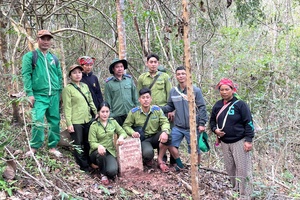
Functional forces of Tủa Thàng commune help residents build great unity houses.

Sharing his feelings in the house that still smells of mortar, Tín Lao Hán spoke slowly with a trembling voice. He recalled times when he thought he could not carry on due to illness and his son’s disadvantage, relying only on the support of the villagers. “I never thought I would live in such a solid and steady house. Thanks to the Party, the State, the Front, and everyone’s help, my son and I have a place to shield us from the rain and sun. This Tết is truly heart-warming,” Tín Lao Hán expressed with eyes full of gratitude.

To stabilize housing for the people, localities in the province have synchronously implemented many solutions, from mobilizing resources to calling for public contributions and promoting the movement to build houses for poor and disadvantaged households. For instance, Tủa Thàng commune effectively mobilized the people’s strength and became one of the first localities to complete the elimination of temporary and dilapidated houses. In the final days of the year, 64 new houses in Tủa Thàng commune were handed over to the people, including 51 new constructions and 13 repairs, with a total cost of over VND 3.4 billion. The state budget supported VND 3.24 billion, while the rest was contributed by the people and socialized sources. According to the Chairman of the Vietnam Fatherland Front of Tủa Thàng commune, Tẩn A Dén, the early completion helps households welcome Tết in warm, solid homes and strengthens the people’s confidence in the Party and State’s policies. “Seeing the people move into new houses just as spring arrives makes everyone feel warm at heart. It is the motivation for the political system to continue accompanying the people on the journey of sustainable poverty reduction,” Tẩn A Dén shared.

The houses of the families of Lò Văn Sơn and Tín Lao Hán are just two of thousands built through support programs in the province. Over the years, housing support for poor and policy households has been identified as a key task in the sustainable poverty reduction program. With the state budget and the contributions of all levels, sectors, the armed forces, businesses, and benefactors, many households have gained stable residences. Many families, after settling down, have boldly borrowed capital to expand production and livestock. For example, Sùng A Vừ in Mường Nhé commune spent many years in a temporary hut with an unstable life. Since receiving support for a solid house, his family felt secure enough to plan for the long term. With a stable residence, he borrowed preferential capital to invest in buffalo and cattle combined with corn and cassava farming. Thanks to hard work and planning, his family’s economy has flourished, his income is more stable, and he can afford his children’s education.

Since 2020, Điện Biên province has mobilized resources and integrated policies and socialized sources to complete support for over 22,300 poor, near-poor, and policy households. These houses of gratitude also contribute to consolidating the people’s confidence in the Party and State’s policies. For Điện Biên, a province with many difficulties and high poverty rates, eliminating temporary houses is not just an economic problem but also one of social welfare. Each completed house is a support point for poor households to stabilize their lives and stay attached to their homeland, especially in the border areas. These solid roofs at the frontier of the Fatherland also contribute to maintaining the all-people national defense and people’s security posture from the grassroots level.

This spring, on the mountain slopes, peach and plum blossoms bloom beside the new houses. The sound of children chirping and the smell of kitchen smoke create a warm and peaceful spring picture. In this shared joy, those working in poverty reduction and the local officials, soldiers, and youth union members who directly helped build the houses also feel the value of their specific and practical deeds. The warm houses of gratitude in Điện Biên are not only the result of programs and projects but also a vivid symbol of solidarity and sharing. As spring knocks on the door of every village, faith is nurtured in every home. This is the foundation for Điện Biên to continue the journey of sustainable poverty reduction and building a more prosperous and happy life for the people.

Thành Đạt
Comment

You have 500/500 characters left

Please enter 5 or more characters!!!

Recent news

  • 'Prime Minister Lê Minh Hưng works in Điện Biên

    Prime Minister Lê Minh Hưng works in Điện Biên

    NEWS - POLITICS -
    ĐBP - As part of his working program in Điện Biên, on the morning of July 25, Prime Minister Lê Minh Hưng held a working session with the Standing Board of the Điện Biên provincial Party Committee regarding the execution of socio-economic development, national defense, security, and foreign affairs tasks in the first six months of the year, alongside upcoming tasks and solutions.
  • 'Kindling hope

    Kindling hope

    NEWS - POLITICS -
    ĐBP - Across the S-shaped strip of land, quietly standing in martyrs’ cemeteries are rows of white gravestones bearing the words “Martyr’s grave with unidentified information.”
  • 'Bridging businesses and job seekers

    Bridging businesses and job seekers

    SOCIAL AFFAIRS -
    ĐBP - With an abundant labor force and growing recruitment demand, connecting businesses with job seekers has become a key solution to employment generation in Điện Biên. Through the collaboration of enterprises and the provincial employment service system, many local workers have secured stable jobs, contributing to more effective labor market matching and the sustainable development of the local workforce.
  • 'Listening to people, resolving people’s affairs

    Listening to people, resolving people’s affairs

    SOCIAL AFFAIRS -
    ĐBP - Identifying dialogue, citizen reception, and the resolution of complaints and denouncements as crucial, regular duties, Điện Biên province has focused on elevating the responsibility of heads of organizations, stepping up dialogue, proactively grasping situations, and settling matters right from the grassroots level.
  • 'Accelerating implementation of social housing projects

    Accelerating implementation of social housing projects

    ECONOMY -
    ĐBP - Social housing development contributes to resolving housing demands for low-income earners, public servants, employees, and workers - while generating momentum to promote urban development, attract investment, and guarantee social welfare.
  • 'Restoring names, reuniting families

    Restoring names, reuniting families

    SOCIAL AFFAIRS -
    ĐBP - Although the war ended decades ago, countless families of fallen soldiers continue to wait quietly for the day their loved ones are found, identified by name, and brought home. From faded photographs and aging death notices to memories preserved across generations, that hope has never faded.
  • 'Preserving green of forests

    Preserving green of forests

    ECONOMY -
    ĐBP - Bordering areas with vast territories, rugged terrain, obstructed transportation, and impacts from agricultural production constantly pose latent risks of forest resource encroachment. Facing these demands, the forest protection forces of Điện Biên and Lai Châu provinces have intensified coordination in forest management, protection, and fire prevention and fighting (FPFF) - contributing to maintaining forested areas and limiting forestry law violations.
  • 'Family support on path to rehabilitation

    Family support on path to rehabilitation

    SOCIAL AFFAIRS -
    ĐBP - In prisoner education and rehabilitation work, the family always serves as a vital spiritual support, helping convicts recognize their mistakes and strive to amend themselves to reintegrate into society early.
  • 'Introducing new crops into production

    Introducing new crops into production

    ECONOMY -
    ĐBP - Expanding coffee and macadamia regions, pineapple fields developing toward commercial production, and experimental models of new crop varieties are painting fresh colors across Điện Biên’s agricultural landscape. The province focuses on developing strategic crops and bringing high-economic-value crop varieties into production - contributing to elevating land use efficiency and creating sustainable livelihoods for the public.
  • 'Driving green transition: Electric vehicles on rise in Điện Biên

    Driving green transition: Electric vehicles on rise in Điện Biên

    ECONOMY -
    ĐBP - Along with the growing transition toward green energy, the use of electric vehicles in Điện Biên is increasing steadily. From electric motorcycles and cars for daily travel to electric taxis for passenger transport, eco-friendly vehicles are becoming increasingly common on local roads, helping reduce emissions, lower operating costs, and gradually foster environmentally friendly transportation habits.
  • 'Expectations from specific policies for agricultural development

    Expectations from specific policies for agricultural development

    ECONOMY -
    ĐBP - Facing requirements for agricultural restructuring toward modernity, the Điện Biên provincial People’s Council passed a Resolution at its 4th session stipulating support policies for sector restructuring toward concentrated, green, smart, and sustainable commercial production.
  • 'Supporting youth union members in economic development

    Supporting youth union members in economic development

    SOCIAL AFFAIRS -
    ĐBP - Over recent years, Youth Union executive bodies across Điện Biên province have consistently accompanied youth union members by supporting preferential credit loans, transferring scientific and technical advances, providing career orientation and job placement services, and building economic models suited to each locality’s conditions. Through practical support policies, many youth union members have boldly started businesses and enriched themselves right on their home soil.
  • 'Removing barriers from backward customs

    Removing barriers from backward customs

    SOCIAL AFFAIRS -
    ĐBP - In several highland areas of Điện Biên province, backward customs persisting through generations continue to leave numerous consequences. Ranging from home births without healthcare worker assistance and sick children not being taken to medical facilities in time, to child marriage and consanguineous marriage, these backward customs directly affect health, population quality, and stand as barriers to the sustainable development of ethnic minority areas.