



This transition focuses on increasing value-added products, linking production with scientific management, and securing sustainable consumer markets.
In recent years, high-tech agricultural applications within the province have manifested in modern production models. Systems using greenhouses and net houses combined with drip irrigation and automated misting have been adopted to enhance productivity and quality, save production costs, and adapt to climate change.
The agricultural model of the Si Pa Phìn High-tech Agricultural Cooperative is a primary example. Here, vegetables are grown under safe standard processes that minimize chemical fertilizers and pesticides through strict monitoring of the cultivation environment and the application of advanced technical measures. Consequently, many products are sold stably through supermarkets, clean produce stores, and linked distribution channels.
.jpeg)
The Điện Biên Import Export Trading Joint Stock Company is also developing a farm model for vegetables and fruits, such as pears, oranges, pomelos, and seasonal greens, across more than 5 hectares. To meet increasingly strict market demands, the business has invested in drip irrigation, net houses, organic fertilizers, and biological pest control. Nguyễn Phú Đỏ, Director of the company, stated that high-tech and organic development is an inevitable trend that allows businesses to control production processes, improve quality, and reduce input costs while ensuring environmental safety.
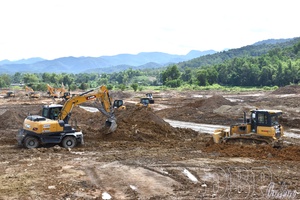
Although there have been positive shifts, high-tech agricultural models in the province are not yet numerous. Science and technology applications are mostly concentrated in small-scale demonstration and testing models. Current efforts include safe vegetable production in net houses, approximately 5 hectares of organic production, 13 hectares with VietGAP certification, and two closed-farm livestock facilities. Recognizing the potential, the province is actively attracting strategic investors. Mavin Group, one of the top ten foreign agricultural investors in Việt Nam, recently surveyed Chiềng Sinh and Búng Lao communes. Their project, planned for 209 hectares, focuses on biosecurity, raw material zones, and closed-loop supply chains to increase local income.
Furthermore, the Tuần Giáo High-tech Livestock and Agriculture Company is implementing a 50-hectare project in bản Củ village within Tuần Giáo commune, with an expected investment of VND 300 billion. The project aims for concentrated livestock farming and high-tech applications linked to sustainable, eco-friendly agriculture. Once operational, it is expected to create stable jobs for approximately 200 local workers, contributing to local socio-economic development.
Improving quality and competitiveness while protecting the environment and creating sustainable livelihoods remains the primary direction for Điện Biên agriculture. Resolution No.11-NQ/TU, issued on December 31, 2025, by the Executive Board of the provincial Party Committee regarding agricultural restructuring for the 2026-2030 period, clearly defines these goals.
According to Lê Xuân Cảnh, Director of the Department of Agriculture and Environment, the core task is to promote science and technology, complete agricultural databases, and strengthen digital transformation for traceability and market connection. At the same time, the sector will focus on removing bottlenecks related to land and infrastructure to improve land use efficiency and product value.
Quang Long
.jpg)
.jpg)
.jpg)
.jpg)
.jpg)
.jpg)
.jpg)
.jpg)
.jpg)
You have 500/500 characters left
Please enter 5 or more characters!!!