



In recent years, alongside the restructuring of the agricultural sector, a number of concentrated production areas have gradually taken shape, laying the groundwork for increasing the value of agricultural products. However, this potential has yet to be fully harnessed. For agriculture to truly become a driver of economic growth, the most important task now is to remove the “bottlenecks” that are hindering the transition from small-scale production to large-scale commercial farming.
.jpg)
Resolution No.11-NQ/TU of the provincial Party Committee on developing agriculture and forestry in conjunction with processing industries for the 2025-2030 period, with a vision to 2050, has set out a clear direction for the agricultural sector. By 2030, the province aims to establish approximately 70,000ha of concentrated commercial production areas, including 40,000ha of macadamia, more than 20,000ha of coffee, 3,000ha of fruit trees and 6,500ha of vegetables and other crops. At the same time, it aims for 25% of communes to develop concentrated commercial production areas of at least 2,000ha each, making Điện Biên the province with the largest macadamia-growing area in the country and the second-largest Arabica coffee-growing area. This is an ambitious goal that reflects the province’s strategic vision and aspiration to raise the profile of its agricultural sector.
In reality, Điện Biên already has an important foundation for achieving these targets. The province currently has approximately 10,860ha of coffee, nearly 13,860ha of macadamia, more than 27,600ha of rice and over 1,100ha of pineapples. Key production areas continue to expand. This provides favorable conditions for developing processing industries, building agricultural brands and increasing the added value of local farm products.
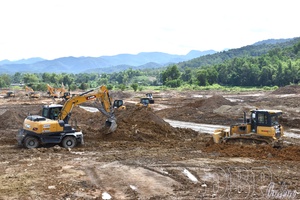
However, there remains a considerable gap between potential and actual results. The first “bottleneck” is the small and fragmented scale of production. Many production areas are not yet large enough to provide processing businesses with a stable supply of raw materials. Land consolidation remains slow, resulting in high production costs and making it difficult to apply mechanization and advanced technologies.
.jpg)
Another constraint is that linkages among farmers, cooperatives and businesses are not yet truly sustainable. In many areas, production is still driven by short-lived trends, with few long-term purchase contracts and insufficient integration between production and market demand. When agricultural prices fluctuate, both farmers and businesses face difficulties. As a result, the added value generated remains below the province’s potential.
In addition, businesses and cooperatives still have limited capacity. Processing industries have not developed in line with the scale of raw-material production areas. Post-harvest storage and preliminary processing facilities remain inadequate, increasing losses and reducing product quality. The application of science and technology and digital transformation in managing growing areas, tracing product origins and forecasting market trends is still fragmented. All of these factors undermine the competitiveness of Điện Biên’s agricultural products.
To achieve the targets set out in Resolution No.11, these “bottlenecks” must first be removed. The priority is to make a decisive shift from small-scale production to concentrated commercial farming. The development of large-scale raw-material production areas must be closely linked to businesses and market demand, rather than being driven by the capacity of individual farming households. Only by establishing strong linkages across the entire chain, from production to processing and distribution, can agricultural products secure stable markets and generate greater value.
.jpg)
At the same time, a favorable environment should be created to attract businesses to invest in agriculture. Priority should be given to developing coffee and macadamia processing plants, promoting large-scale livestock farming, and improving post-harvest storage and preliminary processing systems. As processing industries expand, agricultural products will no longer be limited to raw materials but can generate greater value through deeper processing, meeting the requirements of both domestic and export markets.
Another important task is to accelerate the application of science and technology and digital transformation. Developing databases on growing areas, land and production volumes will make planning, management and investment attraction more effective. At the same time, digital technologies for traceability, quality management and market connectivity will help improve transparency and enhance the competitiveness of Điện Biên’s agricultural products.
Resolution No.11 has opened up a new development path for Điện Biên’s agriculture. The road ahead remains challenging, but if bottlenecks related to production scale, value-chain linkages, processing industries and digital transformation are addressed decisively and in a coordinated manner, the province’s advantages can be turned into tangible value, helping farmers build greater prosperity from the land of their homeland.
Tùng Lĩnh
.jpg)
.jpg)

.jpg)
.jpg)
.jpg)
.jpg)
.jpg)
.jpg)
You have 500/500 characters left
Please enter 5 or more characters!!!