



From coffee slopes in his homeland, he brings that experience to multiple localities across the province, attentively guiding villagers step by step in building and developing cultivation areas, becoming a trusted companion to numerous coffee-farming households.
.jpg)
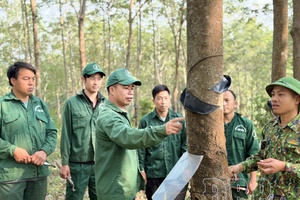
Amidst the lush green nursery, holding each seed seedling bag in his hands, Sùng A Dia inspects soil moisture, root systems, and growth vigor before showing local residents how to recognize a robust seedling. Moving to the field planting stage, he notes the appropriate planting times and necessary tasks during the initial days. For anyone who does not yet understand, he explains again; if an operation is incorrect, he demonstrates further, and then lets learners execute it themselves. Through this hands-on, on-the-job approach, techniques that seem simple yet determine a tree’s growth capacity are taught directly by Sùng A Dia during each implementation stage.
Sùng A Dia’s classroom has neither desks nor chairs, nor does it follow a fixed schedule. Some sessions take place inside the nursery, while others open right on the hillside slopes. Teaching aids comprise seeds, seedling bags, hoes, shovels, and actively growing coffee trees. Following each task, residents practice directly so he can inspect and make adjustments on the spot.
Sùng A Dia’s teaching journeys began when the former Tuần Giáo district implemented its coffee development plan. Alongside specialized cadres, he traveled to Tỏa Tình, Ta Ma, Phình Sáng, Pú Nhung, Pú Xi, Tênh Phông, and Mường Khong communes to share experiences on seed preparation, planting, and tending. Subsequently, he continued sharing practical knowledge across many areas in the province that were expanding cultivation zones.
Because each place has differing soil conditions, climates, and farming customs, Sùng A Dia does not apply a single rigid formula. Before starting instruction, he surveys the planting zone, examining soil quality, water sources, slope angles, and tree growth status to select an appropriate method.
.jpg)
Understanding the language and production practices of ethnic communities, Sùng A Dia communicates technical guidelines in an accessible, relatable manner. Requirements for coffee cultivation and care are conveyed using easy-to-remember phrasing; for those not yet fluent in the national standard language, he uses local indigenous dialects to discuss and instruct. Thanks to this, villagers readily access and practice the guided techniques.
Transitioning from familiar annual crops to perennial trees leaves many households hesitant because it requires labor investment and supplies, along with waiting years to achieve stable harvests. Therefore, Sùng A Dia both demonstrates and provides concrete explanations for each stage, clearly indicating the causes of stunted growth, yellowing leaves, or tree death following field planting. Well-growing coffee slopes also give residents further grounds to trust and continue caring for the crop.
Nguyễn Hữu Đại, Chairman of the People’s Committee of Mường Chà commune, noted that coffee is a new crop for many households, so alongside seed sources, villagers greatly need technical guidance. Sùng A Dia possesses practical experience and directly demonstrates each stage, making it easy for residents to understand and execute. This companionship helps the locality take greater initiative in preparing seedlings, while consolidating public trust during crop restructuring.
Jokingly called the “coffee teacher,” Sùng A Dia merely considers himself a forerunner who shares whatever he knows. According to him, even with good varieties, if growers do not master techniques, achieving efficiency is difficult. To form a stable raw material area, each household must understand the tree’s characteristics, tend it according to proper protocols, and monitor the crop closely across every season.
The experience Sùng A Dia brings to cultivation areas was accumulated directly from his family’s coffee slopes atop Pha Đin Pass. The story began with his father’s generation and continued when he officially took charge of the plantation in 2015. At that time, fresh coffee cherry prices plummeted to only about VND 5,000 per kg, while harvesting costs already ran from VND 2,000 to VND 3,000 per kg. Earnings that failed to match labor caused many households to grow discouraged, with some intending to abandon their orchards.
Instead of abandoning the crop, Sùng A Dia sought ways to preserve the planted coffee acreage. He personally stepped forward to purchase cherries from local residents and transported them to Sơn La for sale; simultaneously, he visited each orchard to guide villagers on pruning, fertilizing, and caring for trees to maintain yields for subsequent seasons. That decision did not always meet with consensus, as low coffee prices made many households wary of continued investment. Through market monitoring and his family’s production realities, Sùng A Dia understood that prices may fluctuate from time to time, but a neglected plantation takes years to recover. Therefore, preserving trees during difficult periods also meant safeguarding livelihood opportunities for the people.
.jpg)
The more he attached himself to coffee trees, the more Sùng A Dia recognized the limitations of fragmented, individual production. Each family selected seeds, raised saplings, and tended trees based purely on experience, leading to uneven crop quality. Harvesting green cherries mixed with ripe ones also affected raw material quality and selling prices. To elevate product value, growers needed linkages from varieties and techniques to purchasing and preliminary processing. From that reality, in January 2024, the Pha Đin Coffee Cooperative was established with 7 members, with Sùng A Dia serving as legal representative. From an off-take point based on personal reputation, the cooperative progressively expanded operations, supplying seedlings, providing technical guidance, underwriting raw materials, and handling preliminary coffee processing for local residents.
As a member of the Pha Đin Coffee Cooperative, Vừ A Thái in Hua Sa village has repeatedly joined Sùng A Dia in selecting seed cherries, disseminating saplings, and providing technical guidance to residents. Vừ A Thái enthusiastically shared that Sùng A Dia possesses abundant experience and gives very concrete instructions, from selecting cherries for dissemination to caring for trees after field planting. Thanks to his guidance, cooperative members and villagers know how to tend trees properly and feel assured developing household economies from coffee.
In November 2025, the Department of Agriculture and Environment of Điện Biên province recognized 40,200 Catimor Arabica coffee trees across 5 orchards in Hua Sa A, Hua Sa B, and Chế Á villages as elite mother trees, spanning a total area of more than 11.48ha. The Pha Đin Coffee Cooperative served as the registered applicant organization. This serves as the foundation for the cooperative to supply seed sources serving the province’s coffee expansion, offering residents reliable selections rather than saving seed on their own or buying saplings of unknown origin.
Right in its first year of operation, the Pha Đin Coffee Cooperative selected and handed over more than 3.3 tons of seeds to specialized agencies. Following trucks carrying seeds departing Hua Sa, Sùng A Dia continued traveling to new planting zones, instructing residents on nursery dissemination and crop care. For him, supplying seeds must go hand in hand with technical guidance so that people know how to tend trees right from the start and mitigate risks when transplanting seedlings onto hillside slopes. From properly nursed seedling bags to coffee slopes taking root day by day, Sùng A Dia’s approach is helping residents become more proactive regarding seed sources, master techniques, and feel confident in developing coffee trees.
Đào Phương
.jpg)
.jpg)
.jpg)
.jpg)
.jpg)
.jpg)
.jpg)
.jpg)
.jpg)

.jpg)
You have 500/500 characters left
Please enter 5 or more characters!!!