



Exploiting each zone’s advantages, the commune is selecting appropriate crops and livestock, progressively establishing stable livelihoods and raising incomes for the people.
Thanh Nưa was formed on the basis of merging 5 communes: Hua Thanh, Thanh Nưa, Thanh Luông, Thanh Hưng, and Thanh Chăn, covering a natural area of nearly 17,696ha with a population of over 29,000 people and 38.8km of borderline adjoining Laos. Varying production conditions between the low-lying and highland areas provide Thanh Nưa with substantial headroom for agricultural development.
In the lowlands, the most evident advantages are relatively flat production land, irrigation systems, and long-standing intensive farming experience. In the 2025 - 2026 Winter - Spring crop alone, the entire commune cultivated 1,114.04ha of rice, with average yield reaching 63.5 quintals per hectare, output exceeding 7,074 tons, and estimated profit reaching VND 40 to 45 million per hectare per crop, excluding labor costs. The Main Crop covers an area of 1,430.35ha. Rice continues to play a vital role in ensuring food security and generating revenue for many households.
However, rather than relying solely on rice, residents across Ló, Bánh, Pe Luông, and Bó villages, alongside Hưng Thịnh, Mỹ Hưng, Thái Hòa, and Việt An villages, are converting a portion of low-efficiency production land to vegetables, fruit trees, and crops of high economic value. Currently, the entire commune has 377.74ha of various fruit trees, yielding an average output of around 2,266 tons, with estimated profits of VND 80 to 150 million per hectare per year. Livestock farming is maintained with 15,584 head of cattle and 404,909 poultry.
.jpg)
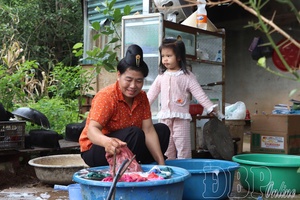
One household effectively exploiting lowland advantages is the family of Hà Thị Hiền in Village 13. Beyond cultivating vegetables and raising aquatic products, Hà Thị Hiền also serves as head of a vegetable production cooperative group spanning over 2ha. In 2025 - 2026, the family continued participating in a commercial TaTa carp trial-raising model. The model illustrates the capacity to combine diverse livelihood forms to generate additional revenue streams instead of depending on a single crop.
While the lowlands take fields, vegetables, fruit trees, and livestock as a foundation, in the highlands, coffee and macadamia are opening up long-term commodity production pathways. Areas such as Nậm Ty, Pá Sáng, Co Pục, Tâu, Nà Hý, Nà Lốm, and Hồng Lạnh possess soil and climatic conditions well-suited to these two crops. To date, the entire commune has 194.5ha of coffee, of which over 48ha has entered the commercial harvesting stage; macadamia area reaches 411.2ha, mostly in the basic establishment phase.
Notably, in 2026, newly planted coffee area reached 96.3ha, equaling 160.5% of the plan assigned by the province; intercropped macadamia area reached 126.23ha, equaling 210.4% of the plan. This result indicates that highland residents have progressively recognized prospects of shifting low-efficiency hillside cultivation plots to high economic value crops. In Pá Sáng village, the family of Vừ A Hồng is among the households taking the lead in developing coffee, currently cultivating and tending more than 2ha. In his former role as head of Xá Nhù village, Vừ A Hồng also mobilized local villagers to participate in coffee planting. By 2026, the coffee area cultivated by Xá Nhù residents reached 37ha. Coffee is gradually forming a concentrated production zone, establishing grounds for production and consumption linkages.
According to Chu Văn Bách, Chairman of the People’s Committee of Thanh Nưa commune, the ultimate goal of reorganizing production is enhancing living standards and incomes for the people. The locality determines not to develop crops following mere trends, but to select models suited to each specific area, assisting people in accessing science and technology, altering farming practices, and step by step transitioning from fragmented production to commodity manufacturing.
Under the general master plan, Thanh Nưa is oriented into 2 production zones. Among them, 12 out of 37 highland villages focus on developing perennial crops such as coffee, macadamia, and passion fruit; 25 out of 37 lowland villages develop rice, annual crops, vegetables, flowers, and ornamental plants toward high-tech applications and value-chain production linkages. By 2030, the commune sets the goal of developing 200ha of coffee, 1,000ha of macadamia, 30ha of passion fruit, 700ha of vegetables, and 50ha of pineapple. Raising incomes is also not restricted exclusively to agriculture.
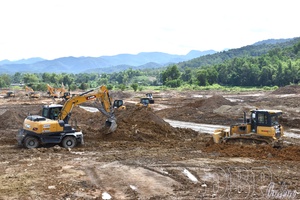
For construction works and projects deployed in the area, the commune facilitates conditions for local labor to participate, securing added employment and earnings beyond paddy fields and hillside plots. For families with limited production land, this revenue stream helps improve livelihoods and reduces reliance on agriculture. Along with reorganizing production, Thanh Nưa determines that infrastructure must stay one step ahead. Favorable transportation helps materials reach production zones and agricultural produce reach markets more easily; irrigation systems enable residents to take initiative in seasonal cropping, increasing capacities for intensive farming and crop rotation. Under constrained resources, the locality prioritizes works that simultaneously satisfy civil needs and directly serve production.
From the differing advantages of the 5 former communes, Thanh Nưa is shaping a common production space that remains non-uniform in its methods: the lowlands elevate value across fields, orchards, and water surfaces; the highlands develop valuable perennial crops; and households with little land seek supplementary livelihoods outside agriculture. From more than 2ha of vegetables cultivated by Hà Thị Hiền’s family to 2ha of coffee grown by Vừ A Hồng and 37ha of coffee planted in response by Xá Nhù villagers, that development direction is materializing through concrete models. When land and labor advantages are transformed into real products and practical earnings, that also serves as the foundation for Thanh Nưa to elevate people’s living standards and construct sustainable new rural areas.
Kông Thao
.jpg)
.jpg)

.jpg)
.jpg)
.jpg)
.jpg)
.jpg)
.jpg)
You have 500/500 characters left
Please enter 5 or more characters!!!