



On December 29, 2025, the Prime Minister issued the National Criteria for NRC at commune level for the 2026-2030 period. The new criteria set includes 10 criteria with 47 indicators, structured across three commune groups based on development conditions and regional peculiarities. Closely following central regulations, on July 15, 2026, the provincial People’s Committee issued Decision No.55/QĐ-UBND stipulating criteria for communes meeting NRC standards and modern NRC standards for the 2026-2030 period. Concurrently, the province drafted plans and determined execution roadmaps suited to local realities.
According to the plan, in 2026, Điện Biên province strives to have 5 communes meet NRC standards: Tuần Giáo, Mường Ảng, Mường Phăng, Thanh An, and Thanh Nưa.
Thanh Nưa is one of the communes concentrating on finalizing criteria to reach the NRC destination in 2026. Following the merger of five communes - Hua Thanh, Thanh Nưa, Thanh Luông, Thanh Hưng, and Thanh Chăn - the commune holds advantages as 4 out of 5 former communes were previously recognized as meeting NRC standards, with Thanh Chăn achieving exemplary NRC standards. However, under the new criteria set, Thanh Nưa commune needs to continue perfecting multiple indicators and criteria.
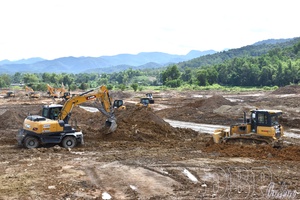
Through preliminary reviews, Thanh Nưa commune has met 7 out of 10 criteria; 3 unmet criteria include socio-economic infrastructure; culture, education, and health; and rural environment and landscape. According to the commune’s evaluation, infrastructure systems remain limited; essential works such as cultural houses, sports areas, and children’s playgrounds lack synchronous investment; lighting systems and security cameras are incomplete; and selected areas have not yet established effective production models to raise public income, while investment resources depend primarily on central budget allocations.
.jpg)
Aiming to complete NRC criteria in 2026, Thanh Nưa proactively integrates programs and projects, flexibly allocates investment capital, and accelerates socialization to finalize transport, irrigation, and cultural institution systems. Alongside infrastructure investment, the commune focuses on elevating education and health quality, developing appropriate economic models, stepping up scientific and technical transfers, and creating sustainable livelihoods for residents. Propaganda is intensified to raise environmental protection awareness, build civilized lifestyles, and promote the people’s role as primary actors in NRC.
Nguyễn Trọng Dương, Vice Chairman of the Thanh Nưa commune People’s Committee, stated: “Right after the Provincial People’s Committee issued the NRC Criteria for 2026-2030, the commune organized reviews and current-status evaluations under each criterion, building roadmaps and allocating appropriate resources to complete unmet contents. With the involvement of the entire political system and public consensus, the commune is determined to fulfill the target of meeting NRC standards in 2026.”
While Thanh Nưa holds advantages from pre-merger NRC results, Chiềng Sinh commune faces greater difficulties. Established on the basis of merging four communes - Nà Sáy, Mường Thín, Mường Khong, and Chiềng Sinh - a vast territory, numerous highland villages, and uneven development conditions present significant challenges to completing NRC criteria. Currently, two villages, Huổi Nôm and Hua Sát, lack national grid electricity and telecommunications coverage; the poverty rate remains above 20%; and per capita average income is low - all directly impacting NRC criteria execution.
According to the provincial People’s Committee plan, Chiềng Sinh will meet NRC standards in 2028. To execute this goal, the commune built a specific annual roadmap while coordinating with the Department of Industry and Trade to accelerate the KOICA electricity project to bring grid power to unserved villages early. Concurrently, the locality concentrates on economic restructuring, exploiting land potential, expanding commercial production models, and raising public income.
Đỗ Văn Sơn, Chairman of the Chiềng Sinh commune People’s Committee, noted: “Based on reviewing criteria and preliminary expenditure requirements, the commune summarized and proposed that provincial departments and sectors consider allocating capital. Concurrently, we step up socialization and mobilize public strength to participate in NRC with determination to fulfill targets on schedule.”
Beside perfecting criteria systems, funding remains the key factor deciding the success of the NRC program during the 2026-2030 period. Executing 2026 tasks, the provincial People’s Committee adjusted capital sources from 2021-2025 national target programs permitted to extend into 2026, totaling over VND 250 billion. However, according to provincial calculations, fulfilling NRC targets for 2026-2030 requires over VND 28,000 billion, whereas expected central allocations stand at around VND 2,394 billion. The substantial gap between demand and supply capacity presents difficulties during provincial implementation. Facing this reality, alongside efficiently utilizing existing capital, Điện Biên province continues petitioning the Government to prioritize allocating additional resources, while researching specific mechanisms and policies so the locality can mobilize extra socialized funding for infrastructure, production, and public living standard elevation.
Constructing new-style rural areas means not only fulfilling criteria indicators, but also aiming toward comprehensive, modern, and sustainable rural development. With political system determination, public consensus, and appropriate solutions, Điện Biên is step-by-step building a foundation for the NRC program to spread - contributing to narrowing development gaps across regions, elevating public living quality, and propelling socio-economic development in the new era.
Phạm Trung
.jpg)
.jpg)

.jpg)
.jpg)
.jpg)
.jpg)
.jpg)


.jpg)
You have 500/500 characters left
Please enter 5 or more characters!!!