



Điện Biên is step-by-step shifting its development mindset from mere growth to green growth, resolutely refusing to sacrifice the environment for socio-economic development. From orienting guidelines and policies to concrete actions across each sector, the locality is building a foundation for a future that develops in harmony with nature. Immediately after Vietnam made its commitment to achieve net-zero emissions by 2050 at the COP26 conference, Điện Biên materialized this target through numerous programs and action plans tailored to practical local conditions.
.png)
It is noteworthy that reducing greenhouse gas emissions is not exclusive to the agriculture and environment sector but has become an overarching goal across fields from energy, transport, and construction to waste management and forest protection. Within this picture, renewable energy is opening up new development room for Điện Biên. With advantages in terrain, climate, and natural resources, the province is step-by-step effectively exploiting clean energy sources to reduce its dependence on fossil fuels. According to the approved planning for the 2025-2030 period, Điện Biên possesses the potential to develop 904MW of solar power, 1,079MW of wind power, 114MW of biomass power, and 3MW of waste-to-energy power.
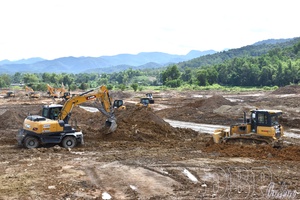
To realize this goal, the province creates an open investment environment to attract enterprises to participate in clean power projects. A typical example is the 300MW Điện Biên 1 Solar Power Plant Project, invested in by Vinenergo Energy Joint Stock Company based in Hanoi and deployed across Điện Biên Phủ ward and Na Son, Muong Lan, and Pu Nhi communes, which is expected to supply over 482,400MWh of electricity annually. This is viewed as a vital direction contributing to cutting carbon emissions, effectively utilizing natural resources, and creating a new growth driver for the locality.
.jpg)
Alongside the energy sector, transport is also witnessing a transformation toward environmental friendliness. Electric vehicles are appearing increasingly on local routes. The entire province currently logs around 576 electric cars and more than 4,100 electric motorbikes put into use. In the passenger transport sector, three out of eight taxi units have transitioned to using electric vehicles, with 192 cars currently operating, including an enterprise that has completely replaced its petrol vehicles with electric means of transport.
From 2024, Phan Hải 89 Company Limited began its taxi transport business utilizing electric vehicles. Currently, the “Xanh Điện Biên” taxi brand has established its reputation, gaining trust among passengers and expanding with over 100 electric cars operating province-wide.
Trần Thanh Quân, a representative from Phan Hải 89 Company Limited, stated that switching to electric vehicles is not only a direction for sustainable development but also actively contributes to the goal of reducing greenhouse gas emissions and protecting the environment. He noted that in the coming time, the company will continue to expand its operational scale, upgrade service quality, and step-by-step construct a green, eco-friendly transport system.
.png)
Điện Biên is also heading toward the goal of developing green urban areas capable of adapting to climate change. Ideas regarding residential areas powered by solar energy, eco-friendly construction materials, ecological drainage networks, or ecological parks are being gradually materialized. During the 2025-2040 period, the province expects to build a pilot residential cluster under this model, while concurrently planting 10,000 new native trees and step-by-step replacing the street lighting system with solar-powered LED lamps.
Recently, on June 3, the provincial People’s Committee organized a conference to collect opinions regarding a scheme to refurbish the park system and sidewalk trees along major roads. In Điện Biên Phủ and Mường Thanh ward, there are currently six public parks and flower gardens. To create an urban identity and aim toward constructing a green, smart, and modern city, the Department of Construction proposed upgrading and refurbishing existing parks while shaping seven landscape tree routes with a total length of around 21km. Within this scheme, several routes will be oriented to become signature ban flower roads, linked with tourism development and building the image of a “ban flower city.”
While energy and transport create changes in urban zones, agriculture is a sector with a profound and broad impact on the lives of rural citizens. As the core economic sector of the province, agriculture is oriented to develop along a green path, adapting to climate change and lowering emissions. Typically, during the 2025-2026 winter-spring crop, the Mường Thanh field registered 76 ha of rice executed under the model of “Greenhouse gas emission reduction smart rice cultivation linked with driving green growth.”
According to review data, the rice yield was 3 to 5 quintals higher than traditional methods, while carbon emissions dropped by 2 to 3.5 tons/ha, meaning the model cut a total of 172 carbon credits. This model does not only lower expenses and boost productivity but also helps farmers gain an extra income of around VND 880,000/ha from selling carbon credits.
.jpg)
For the livestock sector, circular production mindsets have been and are being replicated. During the 2021-2025 period, nearly 1,000 trainees received training on safe, eco-friendly livestock farming techniques. Beside this, forests continue to be viewed as a vital “green lung” in the province’s emission reduction journey. Since 2021, Điện Biên has executed natural regeneration promotion zoning for nearly 67,000 ha of forest, planted nearly 2,600 ha of new concentrated forest, and established sustainable management plans for more than 78,494 ha of forest to upgrade carbon absorption and storage capacity.
Confronted with new development requirements, Điện Biên is step-by-step transforming its growth model toward a green, circular, and sustainable path. The achieved outcomes demonstrate that Điện Biên province does not only fulfill its responsibility within national commitments on climate change but also proactively turns challenges into development drivers. This stands as a vital foundation for Điện Biên to construct a green economy, adapt effectively to climate change, head toward its net-zero emissions target by 2050, and shape a cleaner, safer future for generations to come.
Thu Phương
.jpg)
.jpg)
.jpg)
.jpg)
.jpg)
.jpg)
.jpg)
.jpg)
You have 500/500 characters left
Please enter 5 or more characters!!!