



To guarantee stable supplies, prevent commodity shortages, and stop bad actors from exploiting natural disasters to speculate, hoard, or unreasonably hike prices, levels, sectors, and enterprises across Điện Biên province have proactively deployed various storage and market stabilization solutions, standing ready to meet essential public needs under all circumstances.
Currently, goods market in Điện Biên remains basic and stable, with essential item supplies adequately satisfying public demand. According to Lường Tuấn Anh, Deputy Director of the Department of Industry and Trade, a key task of the sector involves balancing commodity supply and demand while keeping markets stable in areas affected by natural disasters, prompting the department to direct supply enterprises to deploy essential goods storage plans focusing on food and drinking water, while reviewing areas at risk of isolation to build timely transportation plans and prevent item shortages.
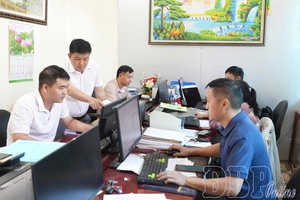
Market management forces intensify inspections and controls to detect and strictly process legal violations in commercial activities early, focusing on stopping parties from exploiting natural disasters to speculate, hoard, or unreasonably hike prices on roofing sheets, building materials, and essential consumer goods. Currently, the province features 3 shopping centers, 4 Class-III standard supermarkets, 16 convenience stores, and 38 large specialized stores operating under supermarket models. This distribution system satisfies commodity arrangement requirements, displays price listings, offers convenient payments, and provides home delivery to safeguard public shopping demands.
.jpg)
To proactively respond to natural disaster situations, commune and ward authorities formulated goods storage plans and market stabilization solutions when heavy rain and floods sever local transport, concentrating on food, foodstuffs, and raw materials.
Units and enterprises consolidated natural disaster prevention steering boards, closely monitored weather developments, implemented “four on-the-spot” and “three readiness” principles, and constructed rain and flood response plans suited to local conditions. Essential items such as rice, instant noodles, bottled water, cooking oil, fish sauce, salt, sugar, milk, canned food, gas, and various other necessities are fully prepared and ready for supply during demand surges or emergency situations.
To date, provincial enterprises have stored goods valued at over VND 66.6 billion, including 65,000 cases of instant noodles valued at VND 6.5 billion, 350 tons of rice valued at VND 7 billion, 800 cubic meters of gasoline valued at VND 19,328 million, 700 cubic meters of diesel oil valued at VND 25,289 million, 10 cubic meters of kerosene valued at VND 360 million, alongside other food and foodstuffs valued at VND 3 billion.
Along with stored goods, the province continues to consolidate distribution networks to ensure commodities reach residents as fast as possible during natural disasters. The province currently counts 41 operating traditional markets, including 2 Class-II markets and 39 Class-III markets, with participating traders, business households, distribution facilities, processing centers, and service providers, remaining the main distribution channel supplying necessities to local residents.
Trần Thị Nga, a trader at Tủa Chùa market in Tủa Chùa commune, shared that during the rainy season, business households proactively import roughly 20% more essential goods like rice, instant noodles, bottled water, and cooking oil, while signing commitments not to hoard or hike prices to protect consumer rights.
Beside traditional markets, supermarkets, commercial centers, and enterprises distribute goods to grocery stores across the province while organizing mobile sales vehicles to serve necessary areas. However, as the province lacks large-scale manufacturing plants, goods are mainly imported from provinces such as Hà Nội, Bắc Ninh, Hưng Yên, and Phú Thọ. Meanwhile, landslides frequently occur on transport networks during the rainy season, making transport and supply difficult, compounded by the fact that most local commercial enterprises operate on a small scale with limited financial capacity, mainly securing inventory for normal circulation.
Proactively storing goods, expanding distribution networks, strengthening market inspections, and resolutely preventing speculation, hoarding, and unreasonable price hikes contribute to market stability during the rainy season, ensuring residents, especially in highland and isolated areas, maintain access to essential items, stabilizing lives, and mitigating natural disaster impacts.
Đức Kiên
.jpg)
.jpg)

.jpg)
.jpg)
.jpg)

.jpg)
.jpg)

.jpg)
You have 500/500 characters left
Please enter 5 or more characters!!!