



Across Điện Biên province, localities are screening operational conditions, identifying priority tasks, and leveraging the participatory role of local people as primary actors to progressively complete infrastructure, advance production, and elevate living standards.
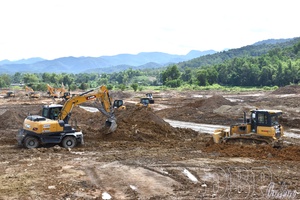
The new cultural house of Na Há village, Mường Nhà commune, was put into operation in June 2026, serving the community gathering needs of more than 130 households. The facility spans over 500m2 with a total investment of VND 1.5 billion sourced from the National Target Program on Building New-Style Rural Areas. Following project completion, local villagers voluntarily contributed over VND 200 million to erect a canopy over the courtyard grounds. Lò Văn Hội, Head of Na Há village, noted that the spacious and dignified new cultural house brought great joy to residents; when discussing the construction of the canopy, everyone agreed to pool resources, reflecting a shared desire to contribute to and preserve public facilities built for their own benefit.
Beyond joining hands to complete community projects, residents of Mường Nhà are bringing local agricultural advantages into play to forge livelihoods. More than 320ha of pineapples are maintained, while acreage for coffee, macadamia, and fruit trees continues to expand. In Xôm village, the family of Lò Thị Vui tends over 4ha of coffee, a portion of which has commenced trial bearing, opening economic avenues for the household.
.jpg)
Mường Nhà currently meets only 3 out of 10 new-style rural criteria. Eight villages still lack concrete roads, the multidimensional poverty rate remains elevated, and several localities have yet to establish effective production models. Under these circumstances, the commune resolved that rural development must align with tangible community needs and grassroots execution capacity. According to Lường Văn Biên, Vice Chairman of the People’s Committee of Mường Nhà commune, matters directly affecting community life are brought to assemblies for discussion and consensus. In the new phase, the commune will focus resources on prioritizing essential infrastructure, while mobilizing residents to capitalize on land assets to maintain and expand productive models - such as pineapple cultivation, industrial crops, fruit orchards, and livestock breeding - while accelerating the application of science and technology to elevate product quality and augment incomes.
In Mường Chà commune, the rural economy is identified as a focal area in elevating criteria quality. The commune currently maintains nearly 100ha of seasonal wet rice, over 280ha of cinnamon, 125ha of amomum, and over 130ha of fruit trees, alongside a total livestock and poultry herd exceeding 126,000 head. Capitalizing on available conditions, many households have chosen suitable production paths. In Na Quang village, the household of Thùng Văn Viễn has bred bamboo rats since 2022. At its peak, the herd reached 460 animals, enabling the family to sell more than 200 head and generate nearly VND 130 million. Currently, he continues selecting breeding stock to expand herds and stabilize scale. Thùng Văn Viễn shared that he selects healthy, high-fecundity females for breeding, aiming first for 100 to 150 breeding females before expanding further, while standing ready to share practical breeding techniques with neighbors.
Mường Chà currently satisfies 3 out of 10 new-style rural criteria. Alongside initial gains, many villages still lack essential conditions serving daily life and production, representing an area the commune aims to address moving forward. Lèng Văn Viện, Vice Chairman of the People’s Committee of Mường Chà commune, stated that given constrained resources, the locality must prioritize truly urgent works. Moving forward, alongside integrating funds from national target programs, the commune will mobilize socialized resources, focusing immediate efforts on roadways, cultural centers, schools, and domestic water supplies. For un-electrified clusters and hamlets, the commune will place them on priority rosters to formulate suitable investment plans.
In Mường Lạn commune, based on screening results, local authorities are establishing an order of priority across each criteria group, starting with components directly tied to daily routines and production. From the beginning of 2026 to date, nearly 10 projects have been rolled out, focusing on domestic water supply repairs, production access road upgrades, and irrigation canal maintenance, directly matching public concerns. Alongside infrastructure improvements, more than 500ha of coffee, including 176ha of newly planted areas, are expanding room for Mường Lạn to develop commercial goods production. Nguyễn Thế Trung, Chairman of the Commune People’s Committee, stated that the locality will base investments on the advantages and practical demands of each area to address urgent bottlenecks and curb resource dispersion.
Grassroots implementation in the new phase demonstrates that while sharing a common objective, each locality faces distinct conditions and hurdles. Selecting the correct focal tasks aligned with realistic resources determines implementation efficiency. This aligns with the approach set out in the National Set of Criteria on New-Style Rural Areas for the 2026 - 2030 period, promulgated by the Prime Minister on December 29, 2025. The regulatory framework comprises 10 criteria and 47 indicators structured across 3 commune groups to match development levels and regional characteristics. In Điện Biên, on July 15, 2026, the Provincial People’s Committee issued Decision No.55/QĐ-UBND stipulating the Set of Criteria for New-Style Rural Communes and Modern New-Style Rural Communes for the 2026 - 2030 period. This fresh approach relieves disadvantaged localities from the burden of pursuing targets beyond their capacity, allowing them to channel resources into core criteria.
Entering the new era, new-style rural development in Điện Biên is being pursued closer to the actual conditions of each locality, taking tangible results and transformations in living standards as the decisive measure. This provides the foundation for localities to identify correct focal areas, leverage advantages, utilize resources efficiently, and progressively forge a fresh appearance and sustainable groundwork for rural regions.
Phương Dung
.jpg)
.jpg)
.jpg)
.jpg)
.jpg)
.jpg)
.jpg)

.jpg)

You have 500/500 characters left
Please enter 5 or more characters!!!