



Untying these “bottlenecks” is becoming an urgent requirement for vocational training to truly link with employment, satisfying the local socio-economic development needs.
As of June 2025, the entire province has more than 355,000 laborers, with rural laborers accounting for nearly 308,000 people. This represents a very large workforce, but it also poses significant pressure on vocational training work when the majority of laborers mainly work in agriculture, forestry, and fisheries with limited technical proficiency. Practical experience in the past showed that some localities used to organize training based on target quotas, whereas what residents needed to learn and what skills enterprises required had not been fully surveyed. This led to sub-optimal post-training effectiveness.
To resolve that inadequacy, vocational training institutions have changed their approach, visiting individual villages to survey vocational learning needs and selecting occupations suitable for each locality’s production conditions before opening classes. In 2026, Vocational Education - Continuing Education Center 1 was assigned a target to provide vocational training for 1,330 laborers. The center coordinated with People’s Committees of communes and wards to survey residents’ learning needs, helping ensure training is no longer impositional but originates from learners’ actual needs.
.jpg)
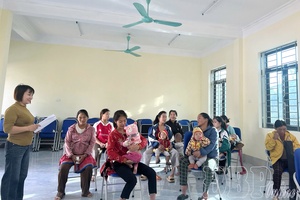
Lường Thị Thắm from Thanh Yên commune shared that her family used to raise chickens based on experience, leading to low efficiency and confusion when diseases broke out. Participating in the elementary vocational class on poultry breeding and disease prevention techniques, she received guidance from breed selection and barn construction to care techniques and identifying and treating common diseases. Conveniently, the class was organized right in the locality at suitable times, allowing her to study while attending to farm production.
According to Deputy Director of Vocational Education - Continuing Education Center 1 Trần Ninh Nam, vocational training currently originates from public demand. The center coordinates with commune authorities to visit individual villages directly to conduct surveys and grasp learning needs before drafting class-opening plans. A distinct feature is that most course hours are dedicated to practical work right in the locality, making it easy for learners to absorb and apply skills to production. From early March to date, the center has organized 13 training classes across 11 communes and wards, striving to open 38 classes in 2026.
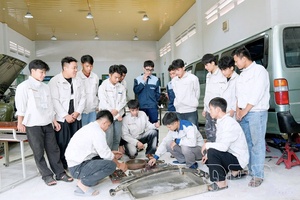
Vocational training at Vocational Education - Continuing Education Center 2 has also been strongly implemented right at the grassroots level. From April 23 to 29, 2026, the center coordinated with People’s Committees of Chiềng Sinh, Mường Mùn, Búng Lao, Mường Lạn, Pú Nhung, Tủa Chùa, Sáng Nhè, and Mường Ảng communes to launch 12 vocational training classes for rural laborers. Training fields include cultivation, care, harvest, preservation, and processing techniques for coffee and macadamia; swine breeding and disease prevention techniques; and sheet metal welding.
Lầu A Chá from Pú Nhung village, Pú Nhung commune, a trainee in the sheet metal welding class, shared that after participating in the course, he mastered basic metal processing and welding techniques. He affirmed that he will apply these learned skills to practical labor and production, while offering repair and processing services for villagers’ daily tools to gain extra income and contribute to his family’s economic growth.
From the effectiveness of short-term vocational classes at the grassroots-level, the province’s human resource development work is also expanded into formal education systems, aiming to supply skilled laborers to the market. Over the years, Điện Biên College has been expanding its training scale and strengthening links with labor recruitment demands. Currently, the college offers training in 16 college-degree majors, 22 intermediate-degree majors, along with dozens of elementary and under-three-month vocational programs, accommodating a scale of 3,500 to 4,000 students annually.
.jpg)
Despite these efforts, during the first six months of this year, the entire province provided vocational training to approximately 3,000 laborers, fulfilling only 35.29 percent of the annual plan. One key reason is that awareness regarding vocational training among a segment of the population remains limited. Many laborers are still accustomed to traditional production methods and do not see the clear benefits of learning a trade. Furthermore, training structures in some places have not fully kept pace with corporate needs and economic development trends. Following training, many graduates still lack access to job opportunities or lack support to expand production, preventing courses from maximizing their potential impact.
Recognizing these “bottlenecks,” on May 8, 2026, the provincial People’s Committee issued a Plan to execute the Program on “Innovating and Elevating the Quality of Rural Vocational Training through 2030.” For the 2026-2030 period, Điện Biên sets a target to train an annual average of over 5,500 laborers. Among these, approximately 4,000 laborers will be trained in agricultural trades and over 1,500 in non-agricultural trades; ethnic minorities will account for around 70 percent; and people with disabilities who have learning needs will receive support for vocational education and suitable job placement.
A key solution involves shifting from capacity-based training to market-demand training. Localities conduct surveys on residents’ learning needs and enterprise recruitment demands to determine suitable occupations aligned with each commune and ward’s economic development orientation. Concurrently, policies supporting poor households, near-poor households, ethnic minorities, and people with disabilities will be perfected - not only regarding training tuition support but also creating conditions to access jobs and transition to sustainable livelihoods.
Beside traditional agricultural trades, priority will be directed toward digital skills, high-tech agriculture, community tourism, value chain production, and non-agricultural occupations. The province is stepping up linkages between vocational education institutions, enterprises, cooperatives, and employers, tying training to recruitment needs and local production value chains. Simultaneously, career guidance, dissemination, and startup support will be strengthened so residents clearly recognize vocational training as a key solution to raise income and achieve sustainable poverty reduction.
Vocational training only succeeds when learners obtain employment or generate stable income after completing courses. Therefore, resolving Điện Biên’s “bottleneck” does not simply mean opening more classes, but more importantly, constructing a linked chain from demand surveys, trade selection, and training organization to production support and job placement. When each link in the chain is perfected, vocational training will become the driving force to elevate human resource quality and boost the rural economy.
Thu Phương
.jpg)
.jpg)
.jpg)
.jpg)
.jpg)
.jpg)

.jpg)
You have 500/500 characters left
Please enter 5 or more characters!!!