



The crying of a newborn in a small house in Hua Rốm village, Nà Tấu commune, brings happiness that G.T.T had to wait for over many years. Out of three pregnancies, it was only on the third attempt that she could hold a child in her arms. During her previous two pregnancies, she experienced premature births at home, and the infants did not survive. Wrapped in an old, hole-riddled swaddle, T recalled that in her Hmông village, many people still view pregnancy and childbirth as natural women’s matters, adding that since grandparents and parents gave birth at home, few thought about visiting medical facilities. Behind this seemingly ordinary mindset lie backward customs deeply rooted in the subconscious of many highland families. When obstetrical accidents occur, both mothers and newborns face mortality risks without timely detection and emergency care.
In Dư O village, Pu Nhi commune, L.A.S and his wife began living together and had a child when they were just 14 and 15 years old. In their small wooden house, three generations cohabitate. Without stable jobs, the young couple’s livelihood relies primarily on hill farming and parental support. At an age when he should still be sitting in a classroom, S became the family breadwinner early. Crucially, S’s story is not an isolated case. Many students drop out of school to marry, with numerous families considering it normal because parents and grandparents also married under legal age in the past. Conceptions passed down through generations make eliminating child marriage exceptionally difficult.
.jpg)
According to Ly A Xá, a population worker in Dư O village, beyond child marriage, child healthcare practices following old habits also represent a major barrier to elevating local population quality.
Ly A Xá noted: “Hmông ethnic people often carry children on their backs to hill fields from a very young age. In winter, infants easily contract respiratory diseases, especially pneumonia. More worryingly, when children fall ill, many families invite shamans or use folk remedies instead of taking them to medical facilities. There have been cases where children passed away due to lack of timely medical treatment.”
In Mường Phăng commune, two daughters of C.T.S are suffering the consequences of consanguineous marriage. Her firstborn was born healthy but showed no response to sound and could not learn to speak like other children, with medical examinations confirming congenital deaf-mutism. Upon reaching school age, these defects made learning and integrating with peers exceptionally difficult. Her family’s story sounds yet another alarm bell regarding the long-term consequences of consanguineous marriage on population quality.
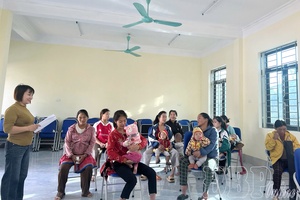
To step-by-step eliminate backward customs rooted in public subconsciousness, localities are stepping up communication efforts through flexible methods tailored to each residential area. Health cadres and population workers visit individual villages and households to conduct dissemination and explanations in native languages, while promoting the role of village elders, village heads, reputable figures, and political-social organizations in mobilizing residents to clearly understand the consequences of child marriage and consanguineous marriage, alongside raising awareness on the benefits of safe childbirth and healthcare at medical facilities.
Leaving the highlands, what remains after these real stories is anxiety over backward customs that continue to negatively impact health and population quality. The journey to eliminate backward customs certainly cannot be completed overnight. However, with the involvement of the entire political system, public awareness will step-by-step change, and backward practices will be replaced by a civilized lifestyle, forming the foundation to elevate population quality and advance toward sustainable development in ethnic minority regions.
Hoàng Út
.jpg)
.jpg)
.jpg)
.jpg)
.jpg)
.jpg)

.jpg)
You have 500/500 characters left
Please enter 5 or more characters!!!