



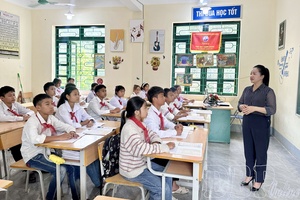
Every Friday morning, the grade 5A IT class at Trần Văn Thọ Semi-boarding Primary School for Ethnic Minority Students in Mường Nhé begins with the rhythmic tapping of keyboards in a small classroom. On the projector screen, a digital lesson comes alive with vivid visuals on how to search for information online. Students actively exchange ideas, guiding one another through the steps. From time to time, excited voices ring out: “Teacher, I’ve done it!” or “Click here!”. The classroom buzzes with energy - a stark contrast to the past, when lessons revolved solely around chalkboards and textbooks.
.jpg)
Phạm Văn Khiêm, the school’s Principal, said integrating images, videos and digital lessons into teaching makes content more visual and engaging, helping students grasp knowledge more easily. “This is especially suitable for ethnic minority students, many of whom still face challenges with the Vietnamese language”, he noted.
At Mường Nhé Semi-boarding Lower Secondary School for Ethnic Minority Students, a grade 9 geography class is equally dynamic. A detailed digital map of Vietnam is projected, highlighting terrain, natural resources and regions. Standing beside the board, the teacher points to different areas while posing guiding questions. Hands shoot up across the room as students eagerly volunteer answers, while others quickly discuss in groups to find solutions.
Cà Anh Vũ, a student in class 9D3, said the projected maps and images make lessons easier to visualize. “As the teacher explains, we can immediately observe, so we understand faster,” the student shared.
.jpg)
Beyond supporting instruction, digital technology is also reshaping how classroom activities are organized. Teachers now have more tools to design interactive lessons and create learning scenarios using images, maps and digital data. Students are no longer passive listeners; they actively participate in discussions, answer questions and analyze content directly from projected materials. This makes lessons more flexible and encourages students to take initiative and express their ideas.
Lường Thị Tuyến, a teacher at the school, said students show greater interest and absorb lessons more quickly with digital teaching materials compared to traditional methods.
To achieve these improvements, Mường Nhé Semi-boarding Lower Secondary School for Ethnic Minority Students has actively promoted the use of information technology in teaching and learning. In addition to a computer lab with dozens of machines, many classrooms are equipped with projectors and internet-connected smart TVs. The school has also enabled teachers to attend training courses on designing digital lessons, using online learning resources and applying educational software. As a result, technology integration has become more routine, helping improve lesson quality.
.jpg)
Dương Tiến Công, the school’s Principal, said digital transformation is seen as a key solution to improving education quality. In recent years, teachers have increasingly applied information technology in lesson planning and delivery.
Digital transformation is also being rolled out in education management. Electronic report cards and student management software are gradually replacing manual processes, making it easier and more accurate to update students’ academic and behavioral records.
At Nậm Pố Semi-boarding Primary School for Ethnic Minority Students, teachers are now familiar with entering grades and tracking student performance through management software. This has sped up reporting and significantly reduced their workload.
According to Principal Vũ Văn Nguyện, digital transformation not only improves management efficiency but also enables teachers and students to access a wide range of online learning resources.
.jpg)
In highland areas, access to digital technology opens up new learning opportunities. With internet connectivity, students can explore knowledge beyond textbooks, watch instructional videos and take part in online academic competitions. However, the process still faces significant challenges. Internet infrastructure remains unstable in many schools, and teaching equipment is limited, preventing widespread implementation. In addition, some older teachers struggle to adapt to new software and digital tools.
“Currently, besides projectors, the school only has two internet-connected smart TVs, so the use of digital lessons remains limited. We hope for continued investment in teaching equipment, especially technology devices, so teachers can apply IT more effectively”, Dương Tiến Công said.
Despite these challenges, digital transformation is gradually taking root in schools across Mường Nhé. Lessons enriched with visuals, digital materials and greater teacher-student interaction are becoming increasingly common. As technology is more widely adopted, teaching and learning methods continue to evolve, giving students better access to diverse sources of knowledge.
Quang Long
.jpg)



.jpg)
.jpg)
.jpg)

.jpg)
.png)
.jpg)
.jpg)
.jpg)
.jpg)
.jpg)

You have 500/500 characters left
Please enter 5 or more characters!!!