



The most visible impact has come from community digital technology teams. Guided by the principle of “going door to door, guiding each person,” these teams have become the driving force behind the movement.
In the border commune of Si Pa Phìn - where more than 90% of residents are ethnic minorities - vast terrain, sparse population, difficult transport, and limited digital infrastructure present significant challenges. Despite these barriers, the commune’s community tech teams, made up of dozens of members, have seized every opportunity to bring digital transformation closer to the people.
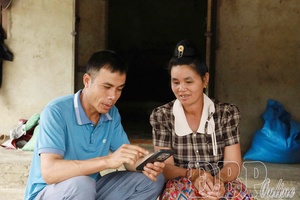
Through village meetings and local programs, they have guided residents in using essential applications on electronic devices (mainly smartphones), such as setting up and using digital identity accounts (VNeID), bank accounts, and accessing public services online. People are also being shown how to carry out administrative procedures on the National Public Service Portal and make digital payments instead of using cash. Step by step, with practical, hands-on guidance, the doors to technology are opening in remote highland villages.
.jpg)
For Mùa Thị Ghênh in Pú Đao village, Si Pa Phìn commune, learning to use a smartphone is not just about gaining a new skill, it has made daily life more convenient. “I used to only know how to make calls. Going to the market meant carrying cash, and if I forgot, I had to go back home. Since being guided by local officials, I can now check information, video call my children, and even transfer money. I can also look up prices and weather to better plan my farming. It was difficult at first, but with repeated guidance, I’ve gotten used to it. Life is much more convenient now”, she shared.
The effectiveness of the movement is also evident across many aspects of daily life, including preparations for the election of deputies to the 16th National Assembly and People’s Councils at all levels for the 2026-2031 term. Citizens’ digital capacity has been demonstrated by their ability to quickly access election-related information. Questions and discussions can now take place directly on social media groups, with timely and clear responses thanks to digital tools.
Vàng Thống Dia, a youth union member in Quài Tở commune, said: “Thanks to technology, we regularly update information on social media. It’s easier to follow election-related content. We know the election schedule, candidate lists, and important voting guidelines. This helps us stay informed quickly and feel more responsible when taking part.”
Another notable highlight is Điện Biên’s proactive introduction of artificial intelligence (AI) to students and teachers, helping improve the quality of education and training. The application of technology is being actively promoted across agencies, units, and localities in ways suited to their specific needs, contributing to more effective governance. At the same time, the province is strengthening IT capacity at the grassroots level by deploying skilled personnel, helping both officials and residents handle administrative procedures more efficiently.
However, the movement still faces internal challenges. Gaps in infrastructure, especially in areas with weak or no signal and limited electricity, along with disparities in education levels, remain significant obstacles. Looking ahead to 2026, Điện Biên views “digital literacy for all” as an ongoing process that must evolve into a culture of lifelong learning, not just teaching basic skills, but empowering people to navigate and thrive in the digital environment. Party members and public officials are expected to lead by example, spreading the spirit of digital self-learning to every household. With collective effort, Điện Biên aims to transform itself in the nation’s digital era.
Lê Dung

.jpg)


.jpg)
.jpg)
.jpg)
.jpg)
.png)
.jpg)
.jpg)
.jpg)
.jpg)
.jpg)

You have 500/500 characters left
Please enter 5 or more characters!!!