Changing habits regarding street food consumption

ĐBP - Fast, convenient, and affordable prices are the reasons street food is increasingly chosen by many people. From snacks sold outside school gates and roadside stalls to ready-to-eat food counters at markets, buyers can easily find items suited to their taste. However, behind that convenience lie potential risks to food hygiene and safety.

As city lights turn on, on the sidewalk of Nguyễn Chí Thanh street, Điện Biên Phủ ward, a small stall begins operation. The vendor sequentially displays trays of sausages, fried meatballs, fried dough pastries, sweet potato fritters, and more on a plastic table, preps ingredients, lights the oil burner, and starts serving customers.

Each evening, the stall welcomes dozens of customers. Yet, what warrants attention is that the preparation area sits right beside the roadway, with food displayed for sale lacking proper covering. According to the stall owner, customer traffic is fairly steady each evening. This work provides extra income for the family while serving customers’ demand for quick, convenient meals. However, discussing food safety conditions, the owner shared that due to the small scale, simple dishes, and absence of past incidents, proper attention has not truly been paid to sanitation requirements during business operations.

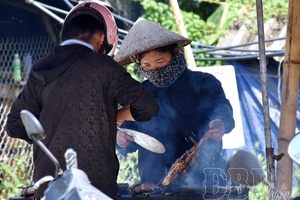
A street food vending point in Điện Biên Phủ ward lacks covers to protect food.

Not far away, along Hoàng Công Chất street, Điện Biên Phủ ward, a fast-food eatery draws a fairly large crowd in the evening. Instead of using separate utensils to handle raw ingredients and cooked, grilled food, the vendor shares the same tongs throughout preparation and serving. This harbors risks of cross-contamination from raw to cooked food, especially when utensils are not sanitized prior to contacting prepared dishes.

While vendors remain subjective, many consumers also easily overlook signs of substandard hygiene. Nguyễn Thị H., residing in Mường Thanh ward, shared: “Buying food outside, looking at the display and preparation sometimes reveals places that are not very sanitary. But because it is convenient, breaking the habit is difficult.”

For Trần Thị N., residing in Điện Biên Phủ ward, choosing street food relies heavily on convenience and practical circumstances. On busy days without enough time to prepare meals at home, she often opts for ready-to-eat dishes. According to her, when purchasing, it is difficult to control the source of ingredients as well as the entire processing cycle, so she merely prioritizes clean-looking sales areas to select food.

Street food provides convenience for consumers. However, the roadside selling environment and a lack of caution in preparation and preservation can impair food quality. Dust from passing traffic, insects, substandard water sources, or unsanitary cooking utensils all harbor contamination risks. For ready-to-eat dishes that are not carefully covered, kept in improper conditions, or left for extended periods at unsuitable temperatures, conditions are ripe for microorganisms to proliferate. In particular, using shared utensils for both raw and cooked food elevates cross-contamination hazards, impacting consumers’ health.

Residents purchase cooked food near the Mường Thanh market area, Điện Biên Phủ ward.

Across the province, there are currently 1,996 food production, trading, and catering service establishments under commune-level management. Điện Biên Phủ ward and Mường Thanh ward alone house approximately 500 food service and street food establishments. Under decentralized administrative management, each year, wards proactively formulate plans, coordinating with functional agencies to organize inspections and supervision while requiring business households to sign commitments guaranteeing food safety. However, managing these establishments still encounters considerable difficulties.

Street food satisfies fast, convenient dining demands while generating livelihoods for many residents. Nevertheless, convenience is truly meaningful only when paired with safety conditions. From the beginning of the year to date, the province has recorded no food poisoning cases related to street food. Even so, shortcomings in preparation, preservation, and serving still harbor latent food safety hazards. To prevent food poisoning, alongside the involvement of functional authorities, vendors must heighten their sense of responsibility, buyers must become more proactive in food choices, and regulatory management must be maintained regularly, tailored to the business realities across each locality.

Quang Long
Comment

You have 500/500 characters left

Please enter 5 or more characters!!!

Recent news

  • 'Changing habits regarding street food consumption

    Changing habits regarding street food consumption

    SOCIAL AFFAIRS -
    ĐBP - Fast, convenient, and affordable prices are the reasons street food is increasingly chosen by many people. From snacks sold outside school gates and roadside stalls to ready-to-eat food counters at markets, buyers can easily find items suited to their taste. However, behind that convenience lie potential risks to food hygiene and safety.
  • 'Guarding Điện Biên’s forests and biodiversity

    Guarding Điện Biên’s forests and biodiversity

    ECONOMY -
    ĐBP - Điện Biên province currently has more than 434,647 hectares of forest, with a forest coverage rate of 45.85%. Facing pressure from illegal deforestation, the risk of forest fires and threats to biodiversity, the province is implementing coordinated measures, expanding the use of technology and promoting community involvement in forest management and protection.
  • 'Applying biotechnology in agricultural production

    Applying biotechnology in agricultural production

    ECONOMY -
    ĐBP - Applying biotechnology is opening up new avenues in agricultural production, helping enhance crop productivity and product quality while mitigating environmental impacts. From models demonstrating initial effectiveness, replicating solutions tailored to practical conditions will create momentum to propel production toward a safe, modern, and sustainable trajectory, elevating agricultural product value and local incomes.
  • 'Effectively implementing inspection and supervision, preventing violations early and from afar

    Effectively implementing inspection and supervision, preventing violations early and from afar

    NEWS - POLITICS -
    ĐBP - Inspection and supervision constitute an essential leadership function of the Party, in which regular supervision serves as a crucial modality directly aiding Party committees, Party organizations, and inspection commissions at all levels in overseeing compliance with the Party Charter, Party resolutions and directives, and State policies and laws; promptly identifying and warning against limitations, shortcomings, and violations right from their inception; while concurrently discovering innovative, exemplary, breakthrough, and highly effective factors for replication.
  • 'Breaking the cycle of child marriage in Si Pa Phìn

    Breaking the cycle of child marriage in Si Pa Phìn

    SOCIAL AFFAIRS -
    ĐBP - Si Pa Phìn commune is stepping up efforts to prevent child marriage through direct outreach in villages, individual counseling for at-risk cases, and closer coordination among local authorities, families, schools and healthcare services. From raising awareness to encouraging families to pledge not to allow their children to marry before reaching the legal age, the commune is gradually improving early detection and timely intervention to reduce underage marriages.
  • 'Bringing women together through clubs and community initiatives

    Bringing women together through clubs and community initiatives

    SOCIAL AFFAIRS -
    ĐBP - With more than 103,000 members across 888 local branches, the Điện Biên provincial Women’s Union is renewing its approach to engaging and mobilizing women through community-based initiatives, clubs and grassroots emulation campaigns. Each activity creates opportunities for women to meet, build bonds and work together on practical initiatives that benefit their families and communities.
  • 'Proud of tradition - steadfastly advancing toward the future

    Proud of tradition - steadfastly advancing toward the future

    SOCIAL AFFAIRS -
    ĐBP - Through 70 years of establishment and development (October 15, 1956 - 2026), Điện Biên provincial Ethnic Boarding High School has persistently overcome hardships, progressively asserting its standing in education and human resource training for the locality. Promoting the proud heritage of preceding generations, the school continues to innovate, elevate educational quality, and nurture knowledge and aspirations to excel among ethnic minority students across the province.
  • 'Helping dreams come true on the fatherland’s frontier

    Helping dreams come true on the fatherland’s frontier

    SOCIAL AFFAIRS -
    ĐBP - Alongside the mission of managing and defending national border sovereignty and security, officers and soldiers of the Nà Bủng Border Post, under the provincial Border Guard Command, also dedicate care and attention to children in difficult circumstances through the “Adopted children of border posts” model. Through practical deeds and life partnership, green-ranked soldiers contribute to creating conditions for these youths to study, train, and step-by-step mature.
  • 'Young volunteers bring digital skills to the community

    Young volunteers bring digital skills to the community

    SOCIAL AFFAIRS -
    ĐBP – As part of the “Digital literacy for all” campaign, the Youth Union of Mường Tùng commune is taking a hands-on approach to digital inclusion, visiting villages and households to help residents use smartphones and access services that make everyday life easier. Starting with basic operations, young volunteers are helping local people, especially older residents, gradually develop digital skills and gain confidence in using technology.
  • 'Serving the people

    Serving the people

    NEWS - POLITICS -
    ĐBP - During his lifetime, President Hồ Chí Minh affirmed: “Cadres are the root of all work.” Therefore, building a contingent of cadres truly close to the people, attuned to the grassroots, understanding of the citizenry, and accountable to the public is the decisive factor in translating guidelines and policies into practical reality.