



For cooperatives and OCOP producers in Điện Biên, this presents both an opportunity to expand sales and a challenge to modernize production, promotion and business practices in order to compete and grow sustainably.
Many products from Điện Biên have advantages in terms of raw materials, flavor and local identity, yet access to major distribution channels remains limited. Small-scale production, weak linkages, and uneven management and marketing capabilities mean that many producers still rely on familiar customers and traditional markets. Some businesses have yet to fully meet requirements for legal documentation, traceability, product design, packaging and supply volumes. As a result, even high-quality products can struggle to reach markets with substantial consumer demand.
At a “Vietnamese people use Vietnamese goods” business-matching conference organized by the provincial Department of Industry and Trade in cooperation with Central Retail Vietnam, businesses, cooperatives and OCOP producers met directly with the retailer’s purchasing team to learn about requirements for supplying GO! and Tops Market stores. Requirements concerning quality, product design, packaging, labeling, legal documentation, traceability and supply capacity were discussed in detail. The event gave producers practical information to review and improve their products before approaching modern distribution networks.
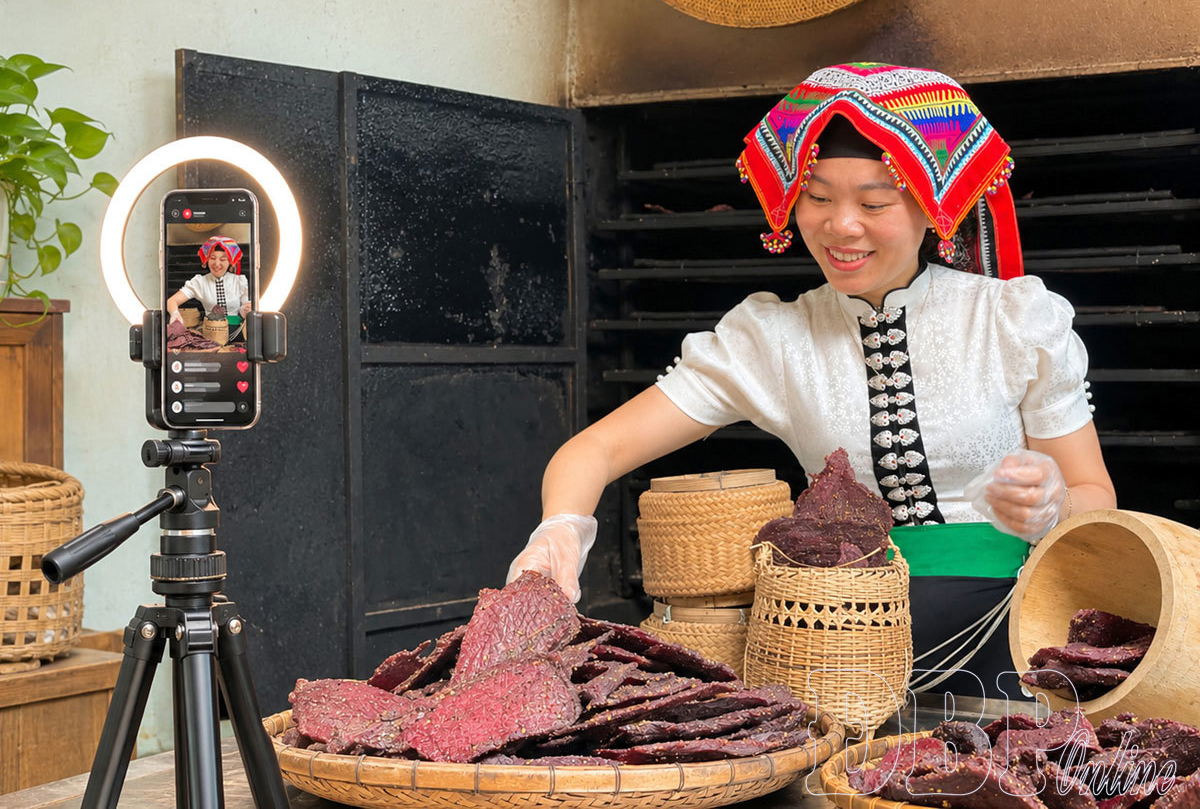
According to Lường Tuấn Anh, Deputy Director of the Department of Industry and Trade, e-commerce is playing an increasingly important role in connecting supply and demand, promoting products and strengthening competitiveness. Given Điện Biên’s mountainous and border location, digital platforms can help businesses, cooperatives and OCOP producers overcome geographical barriers and reach customers both inside and outside the province. However, making effective use of these channels requires personnel with the knowledge, skills and ability to apply technology to management, production and business operations.
Alongside online promotion and sales, improving management capacity, product quality and production organization must also be a priority. Local authorities need to proactively identify the difficulties facing individual cooperatives and OCOP producers and provide appropriate support. They should also strengthen links with businesses and distributors and organize trade promotion activities based on actual market demand. Relevant departments and agencies need to work together to help producers meet quality standards, improve packaging and labeling, complete traceability documentation, and access information on markets, consumer trends and distribution requirements.
In response to these needs, the province, its departments and local authorities have organized various programs to provide businesses, cooperatives, household enterprises and OCOP producers with knowledge and digital skills. Training has focused on brand building, content creation, video production and editing, livestreaming, selling on e-commerce platforms, and using artificial intelligence to promote products.
For Hà Thị Kim Phước, who runs the Chung Phước smoked meat business in Mường Ảng commune, digital skills training has opened up new ways to introduce her products. She said the knowledge gained during the training had made her more confident in using digital platforms and taught her how to film, edit and select content to present products more attractively. Producing videos herself has helped the business reduce promotional costs and reach customers directly, rather than relying entirely on traditional sales channels.
However, gaining access to customers does not automatically mean retaining them. The experience of the Hồng Phước arrowroot noodle cooperative in Nà Tấu commune shows that returned goods account for around 10% of orders shipped through e-commerce platforms. According to Lò Văn Pâng, the cooperative’s Director, managing returned goods remains a challenge. This highlights the need for cooperatives to pay greater attention not only to finding customers but also to order management, packaging, delivery and risk control. Problems in distribution can cause financial losses, damage product reputation and undermine the ability to maintain customer relationships.
In response to these practical challenges, the provincial Cooperative Alliance has focused on advising and supporting cooperatives in addressing weaknesses in management, developing production and business plans, managing finances, marketing, trade promotion and building sales linkages. Support is increasingly delivered through hands-on guidance, with training tailored to each cooperative’s actual operations. This is helping them gradually strengthen production management, maintain quality, ensure reliable supply and establish stable, long-term partnerships.
Hà Linh














You have 500/500 characters left
Please enter 5 or more characters!!!