



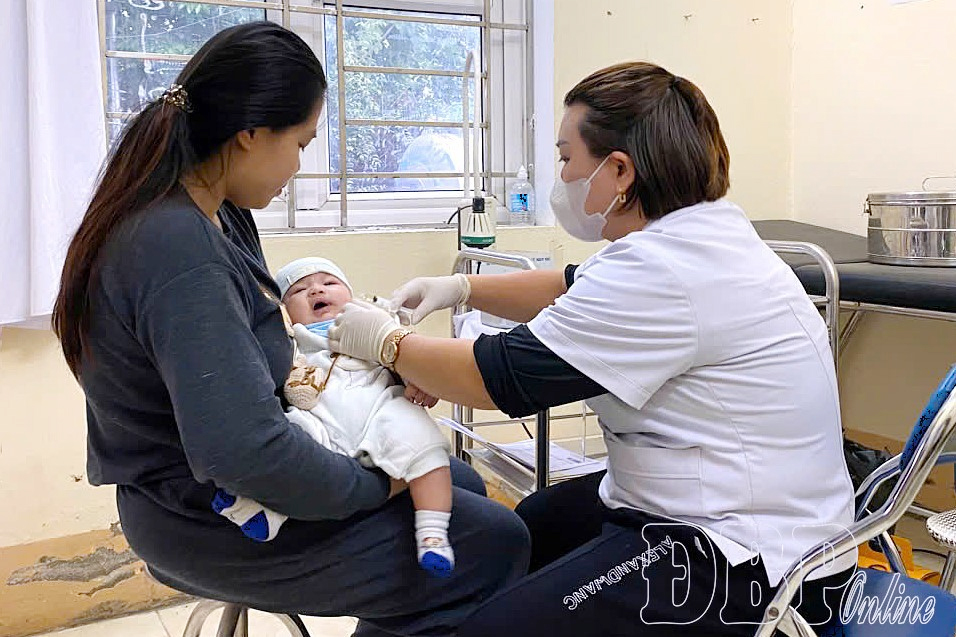
Over the past time, Điện Biên province has fully deployed vaccine types under the Expanded Program on Immunization as regulated. Since 2024, the rotavirus vaccine has been incorporated into the program free of charge for children aged 2 to under 6 months. In 2026 alone, 8,743 children across the province received the oral rotavirus vaccine, helping expand opportunities to prevent acute rotavirus diarrhea and protecting children’s health from the earliest months of life.
Lò Thị Mai, in Nghịu village, Thanh Nưa commune, shared: “Previously, opting for fee-based vaccination services was quite costly and not every family could afford it. Now receiving it free of charge, I can save money and feel reassured that my child is protected early. With disease-preventing vaccines, children reduce the risk of illness and hospitalization, and we do not have to take days off work to care for them. I hope more vaccine types will be incorporated into the program so children in remote and isolated areas can also have full access.”
Implementing the Government's Resolution No.104/NQ-CP dated August 15, 2022 on the roadmap to increase the number of vaccines in the Expanded Program on Immunization for the 2021 - 2030 period, Điện Biên province will administer pneumococcal vaccines for children under 1 year of age from January 1, 2027; and plans to roll out HPV vaccination for girls aged 9 - 15 after 2028. To ensure maximum efficiency in expanding the vaccine list, managing and accurately reviewing beneficiary subjects at the grassroots level has been identified as a pivotal step.
Doctor Phạm Bá Đạt, Deputy Director of the Thanh Nưa commune Health Station, said: The health station updates administrative information and personal identification codes of children on the National Immunization Information System (NIIS). Alongside this, the unit promotes campaigns to “cleanse” immunization data to standardize information and avoid duplicate files or lost vaccination histories when administrative units undergo renaming or boundary changes. Concurrently, the health station collaborates closely with commune police to review lists of children living in the area based on the National Population Database, ensuring rigorous management and leaving out no newborns, newly arrived children, or children reaching vaccination age.
Thanks to synchronous involvement from the provincial to grassroots levels, the 2026 campaign to cleanse and standardize data on the National Immunization Information System in Điện Biên achieved prominent results, ranking among the top in the country. Specifically, in phase 1, the province reviewed 366,289 out of 371,556 files, reaching 98.6% and ranking 2nd among 34 surveyed provinces and cities nationwide. In phase 2, the province reviewed 15,762 out of 16,492 files, reaching 95.6% (ranking 3rd among 34 provinces and cities) and cleansed 11,749 out of 16,492 files, reaching 71.2% (ranking 5th among 34 provinces and cities).
This data foundation serves as an essential premise for Điện Biên to realize the goal of achieving over 95% coverage for all vaccine types under the Expanded Program on Immunization for children in 2026, while standing ready to receive new vaccines in subsequent years.
Specialist Doctor II Đoàn Ngọc Hùng, Director of Điện Biên Provincial Center for Disease Control (CDC), said: In the coming time, the provincial CDC will continue playing its role as a focal point for technical guidance, formulating comprehensive plans, and proactively providing sufficient vaccines, supplies, and communication materials on vaccination benefits to grassroots levels. Concurrently, the unit regularly organizes supervision teams to directly provide technical support to lower levels to ensure vaccination activities across localities take place safely, follow correct protocols, and achieve coverage rates according to plan.
Along with that, in highland and border communes, key solutions are synchronously implemented by the health sector and localities: from strengthening consistent leadership and direction, assigning clear personnel to clear tasks, and pairing inspections with timely problem-solving at the grassroots-level; dispatching capable and experienced officials directly to remote areas to provide professional support to localities with low vaccination rates; to innovating communication tailored to ethnic minority areas. From there, awareness is gradually raised, creating consensus so that each family proactively brings children for full and timely vaccination with safety guaranteed, thereby forging a solid community immunity shield to protect health and enable future generations to develop comprehensively.
Nhật Oanh










You have 500/500 characters left
Please enter 5 or more characters!!!