



Amidst contemporary rhythms of life, artisans possessing deep knowledge and mastery of the trade continue diligently imparting techniques, decorative motifs, and trade know-how to younger generations so that community cultural values endure.
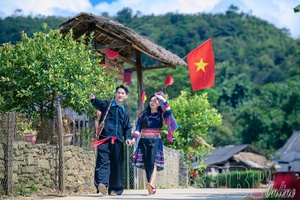
Thèn Pả village comprises 70 households with more than 400 residents, 100% of whom belong to the Xạ Phang ethnic group. Nestled among closely clustered homes, distinctive ethnic cultural traits are carefully preserved, including the traditional shoe embroidery craft, which has been recognized as a national intangible cultural heritage.
At the age of 80, Hồ Pa Mại still works tirelessly with needle and thread. With nearly 50 years devoted to the craft, she not only crafts footwear for her family but also guides descendants in shaping patterns, coordinating colors, and embroidering traditional motifs. Hồ Pa Mại shared that she learned the trade from her grandmother and mother when she was just 12 years old. During her initial training, she carried out each stage under the guidance of family elders. Over time, the needlework, stitching lines, and color harmonies evolved into an essential skill woven into her life. Completing a pair of traditional shoes can take roughly 15 to 20 days for simpler patterns, while intricate designs can require up to a month.
.jpg)
In practice, Xạ Phang footwear features diverse styles tailored to specific users and occasions. There are shoes for men, women, the elderly, and dedicated pairs for brides and grooms. Women’s shoes typically feature closed toes, whereas men’s shoes remain partly open at the front and vamp. Notably, the shoe soles are crafted from bamboo sheaths. Women venture into the forest to select large, thick, broad bamboo sheaths. After being dried in the sun, the sheaths are boiled in hot water and pressed flat beneath heavy weights to ensure firmness and prevent warping.
Today, changing lifestyles present challenges to traditional cultural practices. Several customs and handicrafts face risks of fading, while the number of people possessing and practicing trade skills dwindles over time. Consequently, transmission to the younger generation carries vital significance. Young people require opportunities to learn, practice directly, and innovate upon the cultural foundation of their ethnic community.
To maintain and transmit the traditional craft, the General Services Center of Na Sang commune coordinated with Thèn Pả village to organize a 15-day Xạ Phang shoe-embroidering training class for 30 learners. Combining theory with hands-on practice, the course was guided directly by artisans possessing trade mastery and deep knowledge.
Nguyễn Võ Nam, Vice Chairman of the Na Sang commune People’s Committee, stated that local authorities identify traditional craft transmission as an effective method to help preserve the cultural identity of the Xạ Phang people. Looking ahead, the commune will continue maintaining vocational classes to safeguard, preserve, and foster cultural heritage values. Simultaneously, the commune will step up promotional efforts linking the craft to culture and tourism, while exploring suitable commercial distribution channels to generate supplementary income for residents and motivate youth to remain committed to the trade.
Through ongoing craft transmission within the Xạ Phang community, combined with active multi-generational engagement in preserving, practicing, and promoting shoe embroidery, distinct ethnic cultural values are being preserved and fostered in modern life. When these values are passed down, received, and practiced, cultural heritage is not merely conserved in memory but remains active in daily life, serving as a lasting foundation for successive generations to safeguard, enrich, and spread.
Trí Nam
.jpg)
.jpg)

.jpg)
.jpg)
.jpg)
.jpg)



.jpg)
.jpg)
.jpg)
.jpg)
You have 500/500 characters left
Please enter 5 or more characters!!!