



Visiting these settlements, travelers can immerse themselves in communal life, experiencing local culinary traditions, costumes, folk games, panpipe melodies, and traditional dances. Through each journey, indigenous cultural values are awakened, preserved, and disseminated in a natural, vibrant manner.
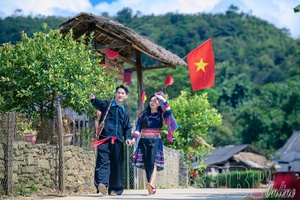
Tìa Ló is an entirely Hmông ethnic village in Pu Nhi commune. Cradled beside Phù Lồng mountain at an elevation exceeding 1,200m above sea level, the village enjoys a cool year-round climate, with clouds blanketing the mountain slopes across various seasons. The landscape retains its pristine wilderness, well suited for ecotourism, retreats, and community-based experiential travel. Tìa Ló currently counts 161 households with 781 residents. In everyday life, villagers continue to preserve numerous traditional cultural features, including costumes, customs, festivals, folk songs, folk dances, and traditional games.
Among these, the spinning top game (tù lu) continues to be maintained during festivals, holidays, and community gatherings. The local economy relies primarily on agro-forestry production: cultivating maize, upland rice, and wet rice, alongside livestock and poultry husbandry. In recent years, alongside road network expansion and focused guidance from local Party committees and authorities, villagers have begun exploring economic avenues through services and tourism.
.jpg)
Chá A Mua, Village Head of Tìa Ló, Pu Nhi commune, stated that local tourism products are not built upon unfamiliar elements, but originate directly from what villagers already possess: their homes, terraced plots, hearths, traditional dishes, ethnic attire, handicrafts, folk games, and daily routines. Arriving in Tìa Ló, visitors can learn about local life, engage in games such as tù lu, pao throwing, and crossbow shooting, experience pounding round sticky rice cakes (bánh giầy), join musical exchanges, or stay overnight in the village. To date, 15 households have registered to participate in tourism, with 5 households operating small-scale homestays capable of providing dining services upon request. Several families have renovated their premises, cleaned their residences, and arranged welcoming spaces for guests.
Another highlight in exploring Tìa Ló is Nong U Lake, a natural mountain lake perched at an altitude above 1,000m. The lake retains a pristine allure, with tranquil waters nestled amidst forests and mountains. In the Hmông language, the lake is also referred to as Pa Già, meaning “Dragon Pond,” associated with legends handed down through generations. The earliest Hmông households arriving in this land discovered the lake while seeking land to clear swidden fields for rice, maize, and cassava cultivation. Consequently, Nong U is tied to the history of reclamation, production, and collective memories of the Hmông community in Tìa Ló. Alongside Phù Lồng peak and village spaces, Nong U Lake is being integrated to form an experiential journey exploring nature, daily living, and Hmông cultural identity in Tìa Ló.
Lê Anh Tuấn, residing in Điện Biên Phủ ward, shared: “What I appreciate most when visiting Noong U Lake is that, beyond the beautiful scenery, the trip helps visitors gain deeper insight into the culture of the local Hmông community. From their clothing and lifestyle to their hospitality and village stories, everything feels remarkably close and authentic. I believe these distinct cultural attributes make Noong U Lake a memorable destination in its own right.”
Located over 100km from the center of Điện Biên Phủ ward, Lồng village in Quài Tở commune is situated amidst high mountain ranges. Turning off National Highway 6 near the summit of Pha Đin Pass onto a 3km concrete road, the village emerges amidst an expansive green setting. The air here remains crisp and fresh. During the coffee blossom season, entire hillsides are cloaked in white. Along the approach to the village, multiple vantage points allow travelers to watch clouds drift, catch the sunrise, and take photographs against highland backdrops.
Visiting Lồng village, travelers can experience a day living as a Hmông local. At the home of Vàng A Tính, visitors can manually grind maize with a stone mill to make mèn mén (steamed cornmeal). While seemingly simple, performing the task directly reveals the labor involved. The stone mill must be rotated evenly, and the corn ground to adequate fineness to yield dishes meeting traditional standards. During the rainy season, villagers guide guests down into paddies to catch field snails. Requiring no intricate gear, one simply opens their hand, scans lightly over the soft mud, and feels for them. When fingertips brush against a shell, excitement arises naturally, especially for first-time participants in agricultural field tasks. Large snails are kept for meals, while smaller ones are released back into paddies to mature.
Activities such as grinding maize, catching snails, cooking, field-working, and folk performance exchanges are not staged performances arranged solely for visitors. They represent inherent facets of village life. Integrated into tourism products, they are restructured to ensure accessibility for tourists while safeguarding authenticity. Mùa A Sùng, Village Head of Lồng village, noted that the village currently counts 116 households, 100% of whom belong to the Hmông ethnic group. The village retains relatively pristine landscapes, a cool climate, and diverse traditional cultural heritage. Four households currently engage in community-based tourism, capable of accommodating roughly 20 overnight guests. From these foundations, villagers have devised a 2-day, 1-night experiential itinerary combining nature exploration, grinding corn for mèn mén, catching field snails, enjoying traditional cuisine, joining musical exchanges, and staying at homestays.
Across each destination, from the terraced fields of Pu Nhi and Tìa Ló to Lồng village, the cultural beauty of the Hmông people is revealed directly through daily life. There, Hmông cultural values do not reside solely in panpipe melodies, embroidered skirts, or folk games. That beauty is present in labor, in preserving villages and forests, in maintaining household customs, and in heartfelt hospitality toward guests. Each village turns into a “living cultural space,” where visitors enjoy authentic experiences, while local residents gain sustained motivation to preserve identity and generate sustainable livelihoods grounded in the values of their homeland.
Diệp Chi
.jpg)
.jpg)
.jpg)
.jpg)
.jpg)
.jpg)
.jpg)
.jpg)
.jpg)
.jpg)
You have 500/500 characters left
Please enter 5 or more characters!!!